

Peptide HPLC Purity in Australia: The Researcher’s Verification Checklist (2026)
In the 2026 Australian research landscape, a Certificate of Analysis is no longer a definitive guarantee of quality; it's merely the starting point for a rigorous verification process. You're likely aware that the integrity of your entire study rests on the chemical precision of your compounds. Subtle impurities or misidentified sequences don't just skew results. They can invalidate months of laboratory work and exhaust limited research funding. High-performance liquid chromatography remains the gold standard, yet many researchers find the raw data difficult to reconcile with supplier claims.
Mastering peptide HPLC purity australia requirements is essential for maintaining the high standards demanded by domestic regulatory bodies and peer-reviewed journals. This article provides a technical framework for verifying peptide identity and purity within the current compliance environment. We'll examine how to interpret complex chromatograms, identify common discrepancies in supplier documentation, and establish a robust checklist for secure compound sourcing. This process ensures your data remains valid and reproducible throughout the duration of your project.
Key Takeaways
- Understand why a minimum threshold of 98% purity is the industry benchmark for generating reliable and reproducible in-vitro data in Australian research settings.
- Learn to audit technical reports by analysing peak integration and baseline stability to ensure peptide HPLC purity australia standards are strictly maintained.
- Discover the importance of cross-verifying HPLC results with Mass Spectrometry to confirm the precise molecular weight and identity of every research compound.
- Establish a procurement protocol that prioritises domestic suppliers offering transparent, batch-specific documentation to mitigate the risks associated with international logistics.
- Implement an internal audit trail for all laboratory supplies to ensure long-term data integrity and compliance with institutional quality control requirements.
The Significance of HPLC Purity in Australian Peptide Research
High-performance liquid chromatography (HPLC) serves as the definitive analytical method for determining the chemical composition of synthesised compounds. In the context of peptide synthesis, this technique separates the target sequence from truncated sequences, deprotected fragments, and other chemical byproducts. For laboratories across the country, maintaining high peptide HPLC purity australia standards is a prerequisite for generating data that can withstand the scrutiny of peer review or institutional audits.
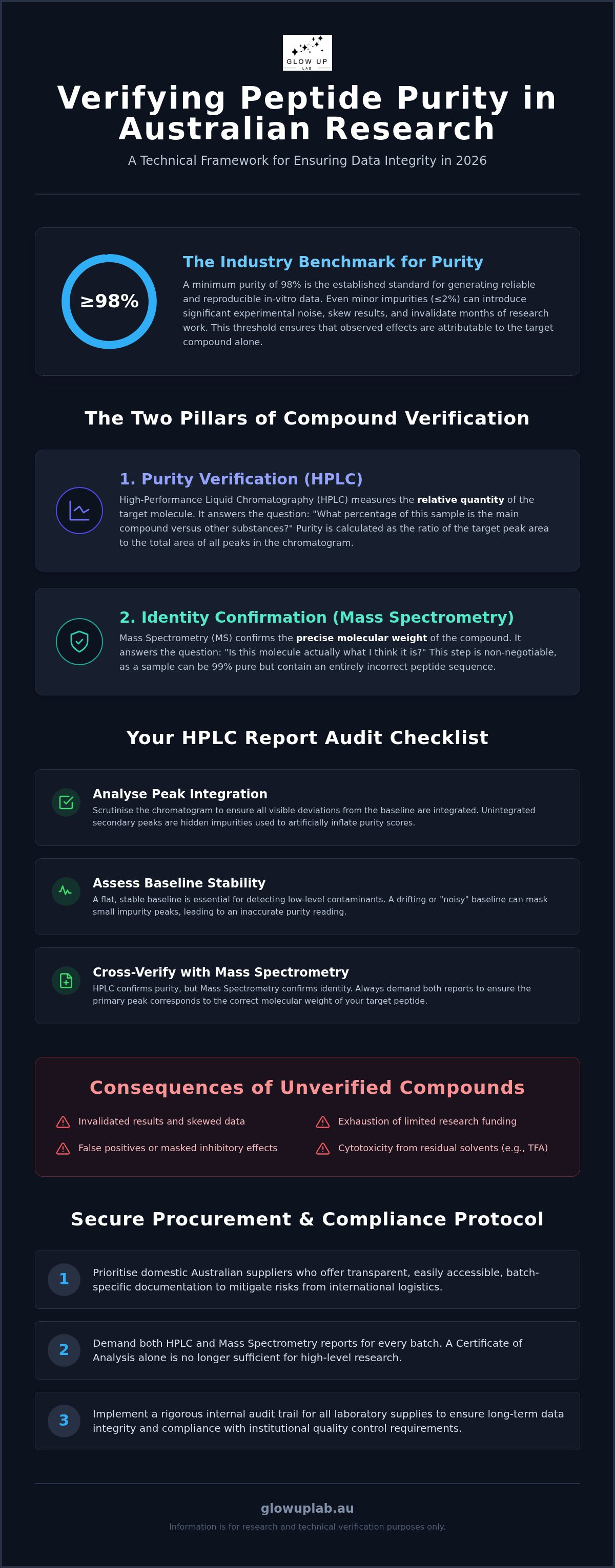
The industry benchmark for research peptides is typically set at ≥98% purity. This threshold isn't arbitrary. In sensitive in-vitro assays, even a 2% variance in purity can introduce significant experimental noise. Impurities may interact with cellular receptors in unpredictable ways, potentially leading to false positives or masked inhibitory effects. Beyond the peptide itself, researchers must account for residual solvents and Trifluoroacetic acid (TFA). While TFA is a common ion-pairing agent used during purification, excessive levels can be cytotoxic to primary cell cultures, skewing viability results and invalidating metabolic studies.
The Australian regulatory landscape in 2026 has seen increased TGA enforcement regarding unapproved therapeutic goods. Compounds designated as "Research Use Only" must be handled with strict adherence to their intended application. This regulatory environment places a greater burden of proof on the researcher to verify that their supply chain is transparent and that the compounds used are exactly what the documentation claims.
Purity vs. Identity: Why the Distinction Matters
It's vital to distinguish between a compound's purity and its chemical identity. HPLC measures the relative quantity of the target molecule compared to other substances in the sample. Specifically, HPLC purity is the ratio of the target peak area to the total area. However, HPLC alone doesn't confirm that the peak represents the correct peptide. A sample could show 99% purity but contain an entirely different sequence if the synthesis or bottling process was compromised. This makes the integration of mass spectrometry data alongside HPLC reports a non-negotiable step for modern laboratory verification.
Australian Research Standards for 2026
In 2026, peer-reviewed journals and grant-funding bodies have higher expectations for raw data transparency. Relying on a single, outdated Certificate of Analysis (CoA) is no longer sufficient. Many leading Australian institutions now utilise independent verification services like Ozcanium or LabDoc to cross-reference supplier data. For those conducting specialised metabolic research, understanding these nuances is critical. You can find more detail in our Tirzepatide Research Peptide Australia: A 2026 Technical Overview, which examines how these standards apply to specific GIP/GLP-1 analogues.
The HPLC Report Checklist: Critical Data Points for Verification
Reading an HPLC report is a technical skill that requires looking past the summary percentage. It's not enough to accept a high purity score at face value. You must scrutinise the raw chromatogram to ensure the reported data accurately reflects the vial contents. Verifying peptide HPLC purity australia requires a methodical approach to the visual and metadata evidence provided in each report.
Peak integration is the process of calculating the area under each curve. If a supplier fails to integrate secondary peaks, those impurities won't appear in the final purity calculation. This is a common tactic used to inflate purity numbers artificially. Ensure the integration markers, which are usually small vertical lines or a highlighted baseline, encompass all visible deviations from the baseline. Every peak represents a chemical entity, and any unintegrated peak is a hidden impurity.
Baseline stability is equally critical. A stable, flat baseline is essential for detecting low-level contaminants. High levels of "noise" or a drifting, erratic baseline can easily mask small impurity peaks. If the baseline lacks stability, the method sensitivity may be insufficient to provide a reliable purity reading. Furthermore, the retention time should be consistent with known standards for that specific sequence. If the peptide elutes significantly earlier or later than expected, it may indicate a synthesis error or a different compound altogether.
The solvent gradient details must also be appropriate for the sequence. Using a gradient that is too steep can cause the target peptide and closely related impurities to elute together. This lack of resolution results in a single, broad peak that hides contaminants, leading to a false sense of security regarding the compound's quality.
Analysing the Chromatogram Peak
The main peak should be sharp and symmetrical. Asymmetry, often appearing as "shoulders" or "tailing", suggests the presence of co-eluting impurities that the chromatography hasn't fully separated. Be cautious of reports claiming 100% purity. In analytical chemistry, a perfect 100.0% is rarely achieved. It often indicates that the detector sensitivity was set too low or the integration parameters were manipulated to ignore minor peaks. Maintaining high standards for peptide HPLC purity australia ensures that your results are not compromised by these hidden contaminants.
COA Metadata Checklist
Every Certificate of Analysis (CoA) must contain specific metadata to be considered a valid document for laboratory records. Verify the following points before accepting a batch:
- Batch number: This must match the physical label on the vial exactly.
- Date of analysis: Reports should be generated within a reasonable timeframe of the batch synthesis to ensure the data reflects the current state of the compound.
- Authorised signature: A legitimate report requires the signature of the analytical chemist who performed the verification.
For researchers requiring verified compounds, reviewing the Retatrutide (20mg) documentation provides a clear example of how these data points should be presented in a professional research context.
Cross-Verification: Integrating Mass Spectrometry with HPLC Data
HPLC provides a quantitative measure of purity, but it remains blind to chemical identity. Without Mass Spectrometry (MS), a researcher cannot be certain that the target peak actually contains the intended sequence. Integrating MS with HPLC data creates a dual-layer verification process. LC-MS workflows allow for the simultaneous separation of components and the confirmation of their molecular weight. For laboratories maintaining peptide HPLC purity australia standards, this cross-verification is the only way to ensure the compound's integrity before starting an assay.
The primary data point in an MS report is the M+H+ peak, representing the molecular ion plus a single proton. This value must match the theoretical molecular weight of the peptide. For example, when verifying a batch of Retatrutide 10mg, the observed mass should align precisely with the sequence's calculated mass. Even a minor discrepancy of a few Daltons can indicate the presence of modified amino acids or incorrect side-chain protections.
The 'Identity Audit' for GLP-1 Agonists
Complex sequences like Tirzepatide and Retatrutide require specific mass signatures for confirmation. These large peptides are prone to "truncated sequences," which occur when an amino acid fails to bond during a synthesis cycle. While HPLC might show these as separate peaks, MS identifies exactly which amino acid is missing by calculating the mass difference. This level of detail is essential for metabolic research where sequence precision determines receptor affinity. You can find a deeper exploration of these technical requirements in our guide on Tirzepatide 20mg Research: Analysing Concentration and Purity.
Dealing with Isomers and Epimers
Standard Mass Spectrometry has limitations. Because isomers and epimers have identical molecular weights, MS cannot distinguish between D-amino acids and L-amino acids. If a synthesis process uses low-quality reagents, racemisation can occur, leading to peptides with the correct mass but incorrect biological activity. In these cases, chiral HPLC or amino acid analysis is required to confirm the stereochemical purity of the sequence. For most high-level research, ensuring the supplier uses high-grade precursors is the first line of defence against these hidden structural defects. Maintaining peptide HPLC purity australia protocols involves acknowledging these limitations and requesting comprehensive documentation from your facilitator.
Procurement Protocol: Selecting a Transparent Australian Peptide Supplier
Selecting a supplier is a critical decision in the research workflow. While international vendors often offer lower price points, the hidden costs of customs seizures and cold-chain degradation can be substantial. In 2026, the TGA has increased enforcement on unapproved peptide imports, collaborating closely with the Australian Border Force to intercept non-compliant shipments. Prioritising peptide HPLC purity australia means choosing a domestic partner that understands the local regulatory environment and can guarantee the integrity of the supply chain from synthesis to delivery.
Vetting the Supplier’s Transparency
A transparent supplier provides a 'COA Library' or allows you to view batch-specific reports before you finalise a purchase. Be wary of 'representative' COAs. These are generic reports that may not reflect the specific vial in your hand, rendering them useless for data verification. Independent laboratory verification is always superior to in-house testing. It removes the conflict of interest inherent in self-reporting and provides an unbiased assessment of the compound's purity. Additionally, consider the level of technical support available. A reliable facilitator should be able to answer specific questions regarding peptide salt forms or reconstitution protocols without delay, ensuring your laboratory team has the information needed for precise experimentation.
Logistics and Stability Standards
The physical state of the peptide provides immediate clues about its stability and purity. High-quality lyophilisation results in a uniform 'cake' or powder that hasn't collapsed or discoloured. A collapsed cake often indicates moisture ingress or temperature spikes during transit. These factors can compromise the peptide's secondary structure and lead to degradation. For successful reconstitution in the laboratory, ensure you have the correct reagents on hand. Utilising BAC Water 3ml is standard practice for maintaining bacteriostatic conditions during your study. Domestic supply chains are inherently better suited to maintaining the required temperature ranges, as they bypass the lengthy delays often encountered at international sorting centres.
Maintaining institutional compliance requires a clear and accessible audit trail. Ensure your supplier strictly adheres to 'Research Use Only' designations and provides the necessary documentation to satisfy internal quality control audits. For more detailed procurement criteria, review our technical guide on Tirzepatide Sourcing & Specs for Australian Labs. If you require compounds with verified documentation, you can view our full range of research peptides to ensure your lab meets domestic quality standards.
Compliance and Quality Control: Securing Your Laboratory Supply Chain
Securing a reliable supply chain requires more than a one-time check. It involves an ongoing commitment to documentation and rigorous handling. Glow Up Lab facilitates this by providing detailed, batch-specific product documentation for every compound. This approach ensures that peptide HPLC purity australia standards are not just met at the point of sale, but remain verifiable throughout the entire research lifecycle. By prioritising domestic logistics, researchers can also maintain better control over the cold-chain integrity of their samples.
Scientific integrity depends on the systematic elimination of variables. Using compounds with unverified purity levels introduces chemical noise that can invalidate years of laboratory work. Sourcing high-purity peptides is an ethical imperative for researchers who aim to produce valid, reproducible data. This commitment to quality supports the broader Australian scientific community by ensuring that findings are based on precise, documented chemical identities rather than questionable materials.
Internal Record Keeping
Effective quality control requires archiving every Certificate of Analysis (CoA) alongside corresponding experimental results. This practice allows researchers to track batch numbers and identify any potential variability during longitudinal studies. Standard Operating Procedures (SOPs) must be established for handling lyophilised powders to prevent accidental contamination. Once a batch is verified, it should be stored at -20°C or -80°C to prevent peptide degradation. Minimising freeze-thaw cycles is essential for maintaining the chemical stability confirmed in the initial HPLC report. Proper storage ensures that the compound used in the final month of a study is identical to the one used on day one.
The Future of Peptide Standards in Australia
The landscape of analytical chemistry is evolving rapidly. Ultra-High Performance Liquid Chromatography (UPLC) is becoming more prevalent, offering even higher resolution and faster separation than traditional HPLC. Additionally, there is a growing emphasis on endotoxin testing for in-vitro research. While the focus on peptide HPLC purity australia remains on chemical composition, ensuring the absence of pyrogens is increasingly vital for sensitive cellular assays. Glow Up Lab supports the Australian research sector by maintaining these high standards and providing the transparency required for modern, quality-conscious laboratories. As analytical technology advances, our commitment to providing the necessary tools for informed, independent research decisions remains constant.
Strengthening Data Integrity in Australian Research
Maintaining high standards for peptide HPLC purity australia is a procedural necessity for any credible laboratory study. As we have discussed, verifying a compound requires more than a cursory glance at a summary percentage. It demands a rigorous audit of chromatogram peak integration, baseline stability, and the cross-verification of molecular weight through mass spectrometry. These steps ensure that the chemical identity of your research material is precisely what your experimental design requires.
Transitioning to a domestic procurement model further secures your supply chain by providing reliable cold-chain logistics and batch-specific documentation. This level of transparency allows you to maintain a robust internal audit trail, protecting the validity of your longitudinal data against the risks of degradation or misidentification. Glow Up Lab provides independent HPLC and MS documentation for every batch, alongside secure Australia-wide shipping to support your project's technical requirements.
View our verified range of high-purity research peptides to ensure your laboratory has access to clinical-grade transparency and reliable domestic support. We are committed to facilitating precise and reproducible scientific outcomes across the Australian research landscape.
Frequently Asked Questions
What is the difference between HPLC purity and peptide content?
HPLC purity indicates the ratio of the target peptide to other chemical byproducts in the sample. In contrast, peptide content refers to the actual percentage of peptide by weight, as the remaining mass typically consists of salts and residual moisture. A sample may demonstrate 99% HPLC purity while having a peptide content of only 80%. Distinguishing between these values is critical for accurate dosage calculations in quantitative research.
Can I trust a supplier-provided HPLC report for Australian research?
Trust should be based on the transparency of the documentation provided. A report is only reliable if it's batch-specific and includes the raw chromatogram rather than a mere summary table. Researchers must verify that the batch number matches the vial and that the analysis date is recent. For peptide HPLC purity australia verification, many laboratories prefer suppliers who provide independent, third-party reports to ensure an unbiased assessment of the compound.
Why is 98% purity considered the standard for research peptides?
The 98% benchmark is established to ensure that experimental results aren't skewed by chemical noise. In sensitive metabolic or cellular assays, even minor impurities can trigger unintended biological responses or mask the true effects of the peptide. Maintaining this high standard of purity allows for greater reproducibility across different laboratory settings. It ensures that the data generated is a precise reflection of the target sequence's activity.
Does HPLC testing confirm that the peptide sequence is correct?
HPLC measures the relative quantity of a substance but doesn't confirm its chemical identity. Two different molecules can have identical retention times under certain chromatographic conditions. To confirm the sequence is correct, researchers must integrate Mass Spectrometry data. MS verifies the molecular weight of the compound. A combined LC-MS workflow is the only definitive way to prove that a high-purity peak actually represents the intended peptide sequence.
What are the common impurities found in synthetic peptides?
Synthetic peptides often contain truncated sequences, which are chains missing one or more amino acids due to incomplete coupling. Other common impurities include deprotected fragments, residual solvents, and salts like Trifluoroacetic acid (TFA). These byproducts occur naturally during solid-phase synthesis. High-quality purification processes are designed to remove these contaminants. If they remain, they can interfere with receptor affinity and lead to inconsistent data in your research assays.
How do I store peptides in the lab to maintain their verified purity?
Lyophilised peptides should be stored in a freezer at -20°C or -80°C to prevent degradation. It's vital to keep the vials tightly sealed and protected from light and moisture. Maintaining peptide HPLC purity australia standards after delivery requires careful handling; you should allow vials to reach room temperature before opening to prevent condensation. Once reconstituted, the peptide is significantly less stable and should be used within a short timeframe.
Is independent third-party testing mandatory in Australia?
Independent testing isn't a legal requirement for research-only compounds in Australia, but it's often a practical necessity for data validation. Many domestic institutions and peer-reviewed journals require evidence of independent verification to ensure scientific integrity. By utilising third-party labs, researchers can confirm the accuracy of supplier-provided reports. This practice mitigates the risk of using sub-standard materials and provides peace of mind regarding the legitimacy of the supply chain.
What should I do if my HPLC report shows a purity below 95%?
If a report shows purity below 95%, the material should generally be rejected for high-precision research. This level of impurity suggests that the synthesis or purification was unsuccessful. You should contact the supplier to discuss the discrepancy and request a batch that meets the standard 98% threshold. Using low-purity peptides can lead to false results and may make it impossible to replicate your findings in future studies.