

Tirzepatide Research Peptide Australia: A 2026 Technical Overview
Could a single degree of temperature fluctuation during domestic transit or a minor deviation in batch purity compromise the integrity of your entire 2026 longitudinal study? For Australian researchers, the challenge isn't just finding a supplier; it's ensuring that the tirzepatide research peptide australia arriving at your laboratory meets the exact chemical specifications required for reproducible data. You likely recognise that inconsistent batch-to-batch quality and the risk of peptide degradation in the harsh Australian heat are significant hurdles to maintaining a controlled research environment.
This technical overview provides a clear framework for sourcing, verifying, and handling high-purity compounds within a domestic supply chain. We'll outline how to interpret complex HPLC reports, manage climate-aware logistics to avoid degradation, and establish the robust documentation needed for professional audit trails. By the end of this guide, you'll have the technical insights required to secure reliable materials and ensure your laboratory's procedural integrity remains uncompromised by external logistical variables.
Key Takeaways
- Understand the dual agonist mechanism of tirzepatide and its specific application in GIP and GLP-1 receptor research models.
- Identify the logistical benefits of sourcing tirzepatide research peptide australia through domestic channels to ensure climate-controlled transit and avoid customs delays.
- Learn to interpret High-Performance Liquid Chromatography (HPLC) reports to verify batch purity and maintain strict laboratory audit trails.
- Master professional reconstitution techniques using Bacteriostatic (BAC) Water to preserve compound stability and prevent degradation in Australian conditions.
- Evaluate the technical differences between 20mg and 30mg lyophilised specifications to select the appropriate concentration for precise dose-escalation protocols.
Understanding the Dual Agonist Mechanism in Tirzepatide Research
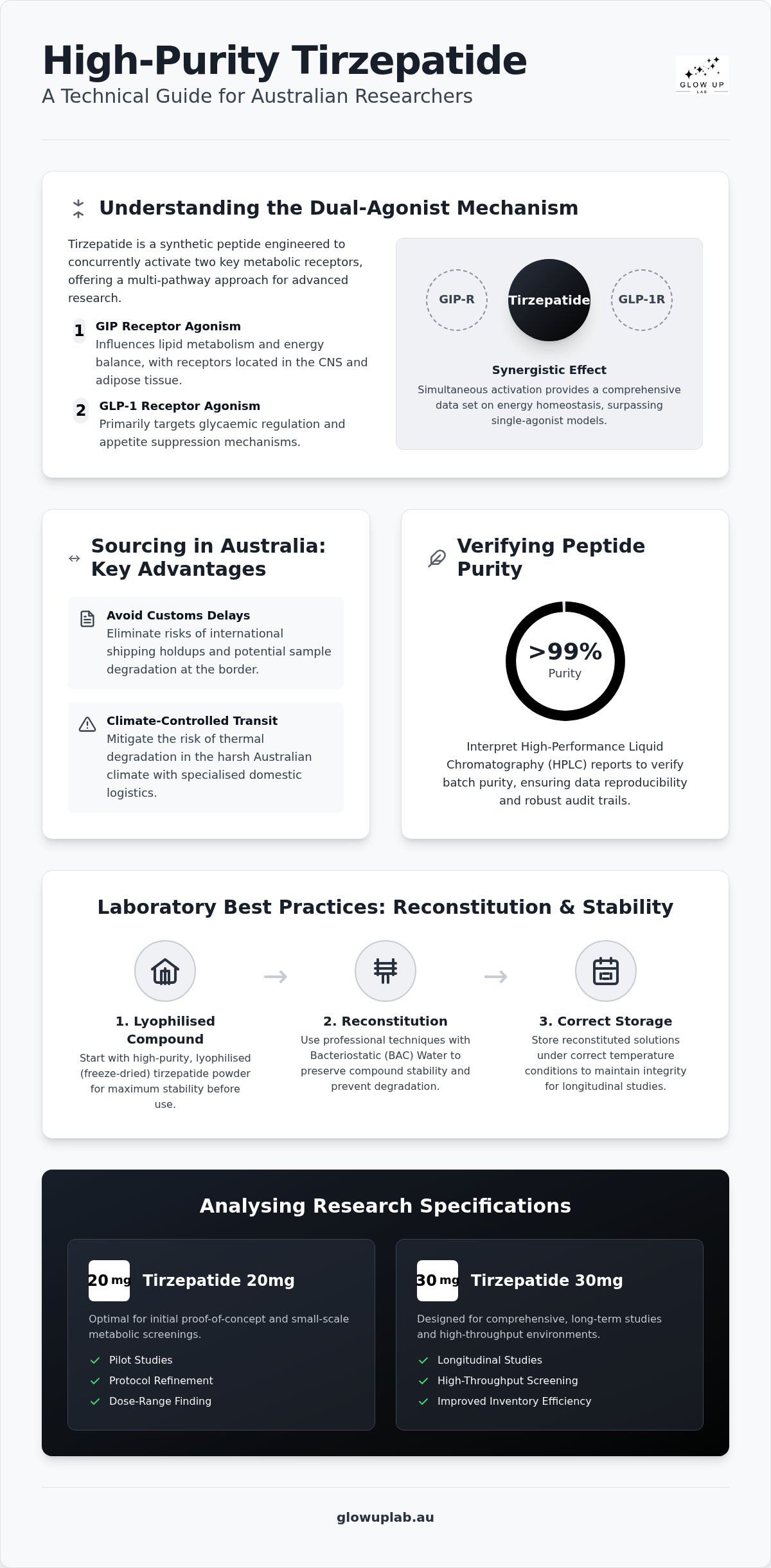
Tirzepatide is a synthetic peptide composed of 39 amino acids, designed to function as a dual agonist. In the context of a tirzepatide research peptide australia study, this compound is primarily utilised to investigate the concurrent activation of the glucose-dependent insulinotropic polypeptide (GIP) and glucagon-like peptide-1 (GLP-1) receptors. Unlike single-agonist compounds, this dual-pathway approach allows researchers to observe complex metabolic interactions that more closely mimic endogenous incretin responses.
The molecular structure includes a C20 fatty acid diacid side chain. This specific modification facilitates high affinity for albumin, which significantly extends the compound's half-life in research models to approximately five days. This extended duration is a critical variable for longitudinal studies in Australian laboratories, as it reduces the frequency of administration required to maintain steady-state concentrations within a test environment.
GIP vs GLP-1: The Synergistic Research Effect
Researching the synergy between GIP and GLP-1 provides insights into energy homeostasis that single-receptor agonists cannot offer. GIP receptors are found in both the central nervous system and adipose tissue, influencing lipid metabolism and energy balance. Conversely, GLP-1 primarily focuses on glycaemic regulation and appetite suppression. By targeting both, researchers can analyse how these pathways interact to modulate metabolic rate and insulin sensitivity.
Current trends in Australian metabolic studies for 2026 show a shift towards these dual mimetics. Scientists are moving away from isolated GLP-1 research to better understand how GIP agonism may counteract certain metabolic compensations. This makes the tirzepatide research peptide australia a central tool for modern endocrine research protocols where multi-pathway analysis is required.
Molecular Stability and Research Applications
The stability of the lyophilised tirzepatide molecule is paramount for maintaining procedural integrity. When stored correctly, the lyophilised powder retains its structural configuration, which is essential for accurate in-vitro assays and in-vivo metabolic profiling. Common applications in Australian institutions include:
- Analysing signal transduction pathways in pancreatic beta-cell models.
- Investigating lipid oxidation rates in murine metabolic chambers.
- Comparing dual-agonist efficacy against traditional single-pathway peptides like semaglutide.
The comparative advantage of this dual-agonist mechanism lies in its ability to address multiple metabolic checkpoints simultaneously. This complexity provides a more robust data set for researchers examining the multifactorial nature of metabolic dysfunction. It offers a sophisticated alternative to single-pathway compounds, allowing for a more comprehensive exploration of incretin-based interventions.
Analysing Research Specifications: Tirzepatide 20mg vs 30mg Compounds
Selecting the appropriate mass of a lyophilised compound is a fundamental step in experimental design. In Australian metabolic studies, the choice between 20mg and 30mg vials often depends on the required dose-response curve and the intended duration of the study. A precise understanding of the Tirzepatide Mechanism of Action is vital when determining these concentrations, as receptor saturation points in various research models will dictate the necessary molarity of the reconstituted solution.
Efficiency in high-throughput environments also extends to inventory management. 30mg vials maximise the utility of limited space in ultra-low temperature laboratory freezers, a critical factor for Australian institutions managing multiple concurrent projects. Reducing the physical footprint of stored peptides simplifies audit trails and stocktaking procedures. If your protocol requires high-concentration stock solutions for high-throughput screening, you can review technical specifications for both 20mg and 30mg options to ensure your inventory aligns with your laboratory's throughput requirements.
When to Utilise Tirzepatide 20mg Specifications
The 20mg specification is frequently the preferred choice for pilot studies or initial metabolic screenings. These smaller batches allow researchers to refine their protocols without committing significant resources to a single cohort. When sourcing a tirzepatide research peptide australia for these early-stage trials, the 20mg vial offers superior flexibility in adjusting reconstitution ratios. For instance, a 20mg vial reconstituted with 2mL of BAC water provides a manageable 10mg/mL concentration, which is ideal for precise, low-volume dosing in small-animal models or in-vitro assays.
The Technical Advantage of Tirzepatide 30mg Vials
For large-scale longitudinal research, the 30mg vial presents a distinct technical advantage. Higher-mass vials reduce the total number of reconstitution events required over the course of a project. Each time a vial is reconstituted, there's a marginal risk of procedural variance or environmental exposure. By using 30mg specifications, laboratories can maintain better batch-to-batch consistency throughout extended dose-escalation protocols.
Calculating potential wastage is another factor. While 30mg vials are efficient for large cohorts, 20mg vials may actually reduce wastage in projects with smaller, staggered groups where the stability of a reconstituted peptide is a concern. Australian researchers must balance the benefits of bulk handling against the specific stability window of the compound once it's in liquid form. This ensures that the tirzepatide research peptide australia used in your study remains within the required purity parameters from the first dose to the last.
Verifying Peptide Purity: Interpreting HPLC and COA Reports
In metabolic research, the chemical integrity of a compound is the most critical variable for ensuring reproducible data. A purity level of 99% or higher is the established industry standard for laboratory reagents. When a tirzepatide research peptide australia falls below this threshold, the remaining 1% often consists of truncated peptide sequences, salts, or residual solvents. These impurities can introduce confounding variables into an endocrine study, potentially altering receptor binding affinity or causing unexpected cellular responses that skew the final results.
Verification relies on two primary analytical techniques: High-Performance Liquid Chromatography (HPLC) and Mass Spectrometry (MS). HPLC is used to determine the purity of the batch by separating the various components within the sample based on their interaction with a stationary phase. While HPLC confirms how much of the substance is the target peptide, Mass Spectrometry is necessary to confirm the identity of the molecule by measuring its molecular weight. Together, these reports form a Certificate of Analysis (COA), which serves as a vital document for laboratory audit trails and institutional compliance.
How to Read a Peptide HPLC Report
Interpreting an HPLC chromatogram requires focus on the primary peak, which represents the target compound. The software calculates the "area under the curve" (AUC) for this peak relative to any smaller, secondary peaks. If the primary peak accounts for 99.2% of the total area, the peptide is 99.2% pure. Researchers should also verify the retention time. This is the duration it takes for the compound to pass through the HPLC column. If the retention time deviates significantly from the known standard for tirzepatide, it may indicate structural degradation or a different molecular configuration.
Secondary peaks on the chromatogram represent impurities. In a high-quality tirzepatide research peptide australia, these peaks should be minimal and clearly identified. Large or numerous secondary peaks suggest a lack of precision during the synthesis or purification stages. This can compromise the stability of the lyophilised powder and its subsequent performance during in-vitro assays.
Transparency as a Trust Factor in Australian Sourcing
Sourcing peptides without verifiable, batch-specific documentation presents a significant risk to laboratory protocols. Without a COA, a researcher cannot be certain of the compound's concentration or purity. Glow Up Lab addresses this by ensuring every batch of tirzepatide is accompanied by technical reports that meet stringent purity benchmarks. This commitment to transparency allows institutions to maintain an accurate archive of documentation, which is essential for peer-reviewed submissions and internal quality control audits. Relying on documented domestic supply chains ensures that the procedural integrity of your research is supported by empirical evidence rather than manufacturer claims.
Laboratory Best Practices: Reconstitution and Stability in Australia
Transitioning tirzepatide research peptide australia from its lyophilised state into a solution requires strict adherence to sterile protocols to ensure experimental accuracy. Bacteriostatic (BAC) Water, which contains 0.9% benzyl alcohol, is the standard diluent for this process. The benzyl alcohol acts as a preservative, inhibiting bacterial growth that could otherwise compromise the peptide's integrity. Using plain sterile water is generally discouraged for multi-use research vials, as it lacks the antimicrobial properties necessary to maintain stability over the duration of a study.
Stability timelines are finite once the compound is in liquid form. Most laboratory protocols recommend utilising the reconstituted solution within 21 to 28 days to ensure peak purity. Beyond this window, the risk of peptide fragmentation increases, which can introduce unwanted variables into metabolic data. Documenting the exact date and time of reconstitution on each vial is a mandatory step for maintaining a professional audit trail and ensuring that only viable compounds are utilised in your research models.
The Reconstitution Process: Precision and Sterility
Precision begins with calculating the correct diluent volume for your required research concentration. For a 30mg vial, adding 3mL of BAC Water results in a 10mg/mL concentration, which simplifies dosing calculations for most protocols. When introducing the liquid, aim the needle toward the inner wall of the vial. This allows the diluent to trickle down the glass rather than impacting the peptide cake directly. You should avoid vigorous agitation at all costs. Gentle swirling is sufficient to dissolve the powder; shaking the vial can shear delicate peptide bonds, leading to denaturation and a total loss of biological activity.
Optimising Storage for Long-Term Stability
Temperature management is a critical variable in the Australian context, especially during the summer months when ambient temperatures can exceed 40°C. Lyophilised vials are best stored at -20°C for long-term preservation. Once reconstituted, the solution must be kept refrigerated between 2°C and 8°C. Exposure to direct light and heat accelerates the breakdown of the peptide's molecular structure, particularly the C20 fatty acid side chain that governs its half-life.
Domestic sourcing through a reliable supply chain is the most effective way to mitigate heat-related degradation during transit. Glow Up Lab employs climate-aware packaging and secure nationwide shipping to ensure that compounds arrive at your facility without being compromised by external environmental factors. To maintain these high standards in your own facility, you can order 3mL BAC Water for your reconstitution protocols to ensure your research materials are handled with the necessary precision.
Sourcing High-Purity Tirzepatide for Australian Research Institutions
Procuring high-quality compounds for 2026 metabolic research initiatives requires a shift from global sourcing to a secure, domestic supply chain. Relying on international vendors introduces significant variables that can compromise the viability of a study. For researchers, the primary objective is to secure a tirzepatide research peptide australia that arrives with its chemical integrity intact and its documentation fully verified. Domestic procurement eliminates the high risk of customs seizures, which have intensified following the TGA's 2026 enforcement operations that resulted in the interception of over 900,000 units of unlawfully imported materials.
Navigating the regulatory landscape is equally critical. In Australia, tirzepatide is classified as a Schedule 4 substance, meaning its possession and use are strictly regulated. While the "Research Use Only" label is a standard industry designation, it doesn't exempt the compound from TGA oversight. Professional institutions must ensure their sourcing partners operate with full transparency and provide the necessary technical documentation to support internal compliance and professional audit trails. This level of procedural integrity is essential for maintaining the standards required by Australian ethics committees and peer-reviewed journals.
Domestic Logistics: Speed and Security
The Australian climate presents unique challenges for peptide stability. International shipping often involves prolonged exposure to uncontrolled temperatures in transit hubs, which can lead to the denaturation of sensitive peptide bonds. By choosing a domestic partner, researchers benefit from climate-aware logistics designed specifically for the Australian environment. Glow Up Lab utilizes secure nationwide shipping protocols to ensure that every vial of tirzepatide research peptide australia remains within the required temperature parameters from dispatch to delivery.
Efficient order processing is another advantage of domestic sourcing. Time-sensitive laboratory projects cannot afford the weeks of delay often associated with international customs clearance. A streamlined domestic supply chain allows for predictable delivery timeframes, ensuring that your research schedule remains on track. This reliability is foundational for longitudinal studies where consistent access to the same batch of high-purity material is required to prevent data variance.
Professional Support and Documentation
A professional research partnership extends beyond the point of sale. Accessing technical support from an Australian-based team provides researchers with a direct line of communication for logistical and documentation inquiries. This is particularly valuable when managing complex studies that involve multiple compounds. Glow Up Lab serves as a reliable facilitator for institutions researching metabolic and neurological pathways, providing a consistent supply of Retatrutide, Selank, and Semax alongside tirzepatide. You can view the Glow Up Lab tirzepatide range and technical reports here.
Every compound supplied is strictly for laboratory research use only and is not for human consumption. By prioritizing transparency and providing batch-specific HPLC and MS reports, Glow Up Lab ensures that your laboratory has the tools needed to make informed, independent decisions. Securing your supply chain with a transparent partner is the most effective way to safeguard the precision and reproducibility of your 2026 metabolic research programmes.
Advancing Metabolic Research with Procedural Precision
Successful metabolic studies in 2026 don't just depend on the dual-agonist mechanism of the compound. They require a rigorous approach to batch verification and climate-aware logistics. By prioritising HPLC-MS reports and domestic procurement, you eliminate the variables of international customs seizures and thermal degradation. This ensures that your tirzepatide research peptide australia maintains its structural integrity from the moment it leaves the facility until it's reconstituted in your laboratory.
Glow Up Lab facilitates this precision by providing compounds with HPLC-MS verified 99%+ purity and clinical-grade laboratory documentation for every batch. Our secure Australia-wide shipping protocols are designed to protect your materials from the harsh local environment, allowing you to focus on gathering accurate, reproducible data. It's the most effective way to secure the long-term viability of your endocrine research programmes. We look forward to supporting the integrity of your next project.
Order High-Purity Tirzepatide for Your Research Project and ensure your next study is supported by the highest technical standards in the industry.
Frequently Asked Questions
Is tirzepatide available for human use in Australia through Glow Up Lab?
No, tirzepatide is not available for human use through Glow Up Lab. All compounds in our catalogue are strictly intended for laboratory research purposes only. We don't provide medical advice or prescriptions, and these products are not for human consumption. Researchers must ensure their protocols comply with institutional ethics and Australian regulations. This commitment to research-only distribution ensures that we focus exclusively on the technical needs of the scientific community.
What is the standard purity level for research-grade tirzepatide?
The industry standard for high-purity research materials is 99% or higher. For a tirzepatide research peptide australia study, maintaining this level of purity is essential to ensure that experimental results aren't skewed by impurities or truncated sequences. Every batch we supply undergoes rigorous HPLC and MS testing to confirm it meets these stringent benchmarks. This level of transparency provides researchers with the confidence needed to conduct reproducible metabolic and endocrine studies.
How should I store my tirzepatide vials upon arrival in the Australian climate?
Lyophilised vials should be stored in a freezer at -20°C for long-term stability. Given the high temperatures in the Australian climate, it's vital to move shipments into a temperature-controlled environment immediately upon arrival. Once you've reconstituted the peptide, the vial must be kept refrigerated between 2°C and 8°C. Protecting the compound from light exposure and temperature fluctuations will help prevent the degradation of delicate peptide bonds over the course of your project.
Can I get a Certificate of Analysis (COA) for my specific batch?
Yes, we provide detailed technical documentation for every batch of research peptides. These reports include High-Performance Liquid Chromatography (HPLC) and Mass Spectrometry (MS) data to verify both purity and molecular weight. Maintaining an archive of these batch-specific certificates is a standard requirement for laboratory audit trails in Australia. This documentation ensures that your research is supported by empirical evidence and meets the transparency standards required for peer-reviewed institutional submissions.
What is the difference between tirzepatide 20mg and 30mg for research purposes?
The primary difference lies in the total mass of the lyophilised compound, which dictates the possible concentrations for your study. A 20mg vial is often suitable for pilot studies or smaller-scale screenings. In contrast, the 30mg specification is more efficient for large-scale longitudinal research cohorts, as it reduces the frequency of reconstitution events. Both options allow for precise dose-escalation protocols depending on the required molarity and the specific metabolic model being investigated.
Does Glow Up Lab ship peptides to all states and territories in Australia?
We provide secure nationwide shipping to all states and territories across Australia. Our logistics network is designed to handle the specific requirements of domestic transit while maintaining the integrity of the research compounds. We don't offer international shipping, which allows us to focus entirely on the efficiency and security of the Australian supply chain. This domestic focus helps researchers avoid the common delays and risks associated with international customs and long-distance transport.
Why is BAC water necessary for the reconstitution of research peptides?
Bacteriostatic (BAC) Water is necessary because it contains 0.9% benzyl alcohol, which acts as a preservative. This inhibits the growth of bacteria within the vial after the first access. For a tirzepatide research peptide australia project, using BAC water ensures the solution remains stable and sterile for the duration of its use, typically up to 28 days. Using plain sterile water without a preservative increases the risk of contamination and rapid peptide degradation.
How long does nationwide shipping take for research compounds?
Shipping timeframes depend on the destination within the domestic network, but we prioritise secure and efficient dispatch for all laboratory orders. Most nationwide shipments are processed quickly to support time-sensitive research projects. By sourcing domestically, you bypass the weeks of delay often associated with international procurement and customs clearance. We recommend checking your tracking information for the most accurate delivery updates based on current 2026 logistics and your specific location.