

Tirzepatide Sourcing & Specs for Australian Labs
The integrity of metabolic research in Australia no longer hinges on whether you can find a supplier, but on whether you can verify the molecule before it ever reaches your lab bench. When you look to a tirzepatide research compound buy, the priority must shift from simple acquisition to rigorous procedural integrity. It's understandable that researchers feel a sense of uncertainty regarding batch-to-batch consistency and the complexities of interpreting HPLC reports from overseas vendors. You need data that is both accessible and verifiable to ensure your study remains on track.
This article provides a technical framework to help you master the specifications and procurement protocols for high-purity tirzepatide research compounds within the Australian scientific community. We'll examine critical solubility and stability profiles, alongside the importance of domestic sourcing to mitigate the risk of customs delays. By the end of this guide, you'll understand how to interpret HPLC/MS data effectively and secure a reliable supply of 20mg or 30mg vials for your laboratory requirements. We'll also cover the role of essential supplies like BAC water in maintaining a controlled research environment.
Key Takeaways
- Understand the dual-agonist mechanism of GIP and GLP-1 receptors and its significant role in modern metabolic research frameworks.
- Evaluate the technical differences between 20mg and 30mg lyophilised vials to optimise concentration management for your specific tirzepatide research compound buy.
- Learn to interpret HPLC and MS supporting documentation to verify compound purity and ensure batch-to-batch consistency in a laboratory setting.
- Master the step-by-step protocol for the safe reconstitution of peptides using 3mL BAC water to maintain stability and prevent microbial growth.
- Identify the logistical benefits of domestic Australian sourcing, including the mitigation of customs delays and adherence to local "Research Use Only" regulations.
The Role of Tirzepatide in Modern Metabolic Research
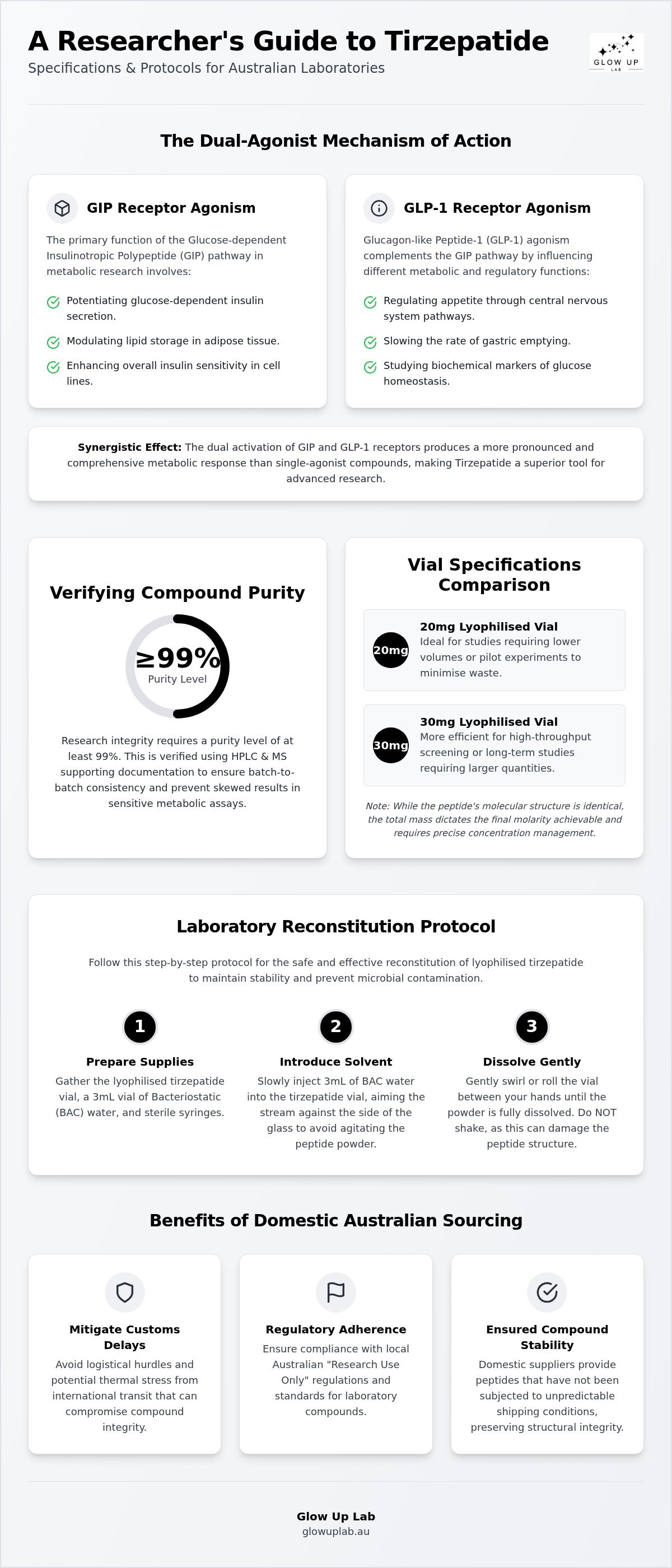
Tirzepatide is a synthetic peptide engineered for metabolic research, functioning as a dual agonist of the glucose-dependent insulinotropic polypeptide (GIP) and glucagon-like peptide-1 (GLP-1) receptors. This 39-amino acid sequence represents a significant shift in laboratory study designs, moving beyond the limitations of single-receptor agonists. When institutions arrange a tirzepatide research compound buy, they prioritise high-purity specifications to ensure the validity of metabolic data. A comprehensive Tirzepatide Overview reveals that its structure is based on the native GIP sequence but is specifically modified to include GLP-1 receptor activity, creating a synergistic effect that single-agonist analogues cannot replicate.
The primary objective of using this compound in Australian labs is to examine how dual receptor activation influences biochemical pathways. Research integrity depends on using compounds with a purity level of ≥99%. Lower purity levels introduce uncontrolled variables that can skew results in sensitive metabolic assays. By using high-fidelity peptides, researchers can maintain strict data integrity across multiple batch cycles.
Understanding GIP and GLP-1 Receptor Agonism
The GIP pathway is a critical component of the incretin system, primarily known for its role in potentiating glucose-dependent insulin secretion and modulating lipid storage in adipose tissue. When combined with GLP-1 receptor agonism, which focuses on appetite regulation and slowing gastric emptying, the resulting metabolic response is significantly more pronounced than when either pathway is activated in isolation. In laboratory settings, this dual-action profile is used to study:
- Enhancements in insulin sensitivity within specialised cell lines.
- Changes in lipid metabolism and fatty acid oxidation rates.
- The biochemical markers of glucose homeostasis in model systems.
This synergistic approach allows researchers to observe complex metabolic interactions that were previously difficult to isolate using earlier GLP-1 analogues. It's this complexity that makes the compound a preferred choice for high-level metabolic studies in 2026.
The Evolution of Metabolic Research Compounds
Metabolic research has evolved from focusing on single-hormone pathways to exploring multi-agonist profiles. Earlier research compounds primarily targeted the GLP-1 receptor alone, but current trends in the Australian scientific community favour the dual-agonist profile of tirzepatide. This transition is driven by the need for more comprehensive data on how multiple incretin hormones work together to regulate systemic metabolism.
Current Australian laboratory studies are increasingly focused on the long-term stability of these compounds when stored in lyophilised form. Securing a tirzepatide research compound buy through a domestic facilitator ensures that the peptides haven't been subjected to the thermal stress often associated with international transit. This domestic focus helps maintain the structural integrity of the 20mg and 30mg vials, which is essential for accurate reconstitution and subsequent analysis.
Comparing Tirzepatide Specifications: 20mg vs 30mg Compounds
Selecting the specific mass for a tirzepatide research compound buy involves balancing logistical efficiency with the technical requirements of a study's protocol. The primary difference between 20mg and 30mg specifications is the total peptide mass available for reconstitution. While the molecular structure remains identical, the total mass dictates the final molarity achievable within standard vial volumes. Researchers must calculate these concentrations precisely to ensure that experimental replicates remain consistent across different batches. A detailed Scientific Review of Tirzepatide provides the necessary pharmacokinetic data to assist in these calculations, particularly when determining the required micromolar concentrations for cellular assays.
Concentration management is a critical factor in laboratory trials. A 20mg vial might be more appropriate for a study requiring lower volumes, whereas a 30mg vial offers better efficiency for high-throughput screening. However, higher mass concentrations in a single vial can increase the risk of peptide aggregation if the reconstitution process isn't handled with care. If you're looking to source these specific masses, you can view the available tirzepatide specifications provided by domestic facilitators.
Tirzepatide 20mg: Ideal for Baseline Studies
The 20mg specification is often the preferred choice for pilot research and baseline metabolic studies. Its smaller mass allows for easier management of reconstitution ratios, typically yielding a 2mg/mL concentration when paired with 10mL of diluent, or higher concentrations when using the standard 3mL BAC water vials. Using 20mg vials can reduce the duration the compound remains in a reconstituted state, which is beneficial for maintaining stability. Since peptides are inherently susceptible to degradation once in solution, exhausting a smaller vial quickly ensures that the research data isn't compromised by time-dependent breakdown of the peptide chain.
Tirzepatide 30mg: Scaling Laboratory Experiments
For large-scale or high-throughput research, the 30mg specification provides a more efficient solution. This larger mass is particularly useful when the research protocol requires a high number of identical samples, as it reduces the frequency of reconstitution and minimises batch-to-batch variability. When using 30mg stock, researchers often aim for specific micromolar concentrations that require precise volumetric measurements. It's essential to consider that while 30mg vials are cost-efficient, they require stringent storage conditions. Once reconstituted, these larger batches must be stored at 2°C to 8°C and used within a 28-day window to prevent significant loss of activity. Proper storage and handling are paramount to ensure that the increased mass doesn't lead to increased experimental error.
Verifying Purity: HPLC Standards for Australian Research
Analytical verification is the cornerstone of metabolic research, ensuring that the results obtained are a product of the compound itself rather than unexpected contaminants. When you initiate a tirzepatide research compound buy, the accompanying documentation serves as your primary assurance of quality. High-Performance Liquid Chromatography (HPLC) remains the gold standard for determining peptide purity. It works by separating the components of a mixture based on their chemical properties, allowing researchers to quantify the exact percentage of the target peptide. While HPLC confirms purity, Mass Spectrometry (MS) is equally vital, as it verifies the molecular weight of the compound to ensure the chemical structure matches the expected profile. Standardising these quality control protocols is necessary for Australian institutions aiming for high-impact publication, where data integrity is scrutinised.
Reading a Certificate of Analysis (COA)
A robust COA should provide clear data on purity, appearance, and molecular mass. When reviewing an HPLC chromatogram, you should look for a single, sharp peak. The "Retention Time" indicates how long the compound takes to pass through the column; any secondary peaks suggest the presence of impurities or degradation products. Batch-specific testing is vastly superior to "representative" testing. Representative testing only indicates what a facility is capable of producing, whereas batch-specific testing confirms the exact specifications of the vial in your laboratory. For tirzepatide, a purity benchmark of ≥99% is often required to minimise the influence of peptide fragments on receptor binding assays.
The Importance of Third-Party Verification
Independent verification adds a critical layer of security to the research process. Relying solely on manufacturer-provided data can be risky, especially when sourcing from international vendors with varying oversight levels. Red flags in documentation include generic reports that lack specific batch numbers, outdated testing dates, or reports that don't clearly state the testing methodology. Australian research institutions often standardise their quality control protocols by requiring documentation that confirms the compound matches the known chemical structure of tirzepatide precisely. Domestic facilitators like Glow Up Lab address these concerns by providing HPLC and MS supporting documentation for every batch. This commitment to transparency ensures that the 20mg or 30mg vials used in your study meet the rigorous standards expected by the Australian scientific community.
Laboratory Handling: Solubility and Reconstitution Best Practices
Precise handling protocols are essential to maintain the structural integrity of dual-agonist peptides. Once a tirzepatide research compound buy is finalised, the transition from lyophilised powder to a stable solution requires strict adherence to aseptic techniques. The reconstitution process isn't merely a logistical step; it's a chemical intervention that can either preserve or degrade the peptide chain. Using Bacteriostatic (BAC) Water is the standard for research applications because the 0.9% benzyl alcohol content inhibits microbial growth, which is vital for studies spanning several weeks. Maintaining a sterile environment during this phase prevents the introduction of contaminants that could interfere with metabolic assays.
Solubility is influenced by both the peptide's primary sequence and the environmental conditions of the laboratory. Tirzepatide exhibits high solubility in aqueous buffers, but the rate of dissolution should be managed carefully. Researchers should avoid aggressive mechanical stress. Instead, gentle agitation or a slow swirling motion is recommended to encourage the powder to enter the solution. This approach protects the delicate peptide bonds from shearing forces that occur during high-speed vortexing.
The Reconstitution Protocol
Calculating the correct diluent volume is the first step in achieving the desired micromolar concentration. For instance, adding 2mL of BAC water to a 20mg vial yields a concentration of 10mg/mL. You should always allow the diluent to flow down the side of the glass vial rather than dropping it directly onto the lyophilised cake. This technique reduces the formation of air bubbles and foam, which can denature the protein structure. For researchers requiring high-precision supplies, you can purchase 3mL BAC water to ensure your reconstitution media meets laboratory standards.
Stability and Storage Factors
The stability profile of tirzepatide differs significantly between its lyophilised and reconstituted states. In its original powder form, the compound is highly stable. The following storage parameters are recommended for maintaining procedural integrity:
- Long-term Storage: Lyophilised vials should be kept at -20°C or -80°C to prevent degradation over several months.
- Reconstituted Stability: Once in solution, the peptide must be refrigerated at 2°C to 8°C and used within a 28-day window.
- Environmental Protection: Minimise light exposure and avoid freeze-thaw cycles, which cause peptide aggregation.
When researchers plan a tirzepatide research compound buy, they must also account for the logistics of cold-chain storage upon arrival. Adhering to these temperature ranges ensures that your metabolic studies remain consistent. Exposure to moisture or thermal stress during storage can lead to hydrolysis, which compromises the purity verified during the HPLC phase.
Sourcing Premium Tirzepatide for Australian Research Institutions
Procurement for Australian metabolic research requires a shift from international vendors to domestic facilitators. When you finalise a tirzepatide research compound buy, the logistical path the vial takes is as critical as the chemical data provided. International transit introduces variables that can compromise sensitive peptides, including temperature fluctuations and prolonged customs holds. Sourcing from a domestic partner like Glow Up Lab ensures that the supply chain remains within Australian borders, providing a more predictable timeline for laboratory trials. This domestic focus allows researchers to maintain strict project schedules without the unpredictability of global shipping networks.
Domestic Supply Chain Security
Customs seizures represent a significant risk when importing unapproved substances for research. The TGA and Australian Border Force have increased scrutiny on peptide imports, which often results in seizures or lengthy delays that disrupt research continuity. By using a domestic supply chain, institutions eliminate these international transit risks and the associated legal liabilities. Local technical support also allows researchers to address procurement inquiries or documentation requests without navigating time zone differences. Glow Up Lab organises nationwide delivery to ensure that 20mg and 30mg vials arrive in a condition that maintains their structural integrity, supporting the rigorous requirements of Australian scientific protocols. This reliable delivery framework is essential for maintaining the cold-chain requirements discussed in previous sections.
Commitment to Research Standards
Adhering to the "Research Use Only" regulatory framework is mandatory for maintaining institutional compliance. Reputable suppliers strictly exclude any claims related to human or veterinary consumption, focusing entirely on the compound's utility in a laboratory setting. This clear distinction is necessary for researchers to meet their ethical and legal obligations under the Australian Industrial Chemicals Introduction Scheme (AICIS). It's a standard that protects the integrity of the scientific community and ensures that compounds are handled with the appropriate level of professional care.
Glow Up Lab prioritises this transparency by providing high-purity compounds, typically verified at ≥99% purity, alongside the necessary HPLC and MS documentation. This focus on procedural integrity allows researchers to make informed decisions based on data rather than marketing rhetoric. By choosing a partner that understands the specific needs of Australian labs, you can ensure that your research is built on a foundation of quality and reliability. You can view the current tirzepatide research specifications at Glow Up Lab to ensure your next study is supported by verified, domestically sourced compounds.
Advancing Metabolic Research with Verifiable Precision
Successful metabolic studies depend on the intersection of chemical purity and logistical reliability. Researchers must prioritise compounds verified by batch-specific HPLC and MS data to ensure results aren't compromised by impurities or structural errors. By choosing domestic facilitators, Australian labs mitigate the risks of international transit and customs interference, ensuring that 20mg or 30mg vials arrive with their structural integrity intact. It's essential to focus on providers that offer comprehensive documentation and specialised lab supplies like 3mL BAC water when you prepare for a tirzepatide research compound buy. Maintaining purity levels of ≥99% and adhering to strict reconstitution protocols will provide the stability required for long-term trials.
Glow Up Lab supports the Australian scientific community with secure nationwide shipping and transparent technical data for all research peptides. This commitment to procedural integrity ensures that your laboratory has the necessary tools to produce high-fidelity data. Procure high-purity tirzepatide for your laboratory study at Glow Up Lab and ensure your research is supported by domestic expertise. We look forward to facilitating your next phase of discovery with precision-engineered compounds.
Frequently Asked Questions
Is tirzepatide available for purchase for research purposes in Australia?
Yes, tirzepatide is available for purchase within Australia for laboratory research purposes. Domestic facilitators like Glow Up Lab provide these compounds under the Australian Industrial Chemicals Introduction Scheme (AICIS) framework. It's important to distinguish these research-grade materials from TGA-approved therapeutic products. When you arrange a tirzepatide research compound buy, the material is intended strictly for in vitro or animal studies in controlled settings, ensuring that researchers can maintain high standards of procedural integrity.
What is the difference between 20mg and 30mg tirzepatide vials for lab use?
The primary difference lies in the total peptide mass, which dictates the achievable molarity during reconstitution. A 20mg vial is often selected for baseline or pilot studies where smaller volumes are required to maintain stability. Conversely, 30mg vials are used for high-throughput research to ensure batch consistency across a larger number of replicates. Both specifications contain the same high-purity synthetic peptide, but the choice depends on the specific concentration requirements of your laboratory protocol.
How should I store tirzepatide research compounds to maintain stability?
To maintain long-term stability, lyophilised tirzepatide should be stored in a freezer at -20°C or -80°C. These temperatures prevent the peptide bonds from degrading over several months. Once the compound is reconstituted, it must be refrigerated between 2°C and 8°C. It's also critical to keep the vials away from direct light and minimise moisture exposure, as these environmental factors can lead to hydrolysis or peptide aggregation, which could compromise your research data.
What purity level is required for tirzepatide metabolic research?
Most metabolic research protocols require a purity level of ≥99% to ensure data integrity. High-purity compounds are necessary to isolate the effects of the dual-agonist mechanism without interference from peptide fragments or synthesis by-products. This level of verification is typically achieved via High-Performance Liquid Chromatography (HPLC). Using lower-purity materials can introduce uncontrolled variables into your study, potentially skewing results in sensitive insulin sensitivity or lipid metabolism assays during your laboratory trials.
Can I reconstitute tirzepatide with sterile water instead of BAC water?
While sterile water can be used, Bacteriostatic (BAC) water is the preferred choice for research applications. BAC water contains 0.9% benzyl alcohol, which acts as a preservative to inhibit microbial growth within the vial. This is especially important for multi-use vials that will be refrigerated over a 28-day period. Using plain sterile water increases the risk of contamination, which can degrade the peptide structure and render the compound unsuitable for further laboratory analysis.
How long does nationwide shipping take for research peptides in Australia?
Nationwide shipping for research peptides in Australia is generally efficient, with most domestic orders arriving within a few business days under current 2026 shipping standards. Sourcing from a domestic supplier avoids the significant delays and seizure risks associated with international customs. Glow Up Lab organises secure delivery across the country to ensure that the compounds remain stable during transit. This reliable timeframe allows Australian research institutions to maintain their project schedules without the uncertainty of overseas supply chain disruptions.
What documentation should accompany a tirzepatide research compound?
Every batch of tirzepatide should be accompanied by a Certificate of Analysis (COA) that includes HPLC and Mass Spectrometry (MS) data. The HPLC report confirms the purity percentage, while the MS data verifies that the molecular weight matches the expected chemical structure. Batch-specific documentation is essential, as generic or outdated reports don't provide the necessary level of transparency. These documents allow researchers to verify the compound's identity and purity before starting any experiments.
Why is tirzepatide labelled as "Research Use Only"?
The "Research Use Only" label is a regulatory requirement that ensures the compound is used exclusively in laboratory settings. It signifies that the product is not intended for human or veterinary consumption and hasn't been approved for therapeutic use in this form. This classification falls under the AICIS guidelines for industrial chemicals used in research and development. Adhering to this labelling ensures that suppliers and researchers remain compliant with Australian law while focusing strictly on scientific discovery.