

Tirzepatide 20mg Research: Analysing Concentration and Purity for Laboratory Studies
The integrity of longitudinal metabolic data rests entirely on the precision of your initial concentration gradients. In the rigorous environment of Australian laboratory studies, even a minor deviation in batch purity can compromise the reproducibility of an entire project. You likely recognise the frustration of managing inconsistent results that stem from unverified compounds or the logistical burden of sourcing HPLC-tested peptides from reliable domestic suppliers. These variables often create unnecessary friction in what should be a streamlined scientific process.
This technical evaluation focuses on tirzepatide 20mg research to assist you in optimising concentration gradients and ensuring absolute batch-to-batch consistency. By prioritising transparency and documented verification, you can mitigate the risks associated with complex reconstitution and maintain a high standard of procedural integrity throughout your study. We'll examine the specific mass-to-volume requirements for precise molarity, the role of third-party verification in securing peer-reviewed outcomes, and how standardised 20mg vials facilitate a more efficient laboratory workflow. This analysis provides the documentation and logistical clarity needed to support your commitment to scientific precision and reliable data collection.
Key Takeaways
- Understand how the 20mg mass specification and specialised lyophilisation process provide the necessary stability for standardised dual-agonist metabolic studies.
- Optimise laboratory workflows by mastering the precise reconstitution mathematics required for successful tirzepatide 20mg research outcomes.
- Compare the cost-per-milligram efficiency of 20mg and 30mg vials to ensure procurement aligns with specific longitudinal study scales and budgets.
- Recognise the importance of domestic Australian sourcing in avoiding Customs-related delays and maintaining the integrity of temperature-sensitive compounds.
- Ensure research reproducibility by utilising HPLC-verified peptides and secure, unbranded shipping protocols designed for professional laboratory environments.
Understanding Tirzepatide 20mg in Metabolic Research
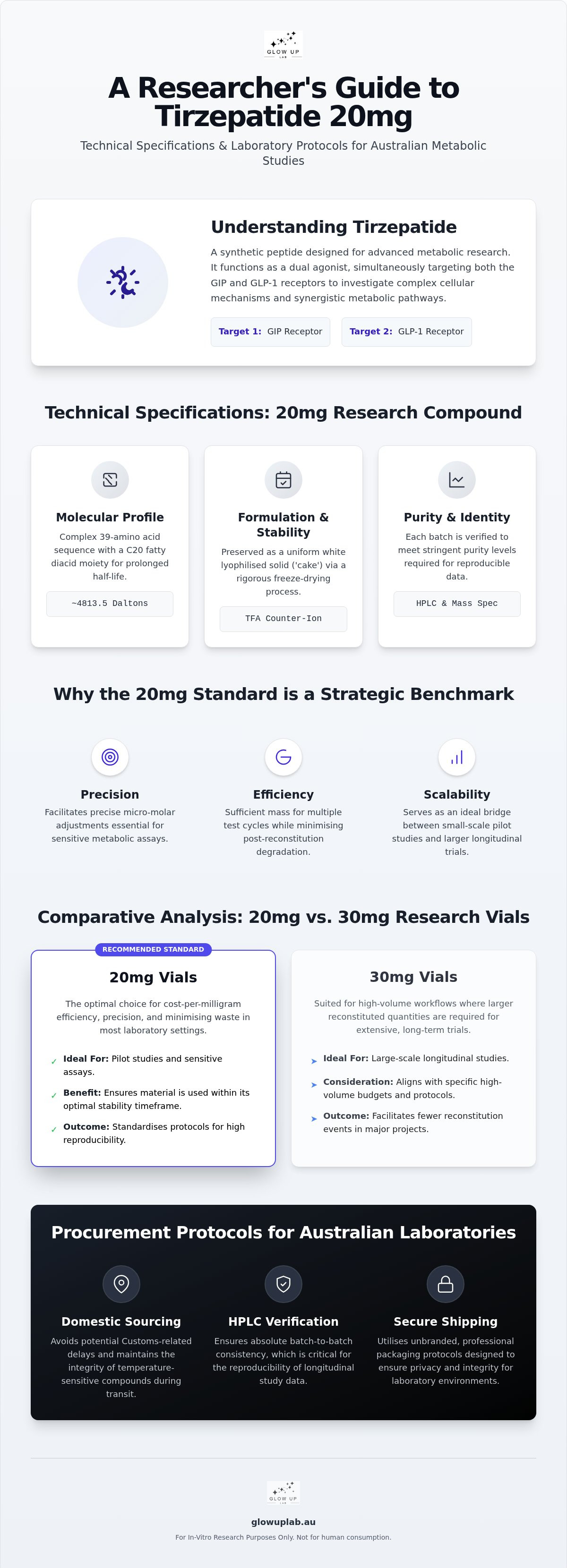
Tirzepatide represents a significant advancement in the study of metabolic regulation and endocrine response. As a synthetic peptide, it functions as a dual agonist, targeting both the glucose-dependent insulinotropic polypeptide (GIP) and glucagon-like peptide-1 (GLP-1) receptors. In Australian laboratory settings, this compound is primarily utilised for in-vitro studies to explore cellular mechanisms. High-purity lyophilised powder is the required format for professional research, as it ensures the chemical integrity of the peptide remains intact during storage and domestic transport.
The Mechanism of Dual Agonism
The efficacy of this peptide in a laboratory environment stems from its ability to mimic two different incretin hormones simultaneously. Dual agonism is the simultaneous activation of two distinct metabolic pathways. By engaging both GIP and GLP-1 receptors, researchers can investigate synergistic effects on insulin sensitivity and lipid metabolism that aren't observable with single-agonist compounds. This Tirzepatide overview provides a foundational look at the molecular structure that allows for such specific binding. In the context of tirzepatide 20mg research, this dual-pathway approach offers a more comprehensive model for studying glucose-dependent insulinotropic polypeptides and their role in metabolic signaling.
Why 20mg is a Strategic Research Benchmark
Selecting the 20mg mass specification offers several practical advantages for laboratory workflows. It provides a versatile baseline for creating various concentration gradients without the excessive waste associated with larger volumes. Researchers often prefer this specific mass because:
- It facilitates precise micro-molar adjustments required for sensitive metabolic assays.
- The 20mg mass is sufficient for multiple test cycles while maintaining post-reconstitution stability.
- It serves as an ideal bridge between small-scale pilot studies and larger longitudinal trials.
Maintaining compound stability is a primary concern in any metabolic study. Reconstituted peptides are sensitive to environmental factors; therefore, the 20mg vial serves as a strategic unit that minimises potential degradation by ensuring the material is used within an optimal timeframe. It allows for efficient use of laboratory resources without the risks of long-term storage after the vial's seal is broken. For Australian researchers, standardising on 20mg vials helps ensure that every milligram contributes to actionable, reproducible data. This consistency is vital when comparing results across different stages of a study, providing a reliable foundation for investigating insulin signalling and lipid oxidation pathways.
Technical Specifications of the 20mg Research Compound
Research-grade Tirzepatide is defined by its complex 39-amino acid sequence, featuring a unique structure that includes a C20 fatty diacid moiety. This specific modification is essential for its prolonged half-life and binding characteristics within laboratory models. The molecular weight typically sits around 4813.5 Daltons. During synthesis, trifluoroacetate (TFA) is frequently utilised as a counter-ion to ensure the peptide remains soluble and stable in its solid form. This salt form is a standard requirement for high-purity tirzepatide 20mg research materials, providing the necessary chemical stability for consistent experimental results.
The stability of the compound is achieved through a rigorous lyophilisation process. By removing moisture through sublimation under a vacuum, the peptide is preserved in a "cake" format. A high-quality 20mg lyophilised cake appears as a uniform, white solid at the base of the vial. Any signs of "melt-back" or a shrunken, discoloured appearance may indicate moisture ingress or temperature excursions during the freeze-drying cycle. These physical defects can compromise the peptide's biochemical activity, making visual inspection a critical first step in any laboratory protocol.
Purity and Identity Verification
Precise metabolic data requires verified compounds. High-Performance Liquid Chromatography (HPLC) is employed to assess the purity levels of each batch, ensuring they meet the stringent requirements of professional laboratories. While HPLC measures the concentration of the target peptide relative to impurities, Mass Spectrometry is used to confirm the molecular identity by measuring the exact mass-to-charge ratio. This dual-verification process is a cornerstone of the service provided by Glow Up Lab. Researchers can access batch-specific documentation to confirm that the chemical profile matches the expected theoretical model. Understanding Tirzepatide's mechanism of action requires this level of purity to ensure that observed cellular responses are not skewed by contaminants.
Stability and Storage Protocols
Peptide integrity is highly sensitive to environmental variables. For long-term storage, unconstituted vials should be kept in a freezer at -20°C to prevent degradation. Short-term storage in a refrigerated environment at 4°C is acceptable for vials intended for immediate use. Light exposure and moisture are the primary catalysts for peptide breakdown, so vials must remain in their original packaging until reconstitution. Upon arrival, it's a standard protocol to allow the vial to reach room temperature before opening to prevent condensation. If you require verified compounds for your next study, you can source HPLC-tested peptides that are shipped in secure, unbranded packaging to maintain their integrity during transit.
Comparative Analysis: Tirzepatide 20mg vs 30mg Research Vials
Selecting the optimal mass for tirzepatide 20mg research requires a balance between budget efficiency and the biochemical stability of the compound. While 30mg vials are available for larger study scales, the 20mg unit is often the preferred benchmark for precision-focused metabolic trials. This comparative analysis examines how vial mass influences laboratory workflows, calculation accuracy, and data integrity within the Australian research context.
Reconstitution Math and Concentration Gradients
Precise molarity is easier to achieve when the starting mass allows for straightforward decimal-based calculations. A 20mg vial reconstituted with 2mL of diluent results in a clean 10mg/mL concentration, which simplifies the process of creating serial dilutions. This simplicity reduces the risk of human error during high-frequency aliquoting. To maintain solution bacteriostasis and prevent microbial growth, the use of BAC Water is essential for any study extending beyond a single day. The following table illustrates the concentration variances between the two common vial sizes:
| Diluent Volume | 20mg Vial Concentration | 30mg Vial Concentration |
|---|---|---|
| 1.0 mL | 20 mg/mL | 30 mg/mL |
| 2.0 mL | 10 mg/mL | 15 mg/mL |
| 3.0 mL | 6.67 mg/mL | 10 mg/mL |
Selecting the Appropriate Mass for Your Study
The "waste factor" is a critical consideration for researchers managing tight project timelines. Once a peptide is reconstituted, the stability window begins to close. In studies requiring low-volume testing over several days, a 30mg vial may face significant degradation before the material is fully utilised. Conversely, the 20mg vial supports a high-frequency workflow while ensuring the peptide remains potent throughout the testing phase. This makes 20mg vials particularly suitable for pilot studies where maintaining a narrow concentration gradient is paramount.
While larger vials might offer a lower cost-per-milligram on paper, the potential for data variance due to compound breakdown often outweighs the initial savings. Professional laboratories prioritising reproducibility typically opt for the 20mg standard to ensure batch-to-batch consistency across multi-lab collaborations. This focus on quality is underscored by global concerns regarding peptide purity. For example, various FDA warnings on unapproved tirzepatide highlight the risks of using unverified sources that may lack the necessary structural integrity for reliable research. By standardising on 20mg units, Australian researchers can better manage their inventory and ensure that every micro-gram of the compound contributes to verifiable, peer-reviewed data.
Verifying Quality Standards in the Australian Market
In the Australian regulatory environment, peptides intended for laboratory use are classified under the "Research Use Only" (RUO) designation. This classification is vital for maintaining clear boundaries between clinical applications and in-vitro studies. For those engaged in tirzepatide 20mg research, adhering to these standards ensures that the compound is utilised strictly within controlled environments. Transparency regarding the origin and intended use of these peptides builds essential trust with Australian research institutions and ethics committees, who require rigorous documentation for project approval.
Sourcing peptides domestically offers a significant advantage over international grey-market alternatives. Importing unverified compounds often leads to complications with the Australian Border Force or, worse, temperature excursions that degrade the peptide's structural integrity. By choosing a domestic supplier, researchers can bypass these logistical hurdles and ensure the stability of the compound is maintained from the laboratory to the bench. This proximity is crucial for temperature-sensitive materials where even a minor delay in a transit hub can compromise the entire batch.
How to Interpret a Certificate of Analysis (COA)
A Certificate of Analysis is the primary document used to verify the quality of a 20mg batch. When reviewing an HPLC report, focus on the retention time and the peak area percentage; a single, sharp peak indicates high purity without significant degradation products. Mass Spectrometry data should complement this by confirming the molecular weight accuracy against the theoretical mass. Researchers must always verify that the batch number printed on the vial matches the COA provided to ensure the data corresponds to the specific material in hand.
The Advantage of Domestic Quality Control
Utilising an Australian-based facilitator provides access to technical support that understands local laboratory requirements. Local stockholding allows for rapid response times, which is essential when urgent research needs arise or when a study requires a quick replenishment of standardised vials. Sourcing Tirzepatide 20mg from verified domestic suppliers ensures that the compound has undergone rigorous HPLC and Mass Spec testing before it reaches your facility. This commitment to procedural integrity allows you to focus on data collection rather than questioning the reliability of your reagents. If you are ready to secure high-purity compounds for your next project, you can view our HPLC-verified research peptides to ensure your study meets the highest standards of reproducibility.
Procurement Protocols for High-Purity Tirzepatide 20mg
Securing reliable reagents is a fundamental step in maintaining the continuity of any metabolic study. For those conducting tirzepatide 20mg research, the procurement process must be as rigorous as the experimental design itself. A professional procurement platform ensures that every transaction is documented and every batch is traceable. This level of logistical precision is necessary to support the reproducibility of data in Australian research institutions, where accountability and procedural integrity are paramount.
Logistical considerations for lyophilised peptides extend beyond mere delivery. While the solid "cake" form of the peptide is robust, minimising time-in-transit is essential to prevent cumulative exposure to environmental fluctuations. Nationwide express shipping ensures that vials reach their destination within a predictable timeframe, typically within one to two business days. To maintain the professional environment of the laboratory, deliveries are made in secure, unbranded packaging. This discretion prevents external interference and ensures that the contents are handled only by authorised laboratory personnel upon arrival.
Ordering and Fulfilment Excellence
The checkout process is designed to meet the requirements of professional research accounts, prioritising security and transparency. Every order is processed with a focus on batch consistency, ensuring that longitudinal studies aren't compromised by sudden changes in compound characteristics. Glow Up Lab utilises Express Post for all domestic shipments, providing a reliable delivery network that spans all Australian states and territories. This system includes comprehensive batch tracking, allowing researchers to align their delivery schedules with their planned reconstitution and testing phases.
Final Preparation for Laboratory Integration
Effective laboratory integration begins with a formal inspection protocol. Upon receipt of the 20mg vials, researchers should execute a standard checklist to ensure the integrity of the shipment:
- Confirm the vacuum seal of each vial remains intact.
- Verify the batch number against the provided HPLC and Mass Spec documentation.
- Inspect the lyophilised cake for uniformity and the absence of moisture ingress.
- Transfer unconstituted vials immediately to a temperature-controlled storage unit at -20°C.
In complex studies, you may need to integrate various dual or triple agonists to compare metabolic responses. For example, researchers often examine the comparative effects of Retatrutide alongside tirzepatide to map different receptor activation profiles. Regardless of the study's complexity, the priority remains the same: the use of high-purity compounds backed by verifiable data. By choosing a domestic partner that values transparency and professional service, you ensure that your laboratory workflow remains efficient and your data remains beyond reproach. Prioritising purity and documentation today is the most effective way to secure successful, peer-reviewed outcomes for your future research.
Advancing Metabolic Studies with Verified Compounds
The success of any metabolic trial depends on the quality of its reagents and the precision of its concentration gradients. Selecting standardised 20mg vials provides a reliable benchmark for creating accurate molarity while minimising the risks of peptide degradation post-reconstitution. It's clear that prioritising domestic sourcing and verified documentation ensures your laboratory data remains reproducible and your study adheres to the highest standards of procedural integrity.
Standardising your tirzepatide 20mg research on HPLC and Mass Spec verified compounds removes the variables that often lead to inconsistent results. This commitment to transparency allows you to focus on the cellular mechanisms of dual agonism with confidence. You don't have to compromise on data integrity when you have access to batch-specific documentation and secure, unbranded shipping. Secure your next batch of strictly research-grade compounds to maintain a seamless laboratory workflow and achieve verifiable scientific outcomes.
Procure High-Purity Tirzepatide 20mg for Your Research and benefit from Australia-wide express shipping and professional support. We look forward to supporting your commitment to scientific excellence and precise metabolic enquiry.
Frequently Asked Questions
Is Tirzepatide 20mg suitable for human consumption in Australia?
No, Tirzepatide 20mg is strictly for laboratory research purposes only and is not for human consumption. In the Australian regulatory framework, these compounds are designated for in-vitro studies and must not be used as therapeutic agents. Glow Up Lab does not provide medical advice or prescriptions. Researchers must handle these chemicals within a professional laboratory environment to ensure compliance with safety standards and institutional ethics requirements.
How should Tirzepatide 20mg be stored upon arrival at the laboratory?
Upon arrival, unconstituted vials should be placed immediately into a freezer at -20°C to ensure long-term peptide stability. If the compound is intended for use within a short timeframe, refrigeration at 4°C is acceptable. It's essential to keep the vials in their original unbranded packaging to prevent exposure to light and moisture, which can lead to premature degradation of the lyophilised powder before your study begins.
What is the expected purity level of Tirzepatide 20mg from Glow Up Lab?
Every batch of Tirzepatide 20mg undergoes rigorous HPLC and Mass Spectrometry verification to ensure the highest possible purity levels. While specific percentages can vary between production cycles, researchers can expect purity levels that meet or exceed industry standards for professional laboratory reagents. This commitment to quality is a cornerstone of tirzepatide 20mg research, providing the necessary chemical integrity required for reproducible data and successful peer-reviewed outcomes in metabolic studies.
Can I request a batch-specific HPLC report for my 20mg vial?
Yes, batch-specific documentation including HPLC reports and Mass Spectrometry graphs is available for every order. Glow Up Lab prioritises transparency and provides these records to assist researchers in verifying the molecular identity and purity of their compounds. This documentation is vital for technical evaluations and ensures that the batch number on your vial matches the verified chemical profile, supporting the overall integrity of your experimental results.
What is the recommended diluent for reconstituting Tirzepatide 20mg?
Reconstitution should be performed using Bacteriostatic (BAC) Water, which contains 0.9% benzyl alcohol to inhibit microbial growth. Using 3mL BAC Water vials allows for precise concentration adjustments while maintaining solution bacteriostasis over the course of your testing phase. It's important to use sterile techniques during the reconstitution process to prevent contamination, ensuring that the peptide solution remains suitable for sensitive in-vitro metabolic assays.
How long is Tirzepatide 20mg stable after it has been reconstituted?
Reconstituted Tirzepatide 20mg is generally stable for up to 30 days when stored in a refrigerated environment at 4°C. However, the stability window begins to close as soon as the diluent is added, and gradual degradation is expected over time. For high-precision tirzepatide 20mg research, it's often recommended to use the solution as soon as possible to ensure maximum potency and to minimise any variance in your longitudinal data.
Does Glow Up Lab ship Tirzepatide 20mg to regional areas of Australia?
Yes, nationwide express shipping is available to all locations across Australia, including regional areas. Every order is dispatched in secure, unbranded satchels to maintain discretion and ensure the compound reaches your laboratory in a timely manner. This logistics network is designed to minimise time-in-transit, which is a critical factor in maintaining the integrity of lyophilised peptides during the delivery process from our domestic facility to your bench.
What is the difference between Tirzepatide 20mg and 30mg for research purposes?
The primary difference lies in the mass specification, which dictates the concentration gradients achievable with standard diluent volumes. A 20mg vial often facilitates easier decimal-based calculations for pilot studies and high-frequency testing. While 30mg vials offer a larger quantity of material for extensive trials, the 20mg unit is frequently preferred for its balance between vial longevity and biochemical stability, reducing potential waste in studies with narrow stability windows.