

Triple Agonist Research Peptides: A 2026 Technical Overview for Australian Laboratories
The transition from dual-receptor agonists to the triple agonist research peptide represents the most significant shift in metabolic research protocols since the introduction of GLP-1 analogues. Many Australian researchers find themselves at a crossroads where marketing claims often obscure the technical reality of glucagon receptor activation. It's difficult to find high-purity compounds and transparent documentation within the local market. This guide provides a rigorous technical overview of the molecular mechanisms and laboratory handling requirements for triple agonists like Retatrutide.
You'll explore the tripartite mechanism of action, establish standardised operating procedures for reconstitution, and learn how to verify batch integrity through HPLC and Mass Spectrometry data. By focusing on procedural integrity and chemical verification, your laboratory can ensure the reliability of its metabolic data. We'll examine the specific interaction between GLP-1, GIP, and glucagon receptors to clarify how these compounds function in a controlled environment. Understanding these nuances is essential for maintaining high standards in Australian bioscience research.
Key Takeaways
- Define the tripartite mechanism involving GLP-1, GIP, and Glucagon receptors to distinguish these compounds from simpler dual-receptor analogues.
- Examine the distinct receptor affinity profiles of a triple agonist research peptide to understand its biochemical divergence from dual-agonist counterparts like Tirzepatide.
- Master standardised laboratory procedures for reconstituting Retatrutide using Bacteriostatic Water to ensure consistent solution stability and concentration.
- Identify the hallmarks of a reliable Australian supplier by prioritising transparent documentation and third-party HPLC verification for every batch.
- Establish rigorous storage protocols to maintain the chemical integrity of sensitive peptide chains for long-duration laboratory studies.
Understanding Triple Agonist Mechanisms in Metabolic Research
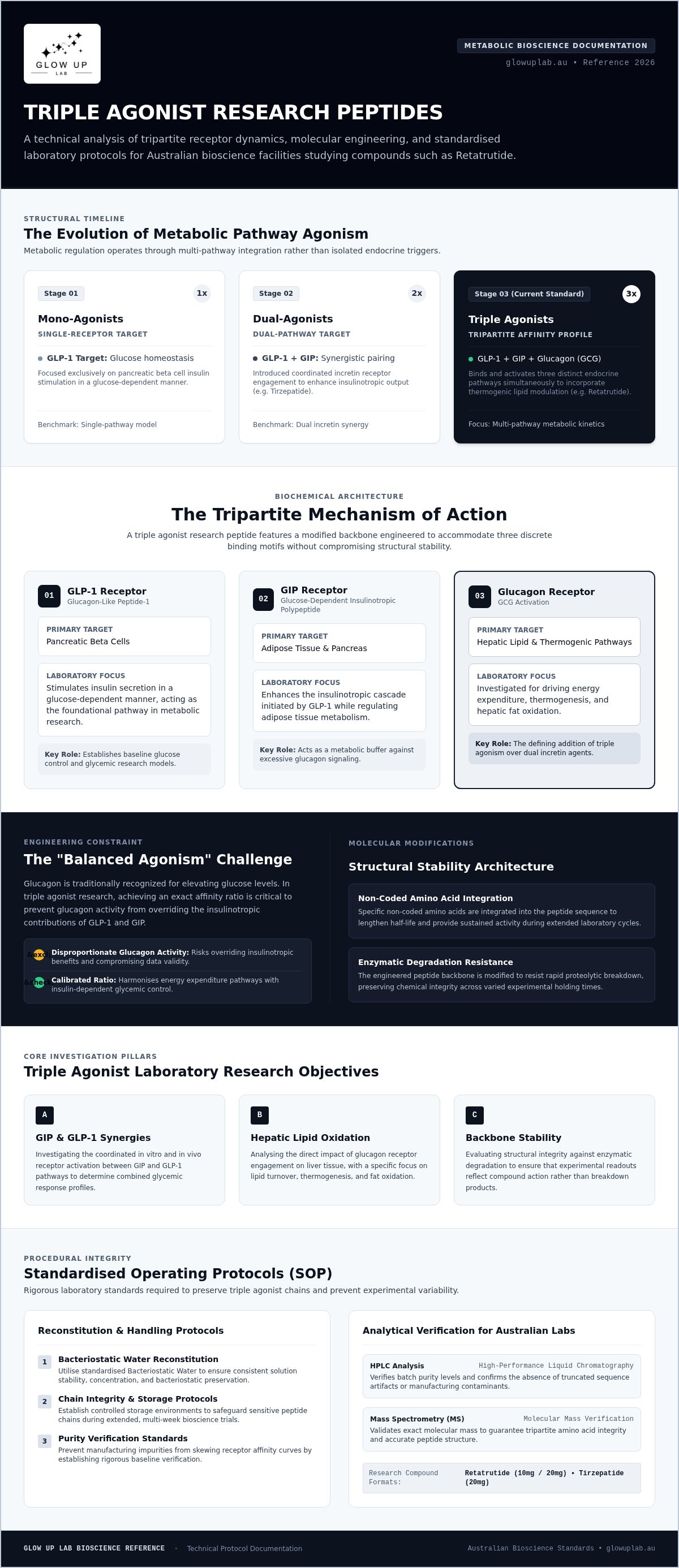
The term triple agonism refers to a molecular structure designed to bind and activate three distinct metabolic receptors simultaneously. In current laboratory settings, this involves targeting the Glucagon-Like Peptide-1 (GLP-1), Glucose-Dependent Insulinotropic Polypeptide (GIP), and Glucagon (GCG) receptors. While mono-agonists focus solely on GLP-1, and dual-agonists like Tirzepatide target GLP-1 and GIP, the triple agonist research peptide represents a more complex structural evolution.
As of 2026, Retatrutide is the primary focus of triple agonist research. The inclusion of the glucagon receptor component is a deliberate engineering choice. Glucagon is traditionally known for its role in glucose elevation; however, in the context of triple agonism, researchers study its ability to modulate energy expenditure and lipid metabolism. This three-way affinity aims to balance insulinotropic effects with thermogenic pathways to create a broader metabolic profile than single-receptor compounds.
The Evolution from Mono to Triple Agonism
Research compounds have progressed from single-receptor targets to more integrated multi-pathway activations. This pivot occurs because metabolic processes are rarely governed by a single pathway. By using a retatrutide triple hormone receptor agonist, laboratories can observe how simultaneous activation affects metabolic rates more comprehensively than previous mono-target models. Peptide engineering achieves this through a backbone modified to accommodate all three binding motifs while maintaining structural stability during laboratory handling.
Key Characteristics of Triple Agonist Compounds
Triple agonists are characterised by high molecular complexity and specific amino acid sequence modifications. These modifications are essential for achieving tripartite receptor affinity. The primary research objectives for a triple agonist research peptide include:
- Investigating the synergy between GIP and GLP-1 receptor activation.
- Analysing the impact of glucagon receptor binding on hepatic lipid metabolism.
- Evaluating the stability of the peptide backbone against enzymatic degradation.
The sequence often includes specific non-coded amino acids to extend the half-life of the compound. This allows for more consistent observations during extended research cycles. Researchers prioritising data integrity must account for these structural nuances when designing their reconstitution and storage protocols. Using high-purity compounds like Retatrutide (20mg) ensures that the observed receptor interactions aren't skewed by manufacturing impurities.
The Biochemistry of GLP-1, GIP, and Glucagon Receptor Agonism
Understanding the biochemistry of a triple agonist research peptide requires a detailed analysis of three distinct yet overlapping endocrine pathways. The Glucagon-Like Peptide-1 (GLP-1) receptor is a primary focus in insulin secretion research. Its activation stimulates pancreatic beta cells to release insulin in a glucose-dependent manner, which is a foundational element in metabolic studies. However, the complexity of triple agonism lies in how this pathway integrates with Glucose-Dependent Insulinotropic Polypeptide (GIP) and glucagon receptor signals.
The GIP receptor exerts a significant metabolic influence by potentially enhancing the insulinotropic response initiated by GLP-1. In laboratory models, GIP activation is also studied for its role in adipose tissue metabolism and its ability to buffer the glucagon component. The glucagon receptor itself provides a unique contribution to energy balance research. Unlike mono-agonists, the inclusion of glucagon agonism allows researchers to investigate increased thermogenesis and hepatic fat oxidation. Achieving "balanced" agonism is the central challenge in these studies. If glucagon activity is disproportionately high, it may override the insulinotropic benefits of the other two receptors, making the specific affinity ratio of the peptide critical for valid data collection.
Synergistic Pathways in Metabolic Studies
In vitro studies suggest that GIP and GLP-1 receptors don't just function in parallel; they interact to create a more robust insulinotropic effect than either could achieve alone. The glucagon receptor acts as a necessary counter-regulatory mechanism, allowing researchers to study energy expenditure alongside glucose management. Receptor synergy in the context of triple agonists is the cooperative interaction where the combined activation of GLP-1, GIP, and glucagon receptors produces a metabolic response greater than the sum of their individual effects. This interplay is essential for observing comprehensive metabolic shifts in controlled research environments.
Retatrutide: The Triple Agonist Prototype
Retatrutide serves as the definitive biochemical prototype for these studies. It's engineered with a specific amino acid sequence that grants it potent affinity for all three target receptors. For precise laboratory applications, researchers often utilise standardised formats such as Retatrutide 10mg or Retatrutide 20mg to ensure dosage accuracy. Stability data indicates that while the lyophilised powder is highly resilient, the peptide requires careful temperature management once in solution. Laboratories prioritising protocol consistency can access HPLC-verified Retatrutide to ensure their samples meet the 2026 purity standards required for high-fidelity metabolic mapping.
Comparative Analysis: Triple Agonists vs. Dual Agonist Research Compounds
In Australian metabolic research, comparing dual agonists with the triple agonist research peptide is a central focus for 2026 protocols. While dual agonists like Tirzepatide 20mg target the GLP-1 and GIP receptors, triple agonists introduce a third affinity for the glucagon receptor. This additional pathway significantly alters research outcomes, shifting the focus from purely insulinotropic effects to a broader study of energy expenditure and thermogenesis. The glucagon component allows for a more comprehensive analysis of fat oxidation pathways that aren't as pronounced in dual-agonist models.
Structural Differences and Chemical Properties
The inclusion of a third agonist pathway changes the peptide's chemical behaviour and molecular weight. Triple agonists often possess a more complex amino acid sequence to accommodate the specific binding requirements of the glucagon receptor. This complexity influences solubility; researchers often find that triple agonists require more careful agitation during reconstitution compared to dual-agonist counterparts. For a detailed breakdown of dual-agonist properties, laboratories can reference our technical guide on Tirzepatide Research Peptide Australia. Solubility data indicates that while both types are stable in aqueous solutions, the triple agonist's triple-motif backbone is more sensitive to pH fluctuations in the laboratory environment.
Research Intensity and Potency Considerations
Potency levels vary across the three receptor pathways. In Retatrutide, the GIP affinity is notably potent, while the GLP-1 and glucagon affinities are calibrated to prevent excessive glycaemic volatility in the model. This balance is harder to maintain than in dual agonists like Tirzepatide 30mg. Consequently, triple agonists demand more precise titration in laboratory settings to avoid saturating any single receptor pathway prematurely.
Key differences in research handling include:
- Titration Precision: Triple agonists require smaller incremental adjustments due to the complex multi-pathway feedback loops.
- Environmental Sensitivity: The additional receptor binding sites can make the peptide more sensitive to environmental stressors like light and heat.
- Degradation Rates: Current data suggests that a triple agonist research peptide may have a slightly faster degradation rate once reconstituted compared to dual agonists, necessitating stricter storage timelines.
Laboratories must account for these variables when designing long-term metabolic studies. Ensuring that the peptide is stored at a constant -20°C in its lyophilised form is essential for preserving the integrity of all three receptor motifs before the study commences.
Best Practices for Reconstituting and Storing High-Purity Research Peptides
The structural complexity of a triple agonist research peptide makes it highly susceptible to degradation during laboratory preparation. Maintaining the integrity of the GLP-1, GIP, and glucagon receptor motifs requires strict adherence to aseptic techniques and precise diluent ratios. Using BAC Water 10mL is essential because the 0.9% benzyl alcohol acts as a preservative, preventing microbial growth while stabilising the peptide chain for the duration of the research study. Without this bacteriostatic agent, the peptide solution becomes a breeding ground for contaminants that can skew metabolic data.
Reconstitution SOP for Triple Agonists
Calculating the correct concentration is the first step in ensuring data accuracy. For a 10mg vial of Retatrutide, adding 1mL of diluent results in a concentration of 10mg/mL, whereas 2mL yields 5mg/mL. When handling a 20mg vial, researchers must adjust the volume to maintain the desired titration levels for their specific laboratory model. Precision at this stage prevents dosage errors during the study.
Technique is as important as the calculation itself. Avoid direct stream contact with the lyophilised powder; instead, aim the diluent at the side of the glass vial to allow it to trickle down slowly. Rapid agitation or vigorous shaking can cause peptide shearing, a process that physically breaks the molecular bonds and renders the compound biologically inactive. Let the vial sit for several minutes until the solution is clear and colourless. Proper reconstitution ensures the peptide remains fully functional for receptor binding assays.
Ensuring Long-Term Stability and Purity
Lyophilised peptides should be stored at -20°C to ensure a shelf life of up to 24 months. Once reconstituted, the solution is far more fragile. It must be kept at 2-8°C and used within a specific timeframe, typically 14 to 21 days, depending on the buffer used. Light sensitivity is another factor; always store vials in a dark environment or use amber-coloured containers to prevent photo-degradation.
Managing the freeze-thaw cycle is critical as repeated temperature fluctuations can lead to chemical degradation and reduced potency. For laboratories conducting multi-stage trials, aliquoting the solution into single-use sterile vials is the preferred method to minimise exposure. For a deeper dive into the chemical properties that necessitate these protocols, see our sibling article, Retatrutide Research Peptide: A Comprehensive Technical Overview. This structured approach to storage maintains the purity levels required for high-fidelity metabolic mapping.
Prepare your laboratory for precise metabolic trials by sourcing reagent-grade BAC Water and verified research compounds today.
Sourcing Triple Agonist Peptides for Australian Research Facilities
Selecting a reliable supplier for a triple agonist research peptide requires a rigorous evaluation of their quality control framework and supply chain transparency. In the Australian research landscape, procurement officers must prioritise entities that provide comprehensive documentation to satisfy institutional audit requirements. Adhering to Research Use Only (RUO) standards is a mandatory component of laboratory compliance. These standards ensure that compounds are utilised strictly within controlled environments for data collection, avoiding any deviation from established bioscience protocols. For Australian laboratories, sourcing from a domestic facilitator simplifies the procurement process while ensuring that the compounds meet the high-fidelity requirements of 2026 metabolic studies.
Verifying Purity and Transparency
The integrity of metabolic data depends entirely on the chemical purity of the research compound. A Certificate of Analysis (COA) for Retatrutide should be the primary document reviewed during the sourcing process. This report must include High-Performance Liquid Chromatography (HPLC) data to confirm the purity level of the batch. Mass Spectrometry is equally vital; it confirms the precise amino acid sequence and molecular weight, ensuring the peptide matches the intended tripartite receptor affinity profile. Glow Up Lab prioritises this level of transparency by providing detailed documentation for every batch of Retatrutide (10mg) and Retatrutide (20mg). This commitment to verification allows researchers to proceed with confidence, knowing their samples are free from manufacturing impurities that could skew receptor binding results.
Logistics and Support for Australian Labs
Domestic logistics play a critical role in preserving the stability of sensitive research compounds. International shipping often involves prolonged transit times and customs delays, which can expose peptides to fluctuating temperatures. By utilising a domestic supply chain, Australian laboratories benefit from faster transit times and secure, tracked nationwide delivery. This reduces the risk of the peptide chain degrading before it reaches the facility. Furthermore, having access to Australian-based support ensures that technical inquiries regarding batch numbers or reconstitution volumes are handled by professionals who understand local laboratory standards. Secure handling protocols and efficient delivery are essential for maintaining the cold chain requirements of high-purity peptides. To view the current range of HPLC-verified compounds available for your laboratory, you may explore the Glow Up Lab research catalogue. Establishing a partnership with a transparent, local facilitator ensures that your facility has the reliable tools necessary for advancing metabolic science.
Advancing Metabolic Research Standards in 2026
The integration of a triple agonist research peptide into Australian laboratory protocols marks a significant advancement in metabolic mapping. By targeting the GLP-1, GIP, and glucagon receptors simultaneously, your facility can observe complex physiological interactions that mono and dual agonists cannot replicate. Maintaining the integrity of these tripartite compounds requires strict adherence to standardised reconstitution and storage procedures. High-purity reagents and stable environmental conditions are essential for ensuring that your research outputs remain accurate and reproducible.
Reliable data begins with verified chemical transparency. Sourcing your compounds from a domestic facilitator ensures that you receive detailed HPLC and Mass Spectrometry documentation while benefiting from secure nationwide shipping and Australian-based technical support. This professional approach to procurement allows your team to focus on the science of metabolic regulation without the logistical uncertainties of international supply chains. We're committed to providing the documentation and purity standards necessary for your facility to lead in the field of metabolic research.
Secure HPLC-Verified Triple Agonist Peptides for Your Research to ensure your laboratory operates with the precision required for modern metabolic studies.
Frequently Asked Questions
What is the primary difference between a triple agonist and a dual agonist in research?
The primary difference is the addition of the glucagon receptor pathway to the GLP-1 and GIP activation seen in dual agonists. While dual-receptor compounds like Tirzepatide focus on insulinotropic research, a triple agonist research peptide allows for the study of energy expenditure and lipid metabolism. This three-way affinity provides a more comprehensive model for observing how multiple metabolic pathways interact simultaneously under controlled laboratory conditions within Australia.
Is Retatrutide the only triple agonist research peptide available in Australia?
Retatrutide is the primary triple agonist currently utilised in Australian research, though it isn't the only compound in the broader category. It serves as the prototype for most 2026 metabolic studies due to its well-documented affinity for GLP-1, GIP, and glucagon receptors. Other experimental molecules exist in the global pipeline, but Retatrutide remains the most accessible and standardised option for laboratories requiring consistent, HPLC-verified data for their multi-receptor studies.
How should a triple agonist research peptide be stored to ensure stability?
Optimal stability is achieved by storing the lyophilised peptide at -20°C in a secure laboratory freezer. Once you've reconstituted the compound, it must be kept refrigerated at 2-8°C and used within 21 days to prevent degradation. It's essential to protect the vials from direct light and avoid repeated freeze-thaw cycles. These steps preserve the chemical integrity of the peptide motifs and ensure the reliability of your metabolic research data.
Can triple agonist peptides be reconstituted with sterile water instead of BAC water?
Peptides should be reconstituted with Bacteriostatic Water rather than plain sterile water for any study involving multiple samplings. BAC water contains 0.9% benzyl alcohol, which acts as a preservative to prevent microbial growth over time. Sterile water lacks this agent; its use significantly increases the risk of solution contamination and rapid chemical breakdown. For long-term stability in the lab, using standardised BAC water is the only way to maintain batch integrity.
What purity level is required for triple agonist peptides in laboratory studies?
Precision research typically requires a purity level of at least 98% as verified by HPLC analysis. Using high-purity compounds ensures that manufacturing impurities or residual solvents don't interfere with receptor binding or metabolic observations. For Australian institutional studies, maintaining this standard is critical for data reproducibility. Every triple agonist research peptide batch should be accompanied by a Certificate of Analysis to confirm that the compound meets these rigorous laboratory purity requirements.
Are triple agonist research peptides legal to purchase for Australian laboratories?
Research peptides are legal for Australian laboratories to acquire when they're used strictly for scientific investigation. These compounds are classified as Research Use Only (RUO) and are not intended for human consumption or medical use. Procurement departments should ensure that all purchases are documented correctly and that the compounds are handled within a professional laboratory environment. This ensures compliance with local regulations while supporting the advancement of metabolic science across Australia.
What are the common research applications for triple agonist compounds in 2026?
In 2026, research focuses on the synergistic effects of simultaneous GLP-1, GIP, and glucagon receptor activation. Laboratories use these compounds to investigate hepatic lipid metabolism, thermogenesis, and insulinotropic responses. These studies are vital for understanding how triple-receptor affinity modulates energy balance more effectively than single-pathway models. The data collected helps clarify the complex feedback loops between different metabolic receptors in both in vitro and in vivo research settings.
How do I verify the authenticity of a triple agonist peptide batch?
Batch authenticity is verified through a combination of HPLC and Mass Spectrometry reports. HPLC provides a purity profile by identifying any related substances or manufacturing by-products. Mass Spectrometry confirms the molecular weight and amino acid sequence, ensuring the peptide is indeed the correct triple agonist compound. Reliable Australian suppliers provide this documentation transparently to ensure that laboratories can independently verify the quality and authenticity of their research materials.