

Retatrutide Research Peptide: A Comprehensive Technical Overview for Australian Laboratories
While dual-agonist compounds have redefined metabolic studies, the addition of glucagon receptor agonism represents the most significant shift in peptide research architecture to date. Australian researchers often struggle with the logistical reality of sourcing high-purity materials that maintain structural integrity during domestic transit. You likely recognise that inconsistent documentation and the rise of mislabelled imports make it difficult to maintain rigorous laboratory standards. Ensuring the retatrutide research peptide remains stable and verified requires a level of transparency that many international suppliers simply cannot provide within the local market.
This technical overview provides a clear breakdown of the biochemical mechanisms, research applications, and handling protocols for this specific triple-agonist. We will examine the GIP, GLP-1, and GCG framework in detail; discuss essential laboratory stability requirements; and outline the standards required for verifiable domestic procurement. By focusing on HPLC verification and clinical-grade documentation, laboratories can ensure their data remains reliable and reproducible. This guide serves as a professional resource for institutions managing the complexities of advanced metabolic research within Australia's evolving regulatory environment.
Key Takeaways
- Understand the triple-agonist architecture of the retatrutide research peptide, specifically how it targets GIP, GLP-1, and glucagon receptors to influence metabolic pathways.
- Explore specific research applications in energy expenditure and non-shivering thermogenesis, providing a foundation for studies into lipid metabolism and adipose tissue regulation.
- Implement precise laboratory protocols for the reconstitution of lyophilised vials, ensuring stability through the use of clinical-grade bacteriostatic water.
- Evaluate the benefits of domestic sourcing in Australia, which mitigates risks associated with customs delays and ensures temperature control throughout the supply chain.
- Verify batch integrity through HPLC and Mass Spectrometry documentation to maintain the high-purity standards required for reproducible laboratory results.
Defining Retatrutide: The Triple-Agonist Research Frontier
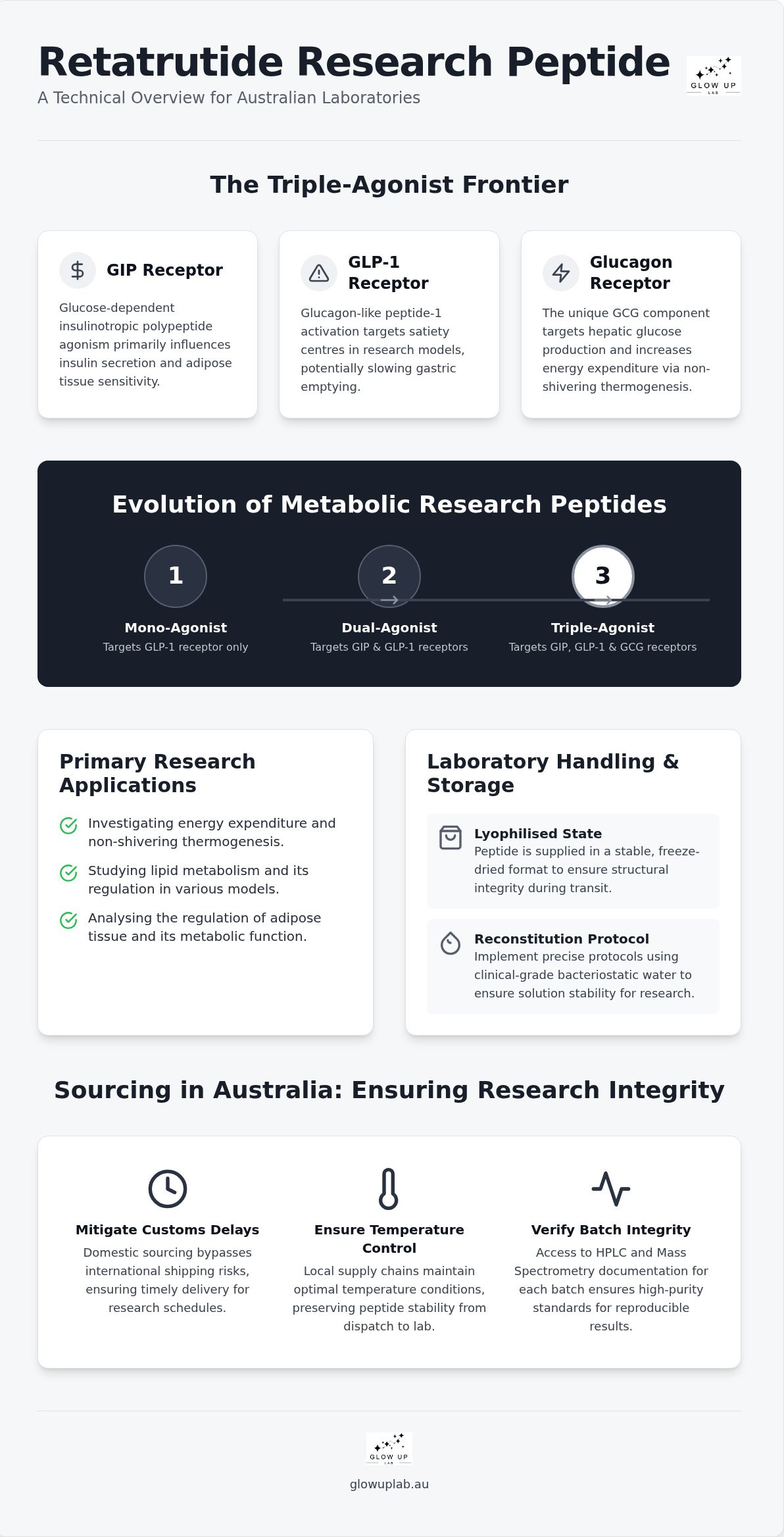
Retatrutide is a synthetic unimolecular peptide developed for advanced metabolic and endocrine studies. It functions as a potent triple agonist, meaning it simultaneously targets three distinct nutrient-stimulated hormone receptors. Specifically, it engages the glucose-dependent insulinotropic polypeptide (GIP), glucagon-like peptide-1 (GLP-1), and glucagon (GCG) receptors. The primary objective for laboratories using the retatrutide research peptide is to investigate how this multi-receptor activation influences energy homeostasis and glucose regulation. This compound is strictly intended for laboratory research purposes and is not for human consumption.
The Biochemical Structure of Retatrutide
The structural integrity of Retatrutide is based on a 39-amino acid backbone. This sequence includes specific chemical modifications, such as fatty acid side chains, designed to extend the peptide's half-life and improve stability during experimental protocols. Its architecture allows for simultaneous receptor binding across three distinct pathways, providing a unified approach to metabolic research. The GIP component is essential for insulin secretion research, while the GLP-1 element targets appetite pathways. The GCG component is unique in its ability to potentially stimulate metabolic rate in research models. In a laboratory setting, the peptide is provided in a lyophilised state. This freeze-dried format ensures the compound remains stable during domestic transit within Australia. Researchers must account for the specific molecular weight of the peptide when preparing stock solutions for study.
Evolution from Mono and Dual Agonists
The development of this triple agonist represents the next phase in the evolution of metabolic research tools. Peptide science moved from GLP-1 mono-agonists to dual GIP/GLP-1 agonists, which provided a more complex understanding of nutrient-stimulated hormone interactions. The inclusion of the glucagon (GCG) receptor is a significant milestone because it introduces a pathway for investigating energy expenditure. This allows for detailed comparative analysis against existing standards, such as the tirzepatide research peptide australia. By comparing dual and triple-agonist mechanisms, laboratories can better understand the synergistic effects of glucagon activation on lipid metabolism and thermogenesis.
For Australian institutions, sourcing reliable materials is a priority for data reproducibility. The availability of verified Retatrutide (10mg) and Retatrutide (20mg) vials supports various research scales. Using domestic suppliers helps avoid the complications of international customs while ensuring that all materials come with the necessary documentation for procedural integrity.
Mechanisms of Action: GIP, GLP-1, and Glucagon Receptors
The core of current Retatrutide pharmacotherapy research lies in the simultaneous activation of three distinct hormonal pathways. Unlike previous generations of peptides, the retatrutide research peptide integrates glucagon (GCG) receptor agonism with GIP and GLP-1 activity. This triple-receptor engagement aims to address glucose homeostasis and energy expenditure through a single, unimolecular structure. Researchers prioritising metabolic studies in 2026 focus heavily on how these pathways interact to modulate lipid metabolism. GIP receptor agonism primarily influences insulin secretion and adipose tissue sensitivity, while GLP-1 receptor activation targets satiety centres and slows gastric emptying in research models. The addition of GCG agonism is what distinguishes this compound; it specifically targets hepatic glucose production and increases energy expenditure through non-shivering thermogenesis.
Synergistic Effects on Metabolic Pathways
In laboratory models, the synergy between GIP and GLP-1 helps stabilise insulin levels, while the glucagon component promotes lipolysis. This unimolecular design offers a distinct advantage over the co-administration of separate agonists. It ensures consistent pharmacokinetic profiles and simplifies dosing protocols during longitudinal studies. By activating the GCG receptor, the peptide facilitates a higher metabolic rate than dual-agonists alone. This makes it a critical tool for investigating adipose tissue regulation and energy homeostasis. Laboratory observations suggest that the combined effect on these three receptors produces a more comprehensive metabolic response than targeting one or two pathways in isolation.
Retatrutide vs Tirzepatide: A Research Comparison
When comparing the retatrutide research peptide to earlier dual-agonists, the primary difference is the breadth of receptor affinity. While dual-agonists focus exclusively on GIP and GLP-1, the inclusion of GCG in retatrutide shifts the research focus toward active energy expenditure. For higher-intensity protocols, researchers often prefer the Retatrutide (20mg) specifications to ensure adequate receptor saturation throughout the study period. The following table contrasts the activity levels between these classes of research peptides:
| Feature | Retatrutide (Triple Agonist) | Tirzepatide (Dual Agonist) |
|---|---|---|
| GIP Receptor Agonism | High | High |
| GLP-1 Receptor Agonism | Moderate | High |
| GCG Receptor Agonism | High | None |
| Primary Research Goal | Triple-pathway synergy | Dual-pathway homeostasis |
Institutions looking to expand their comparative studies can source verified materials locally to avoid international transit risks. You can compare dual-agonist standards like Tirzepatide (30mg) alongside these newer triple-agonist compounds to establish clear baseline data for your laboratory projects. Maintaining batch-to-batch consistency is vital when transitioning from dual to triple-agonist models.
Primary Applications in Metabolic and Endocrine Research
Research applications for the retatrutide research peptide focus on the integration of glucagon receptor activation with established incretin pathways. This triple-agonist framework allows laboratories to investigate energy expenditure alongside glucose modulation in a way that dual-agonists cannot replicate. Scientific interest often centres on how the GIP, GLP-1, and GCG receptors work in tandem to influence central nervous system (CNS) appetite signalling and peripheral metabolic processes. By using this compound, researchers can evaluate glycaemic control mechanisms within various insulin-resistant models, providing a more comprehensive view of metabolic homeostasis. A systematic review of retatrutide trials highlights the significant impact this multi-receptor approach has on metabolic parameters in experimental settings.
Adipose Tissue and Lipid Research
One of the most active areas of study involves the regulation of adipose tissue and lipid metabolism. Laboratories use the retatrutide research peptide to monitor fatty acid oxidation rates and the structural changes within fat cells. Specific focus is placed on the following areas:
- Tissue Phenotyping: Investigating the potential for white adipose tissue to undergo "browning" or transition into more metabolically active brown adipose tissue in vitro.
- Lipolysis Mechanisms: Measuring the breakdown of lipids and the subsequent release of free fatty acids in response to triple-agonist stimulation.
- Hepatic Research: Evaluating the peptide's role in non-alcoholic fatty liver disease (NAFLD) models, where researchers observe changes in intrahepatic lipid content.
These studies are essential for understanding how multi-receptor agonism affects overall lipid distribution and storage patterns without the confounding variables found in human clinical environments.
Energy Homeostasis and Thermogenesis
The addition of the glucagon receptor (GCG) into the peptide's architecture makes it a unique tool for studying caloric expenditure. In metabolic laboratory settings, researchers measure oxygen consumption (VO2) and changes in resting metabolic rates to quantify the impact of GCG activation. This receptor's contribution is vital for studies on non-shivering thermogenesis, where energy is dissipated as heat rather than stored as fat. Monitoring these shifts provides data on long-term metabolic stability and the potential for sustaining energy balance in research models. For institutions conducting higher-scale studies, the Retatrutide (20mg) vial provides sufficient material for extended observation periods. Each batch is HPLC verified to ensure that these sensitive thermogenic measurements aren't compromised by impurities or inconsistent peptide concentrations.
Laboratory Handling, Reconstitution, and Storage Standards
Maintaining the structural integrity of the retatrutide research peptide requires strict adherence to laboratory protocols. In Australia, the varied climate presents specific challenges for peptide stability, particularly during domestic transit and subsequent long-term storage. Lyophilised compounds are highly sensitive to temperature excursions and mechanical stress. Proper handling is therefore essential to ensure that experimental data remains reproducible and free from variables introduced by peptide degradation. For researchers, the transition from a freeze-dried state to a liquid solution is the most critical phase for preserving the compound's biochemical activity.
Step-by-Step Reconstitution Protocol
Reconstitution must be performed using a bacteriostatic agent to inhibit microbial growth and maintain stability. The use of BAC Water 3mL or the larger BAC Water 10mL format provides the necessary bacteriostatic environment for multi-use research vials. When preparing a Retatrutide 10mg vial, researchers should calculate the desired concentration before introducing the diluent. The following steps ensure maximum stability:
- Sterile Preparation: Clean the vial stopper with an isopropyl alcohol swab and allow it to air dry completely.
- Controlled Introduction: Angle the needle so the bacteriostatic water runs slowly down the inside wall of the glass. Do not spray the liquid directly onto the lyophilised cake.
- Gentle Dissolution: Swirl the vial with a slow, circular motion. Never shake the vial, as vigorous agitation can lead to the denaturation of the peptide's delicate 39-amino acid chain.
Once reconstituted, the solution should be clear and free of particulates. Any cloudiness indicates potential contamination or degradation, and the sample should be discarded.
Purity Verification and HPLC Analysis
Australian researchers must prioritise the use of compounds that have undergone rigorous independent testing. A Certificate of Analysis (COA) should be reviewed for every batch to confirm that purity levels meet a minimum standard of ≥99%. This level of precision is necessary to reduce research variables and ensure that observed effects are attributable solely to the triple-agonist mechanism. High-Performance Liquid Chromatography (HPLC) and Mass Spectrometry are the industry standards for verifying peptide identity and purity. These reports confirm the absence of residual solvents and TFA, which can interfere with sensitive metabolic assays. You can order batch-verified Retatrutide (20mg) from Glow Up Lab to ensure your laboratory receives materials that include comprehensive HPLC documentation as standard.
Storage requirements are equally stringent. Lyophilised vials should be stored at -20°C for long-term preservation, while reconstituted solutions must be kept at 2°C to 8°C. In the Australian context, where ambient temperatures often exceed 30°C, the use of temperature-controlled storage and insulated shipping is a non-negotiable requirement for maintaining compound integrity from the supplier to the laboratory bench.
Sourcing Retatrutide Research Peptides in Australia
Procuring the retatrutide research peptide within Australia requires a focus on logistical reliability and chemical verification. International supply chains often expose sensitive compounds to excessive heat and customs delays, which can lead to significant peptide degradation. Domestic procurement ensures that materials remain within a controlled environment, preserving the integrity of the complex 39-amino acid sequence from the point of manufacture to the laboratory bench. Researchers must also navigate the specific regulatory requirements for "Research Use Only" materials. These compounds are strictly for laboratory use and are not for human consumption. Evaluating a supplier's commitment to transparency is the first step in ensuring institutional compliance and data reproducibility.
Domestic vs International Procurement
Procurement teams in 2026 face increased scrutiny regarding the provenance of research materials. International orders are subject to unpredictable transit times and potential seizures by border authorities, which often result in temperature excursions that compromise lyophilised stability. By choosing an Australian-based partner, laboratories avoid these risks and gain access to domestic support and faster quality control resolutions. This approach ensures that the retatrutide research peptide arrives in a state that matches its documented specifications. Institutional guidelines often prefer domestic sources to simplify the auditing process and ensure that all safety data sheets (SDS) and certificates of analysis (COA) align with Australian laboratory standards.
Glow Up Lab: Australian Research Integrity
Glow Up Lab facilitates metabolic studies by providing high-purity compounds with clinical-grade transparency. Every batch of Retatrutide (10mg) and Retatrutide (20mg) undergoes HPLC and Mass Spectrometry verification to ensure purity levels meet our rigorous standards. This commitment to quality extends to our entire range of metabolic research tools, including compounds like Cagrilintide (10mg). We prioritise secure, nationwide shipping that accounts for the Australian climate, ensuring that materials reach remote and metropolitan laboratories without loss of structural integrity. Our focus remains on providing the documentation and reliability required for professional research environments.
The introduction of triple-agonist peptides marks a new phase in endocrine research. As laboratories continue to investigate the synergistic effects of GIP, GLP-1, and GCG activation, the need for reliable, verified materials will only grow. By maintaining rigorous laboratory handling and sourcing from transparent domestic partners, Australian researchers can contribute high-quality data to the global understanding of energy homeostasis and metabolic regulation. This methodical approach to sourcing ensures that the future of metabolic science in Australia is built on a foundation of precision and trust.
Advancing Metabolic Research Standards in Australia
The transition from dual to triple-agonist models represents a significant progression in endocrine studies. By targeting three distinct hormonal pathways, researchers can explore energy expenditure and glycaemic regulation with unprecedented precision. Maintaining this precision requires high-purity materials and strict adherence to standardised reconstitution protocols. Accessing the retatrutide research peptide through a domestic partner allows laboratories to bypass the stability risks associated with international transit. Every study depends on the reliability of its compounds. Glow Up Lab supports these efforts by providing batch-specific HPLC reports and secure Australia-wide express shipping for all strictly high-purity research-grade materials. Ensuring your laboratory has access to verifiable documentation is essential for producing reproducible results and maintaining institutional compliance. We invite you to View HPLC-Verified Retatrutide for Australian Research to secure the materials required for your specific experimental needs. We look forward to facilitating your next phase of discovery with materials that meet the highest professional standards.
Frequently Asked Questions
Is retatrutide approved for human use in Australia?
Retatrutide is not approved by the Therapeutic Goods Administration (TGA) for human use or clinical prescription in Australia. It remains an unapproved therapeutic good under the Therapeutic Goods Act 1989. Suppliers like Glow Up Lab provide the retatrutide research peptide strictly for laboratory research and experimental purposes. It is not for human consumption, and any use outside of a controlled research environment is strictly prohibited. This ensures all experimental data remains within professional institutional frameworks.
What is the recommended storage temperature for lyophilised retatrutide?
Lyophilised vials should be stored at a temperature of -20°C for long-term preservation and structural stability. For short-term use during active laboratory protocols, the vials can be kept in a refrigerated environment between 2°C and 8°C. Maintaining these precise temperatures is essential to prevent the degradation of the 39-amino acid chain. In the Australian climate, temperature-controlled storage is a non-negotiable requirement for all research materials to ensure consistent and reproducible results.
How does retatrutide differ from tirzepatide in a research context?
The primary difference lies in the receptor affinity profile. Tirzepatide functions as a dual agonist targeting the GIP and GLP-1 receptors, whereas retatrutide is a triple agonist that adds glucagon (GCG) receptor activation. This third pathway allows researchers to investigate energy expenditure and thermogenesis in ways that dual-agonist models cannot. This makes the retatrutide research peptide a more complex tool for studying metabolic homeostasis and lipid metabolism in a professional laboratory setting.
What diluent should be used to reconstitute retatrutide research peptides?
Bacteriostatic water is the required diluent for the reconstitution of these compounds. Using BAC Water 3mL or 10mL ensures that the solution remains stable and protected against microbial growth during multi-use experimental cycles. Sterile technique is mandatory during this process. Researchers should allow the diluent to run slowly down the side of the vial wall to avoid mechanical stress on the lyophilised cake, ensuring the peptide's biochemical integrity is maintained for all subsequent trials.
How can I verify the purity of a retatrutide batch?
Purity verification is achieved through High-Performance Liquid Chromatography (HPLC) and Mass Spectrometry analysis. Every batch should be accompanied by a Certificate of Analysis (COA) confirming a purity level of at least 99%. These reports verify the molecular weight and ensure the absence of residual solvents or impurities. Glow Up Lab provides batch-specific HPLC documentation with its materials, allowing Australian researchers to confirm the identity and quality of their materials before starting any laboratory projects.
What is the half-life of retatrutide in laboratory models?
In various laboratory models, the estimated half-life of retatrutide is approximately six days. This extended duration is achieved through specific amino acid modifications and fatty acid side chains that enhance albumin binding and reduce renal clearance. This pharmacokinetic profile is a key focus for researchers investigating long-term metabolic effects. Maintaining consistent dosing intervals based on this half-life is critical for achieving steady-state concentrations during longitudinal studies in metabolic and endocrine research environments.
Are there specific Australian regulations for purchasing research peptides?
Research peptides are regulated under the Therapeutic Goods Act 1989 and the Poisons Standard. While they are available for purchase for "Research Use Only," they cannot be sold or supplied for human consumption. Australian laboratories must ensure they procure materials from domestic suppliers that provide clinical-grade transparency and documentation. Compliance involves maintaining strict laboratory protocols and ensuring that these compounds are never diverted for therapeutic use, as they are not approved for human consumption.
Why is glucagon receptor agonism included in retatrutide research?
Glucagon receptor (GCG) agonism is included to investigate its role in increasing energy expenditure and promoting non-shivering thermogenesis. While GIP and GLP-1 focus on insulin secretion and satiety, the GCG component targets hepatic glucose production and lipid metabolism. This triple-receptor approach allows laboratories to study a more comprehensive metabolic response. It provides a unique framework for researching the synergistic effects of multiple hormones on adipose tissue regulation and overall caloric balance in research models.