

Semax Cognitive Peptide Research: A 2026 Laboratory Overview
Engineered neuropeptide fragments rarely achieve both enzymatic stability and targeted central nervous system activity; yet Semax stabilises ACTH signalling to drive neurotrophic cascades within controlled research models. For investigators conducting semax cognitive peptide research, establishing reproducible benchmarks is often complicated by fragmented historical archives, conflicting reconstitution guidelines, and unverified domestic sourcing. You already recognise that reliable scientific outcomes depend on rigorous biochemical validation and uncompromised peptide integrity from the moment a vial enters your facility.
This 2026 laboratory overview examines the molecular mechanisms, cognitive research data, and laboratory handling standards for Semax in Australian scientific studies. We deliver a clear technical synthesis of core pathways, focusing on hippocampal BDNF upregulation and neurotransmitter modulation, followed by precise operating procedures for reconstitution, aliquot preparation, and thermal stability. You'll also gain direct insight into analytical verification standards, including RP-HPLC purity profiling and mass spectrometry, to support complete procedural control across your experimental workflows.
Key Takeaways
- Explore how structural engineering links an ACTH(4–7) core with a C-terminal tripeptide to achieve central biological activity without triggering systemic hormonal cascades.
- Understand the neurotrophic mechanisms documented in semax cognitive peptide research, including rapid BDNF expression and downstream TrkB receptor activation.
- Review comparative data from established experimental paradigms, focusing on spatial navigation models and conditioned response retention assays.
- Implement standard laboratory reconstitution protocols, covering thermal equilibration steps, diluent selection, and aliquot management to prevent methionine oxidation.
- Establish analytical verification benchmarks for domestic procurement using high-performance liquid chromatography purity assays and electrospray mass spectrometry.
Molecular Architecture: What Is Semax in Cognitive Peptide Research?
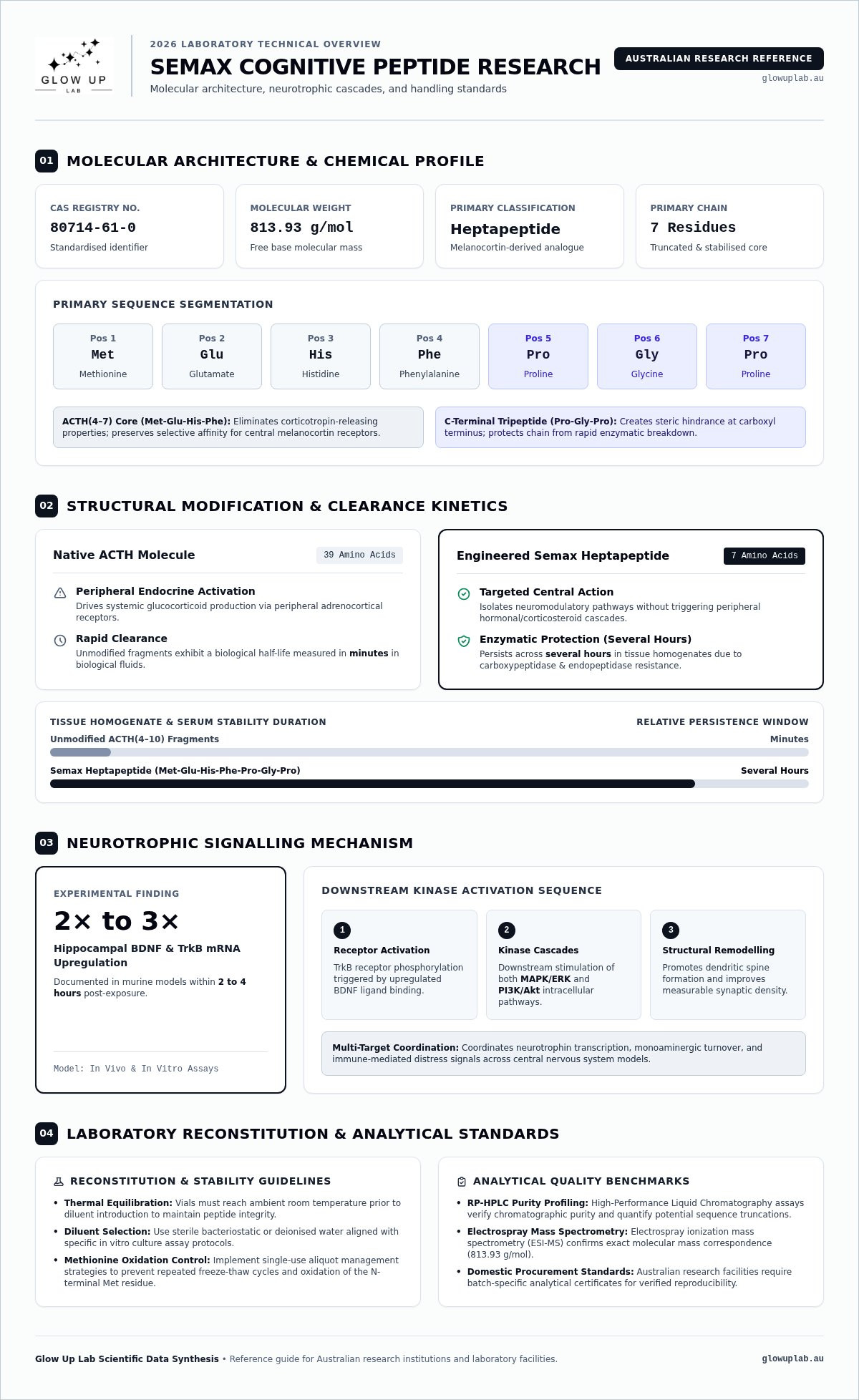
Semax is a synthetic melanocortin-derived heptapeptide investigated for neurotrophic regulation across diverse cellular and animal models. Within modern biochemical literature, the compound represents an engineered analogue of adrenocorticotropic hormone, specifically truncated to the ACTH(4–10) core and stabilised with a C-terminal tripeptide sequence. Structurally defined by the primary sequence Met-Glu-His-Phe-Pro-Gly-Pro, the free base exhibits a molecular weight of 813.93 g/mol under CAS registry number 80714-61-0. In Australian laboratory settings, investigators procuring Semax for in vitro evaluation focus heavily on how this defined sequence separates central neuromodulatory pathways from peripheral endocrine cascades.
Native ACTH encompasses 39 amino acids, driving glucocorticoid production via peripheral adrenocortical receptors. By contrast, the synthetic peptide Semax isolates central cognitive actions without triggering corticosteroid release. Adding the tripeptide domain prevents rapid degradation by serum and tissue peptidases, overcoming a primary hurdle in early neuropeptide research.
Structural Modification of the Endogenous ACTH Sequence
Endogenous ACTH(4–10) fragments possess central neuroactivity but suffer from rapid enzymatic clearance. Truncating the parent hormone to the Met-Glu-His-Phe sequence eliminates corticotropin-releasing properties entirely. Researchers then fused a Pro-Gly-Pro (PGP) tripeptide to the carboxyl terminus. This targeted modification preserves binding compatibility with central melanocortin receptors while shielding the molecule against rapid proteolytic cleavage. Native fragments break down within minutes in biological fluids; the C-terminal PGP tail creates steric hindrance that protects the core chain, allowing researchers to study stable neurotrophic cascades in non-clinical environments.
In Vitro Enzymatic Resistance and Biological Half-Life
Enzymatic stability dictates experimental viability in semax cognitive peptide research. Unmodified regulatory peptides are vulnerable to ubiquitous biological enzymes, limiting their practical use in extended assays.
- Carboxypeptidase shielding: The C-terminal Pro-Gly-Pro motif creates structural resistance against carboxypeptidase cleavage, preserving sequence integrity in culture media.
- Endopeptidase protection: Proline-rich conformations introduce steric constraints that reduce internal cleavage by neutral endopeptidases.
- Extended clearance kinetics: While unmodified ACTH fragments exhibit a serum half-life measured in minutes, the heptapeptide architecture persists across several hours in tissue homogenate preparations.
This enzymatic resilience ensures consistent target exposure during prolonged cell culture assays. For researchers evaluating neurotrophin signalling, structural longevity provides the experimental window necessary to observe genuine downstream transcriptional changes rather than transient receptor binding events.
Primary Neurobiological Mechanisms Documented in Semax Investigations
Semax influences multiple distinct targets across the central nervous system rather than engaging a single isolated receptor pathway. Contemporary semax cognitive peptide research demonstrates that the compound coordinates changes across neurotrophin transcription, monoaminergic turnover, and immune-mediated distress signals. For a broader comparative perspective across modern peptide categories, review our 2026 Neuropeptide Research Guide for Australian Labs.
Upregulation of BDNF and TrkB Signalling Pathways
Experimental data reveals rapid transcriptional activation of neurotrophin networks following peptide exposure. In murine models, researchers document an approximate two- to three-fold upregulation in hippocampal Brain-Derived Neurotrophic Factor (BDNF) and TrkB receptor mRNA levels within two to four hours of exposure. Binding stimulates TrkB receptor phosphorylation, triggering downstream MAPK/ERK and PI3K/Akt kinase cascades. This prolonged signalling promotes dendritic spine formation, improves synaptic density, and supports robust long-term potentiation across controlled cellular learning models.
Modulation of Central Neurotransmitter Systems
Parallel investigations highlight clear monoaminergic adjustments within subcortical structures:
- Dopaminergic regulation: Striatal tissue assays show increased dopamine synthesis and steady metabolite turnover without inducing cellular depletion.
- Serotonergic balance: Behavioural models reflect calibrated shifts in 5-HT receptor sensitivity, avoiding excessive transmitter spikes.
- Monoaminergic stability: Coordinated turnover across dopamine and serotonin systems creates an optimal neurochemical baseline for memory acquisition.
These neurotransmitter adjustments occur without psychostimulant-like agitation, confirming the peptide's balanced regulatory role.
Cellular Neuroprotection and Ischaemic Cascade Attenuation
Beyond baseline neurotransmission, the peptide confers documented resilience during severe metabolic distress. A genome-wide transcriptional analysis of Semax demonstrated significant modulation of genes governing immune response, endothelial preservation, and microvascular stability in ischaemic models. During experimentally induced oxygen-glucose deprivation, the peptide suppresses pro-inflammatory cytokines, specifically interleukin-1 beta (IL-1β) and tumour necrosis factor-alpha (TNF-α). This anti-inflammatory action halts microglial overactivation and prevents secondary apoptotic cell death in vulnerable cortical tissues.
Establishing these multi-target pathways requires validated raw materials that yield clean, uncompromised baseline readouts. Facilities seeking dependable analytical reference standards for ongoing cell line testing can source verified research materials directly from Glow Up Lab.
Comparative Overview: Semax Across Key Cognitive Assay Models
Translational research relies on standardised behavioural models to quantify neuropeptide efficacy. In preclinical literature, investigators assess Semax across distinct performance paradigms designed to challenge memory consolidation, environmental navigation, and adaptive learning under distress. These functional assays bridge the gap between cellular neurotrophin release and measurable cognitive preservation.
Synaptic Plasticity and Long-Term Potentiation (LTP)
Electrophysiological studies on rodent hippocampal slices provide direct insight into synaptic efficacy. Bath application of analytical Semax increases field excitatory post-synaptic potentials (fEPSPs) within the CA1 subfield. Rather than causing uncontrolled firing, the sequence enhances sensitivity to high-frequency stimulation trains. Histological markers show corresponding elevations in dendritic spine density and actin polymerisation. These structural changes directly correlate with elevated local neurotrophin presence, demonstrating how acute exposure can induce lasting structural remodelling across synaptic junctions.
Rodent Spatial Memory and Task Acquisition Metrics
Preclinical behavioural paradigms reveal quantifiable gains in task performance and retentive stability:
- Morris water maze (MWM): Treated rodent cohorts consistently record shorter escape latencies and spend significantly higher percentages of probe trial time in target quadrants, reflecting accelerated spatial mapping.
- Novel object recognition (NOR): Test subjects demonstrate improved discrimination indexes between familiar and novel objects, confirming enhanced non-spatial working memory retention.
- Passive avoidance conditioning: Test cohorts show prolonged latency to re-enter dark chambers associated with aversive stimuli, proving resilient conditioned memory retrieval under stressful test conditions.
Outcomes vary based on subject age and baseline neural state, with the most pronounced improvements documented in aged or metabolically compromised cohorts.
Comparative Analysis: Semax Versus Selank in Research Paradigms
Selecting appropriate regulatory peptides requires matching chemical architecture to target endpoints. While both heptapeptides share a protective C-terminal Pro-Gly-Pro sequence, their biological cascades serve complementary yet distinct research objectives. For an in-depth breakdown of the latter molecule, consult our Selank in anxiety research analysis.
| Parameter | Semax | Selank |
|---|---|---|
| Core Derivation | ACTH(4–7) analogue | Tuftsin immunomodulatory fragment |
| Primary Targets | TrkB receptors, BDNF/NGF upregulation | GABAergic allosteric modulation, enkephalin preservation |
| Functional Profile | Neurotrophic and alertness-oriented | Anxiolytic and stress-mitigating |
| Primary Model Fit | Spatial navigation, ischaemic recovery, LTP | Elevated plus maze, open field assays, stress markers |
Where Semax drives neurotrophin cascades and executive performance, Selank 10mg acts as a calmative modulator of inhibitory transmission. Understanding these mechanistic boundaries enables laboratories to design rigorous, parallel assays evaluating attention against emotional regulation without confounding cross-receptor interference in semax cognitive peptide research.
Laboratory Reconstitution, Solubility, and Storage Protocols
Precision in downstream semax cognitive peptide research hinges entirely on strict laboratory preparation. Because synthetic neuropeptides lack the structural mass of larger globular proteins, minor handling errors during reconstitution can trigger rapid oxidation or hydrolytic cleavage. Standardising your benchwork ensures consistent concentrations across every assay run.
- Thermal equilibration: Equilibrate the lyophilised vial to ambient room temperature for 15 to 20 minutes before breaking the vacuum seal. This simple pause prevents immediate condensation of atmospheric moisture, protecting the dry cake from surface hydrolysis.
- Concentration calculation: Calculate target diluent volumes using analytical balances suited to your assay design, ensuring clean alignment with required micro-dosing parameters.
- Sterile introduction: Introduce reconstituted diluent using sterile BAC Water 3ml (0.9% benzyl alcohol) or sterile physiological saline. Direct the fluid slowly down the inner glass wall rather than forcing a direct stream into the dry cake.
- Passive dissolution: Allow the peptide cake to hydrate completely without mechanical agitation or vigorous vortexing. Gentle, circular swirling protects the sequence from mechanical shear stress.
- Aliquot subdivision: Divide the clear stock solution into low-protein-binding polypropylene tubes immediately to avoid destructive freeze-thaw cycles.
Solubility Profiles and Reconstitution Procedures
Semax dissolves readily in aqueous media within a neutral physiological pH range of 6.5 to 7.4. Strong acidic or highly alkaline buffers accelerate spontaneous deamidation and must be avoided. While sterile 0.9% sodium chloride suits acute cellular applications, bacteriostatic water containing 0.9% benzyl alcohol serves as the standard diluent for multi-day protocols. The bacteriostatic agent inhibits microbial proliferation without altering the heptapeptide's secondary conformation. Always maintain a calm, methodical swirling motion; excessive agitation introduces air bubbles that promote interface denaturation.
Stability Horizons and Cryogenic Storage Benchmarks
Lyophilised powder stored in a manual-defrost freezer at -20°C maintains integrity for up to 24 months, whereas -80°C environments support prolonged multi-year preservation. Avoid automatic frost-free freezers completely, as continuous temperature cycling creates internal thermal fluctuations that degrade delicate peptide bonds.
Once reconstituted in bacteriostatic solution, the peptide remains stable between 2°C and 8°C for 14 to 28 days. The primary vulnerability in solution involves the N-terminal methionine residue (Met1), which oxidises to methionine sulfoxide upon sustained contact with dissolved oxygen. Multiple freeze-thaw cycles dramatically accelerate this oxidative degradation, leading to altered binding kinetics. Dividing reconstituted material into dedicated, single-use aliquots preserves baseline efficacy across extended testing schedules.
For certified facilities establishing strict procedural controls, acquire analytically verified reference materials by choosing to order laboratory research peptides from Glow Up Lab.
Procuring Analytical-Grade Semax for Australian Research Facilities
Reproducibility in semax cognitive peptide research relies entirely on the chemical integrity of the initial peptide supply. When raw synthesis batches contain residual trifluoroacetate salts, truncated sequences, or synthesis byproducts, downstream biological observations become compromised. Validating analytical purity thresholds through rigorous batch-specific documentation remains essential before introducing materials into laboratory trials.
Interpreting HPLC and Mass Spectrometry Documentation
Analytical verification requires two complementary testing methodologies. Reverse-Phase High-Performance Liquid Chromatography (RP-HPLC) serves as the primary method for quantifying peptide purity. Reviewers should examine traces for clean baseline resolution and a sharp target peak indicating at least 98.0% purity by area integration.
Complementary electrospray mass spectrometry (ESI-MS) confirms structural identity by measuring the mass-to-charge ratio against theoretical molecular weight parameters (813.93 g/mol). Research teams must scrutinise testing documentation carefully, rejecting vendors who supply generic or recycled Certificates of Analysis lacking individual batch numbers and authentic chromatograms.
Australian Compliance and Laboratory Procurement Standards
Securing peptides via domestic distribution channels protects institutional compliance and sample integrity across Australia:
- Research Use Only (RUO) parameters: All procured materials must maintain strictly non-clinical designations, restricted entirely to in vitro experiments and non-human laboratory models.
- Cold-chain reliability: Domestic transit avoids extensive customs inspections and unmonitored transit holds, eliminating thermal stress that risks premature sequence breakdown.
- Regulatory tracking: Procuring reference materials through established domestic networks ensures alignment with institutional audit criteria for laboratory reagents.
Maintaining documented chemical transparency forms the basis of defensible scientific publishing. Certified institutions can evaluate batch-verified purity profiles and identity documentation by reviewing analytical Semax 10mg laboratory materials designed for controlled experimental workflows.
Advancing Precision Benchmarks in Neuropeptide Investigations
Achieving verifiable, publishable outcomes in semax cognitive peptide research demands methodical attention across every experimental stage. From the structural engineering that uncouples central neurotrophin cascades from hormonal pathways, to disciplined aliquot preparation that limits methionine oxidation, rigorous laboratory standards dictate scientific success. When handling neuropeptides, process consistency remains your most critical asset.
Reliable science begins with verified raw materials. To support your facility's protocols, explore analytical-grade neuropeptides at Glow Up Lab. Every research compound arrives with batch-specific documentation confirming high purity thresholds via analytical HPLC chromatography alongside molecular identity verification through electrospray mass spectrometry. Supported by reliable, temperature-conscious nationwide dispatch across Australia, your research team can maintain strict compliance while pursuing dependable, reproducible neurobiological discoveries with total experimental confidence.
Frequently Asked Questions
What is the primary molecular target of Semax in cognitive research models?
Semax primarily stimulates central neurotrophic signalling cascades rather than binding a single isolated receptor. In laboratory models, it triggers rapid transcriptional activation of Brain-Derived Neurotrophic Factor (BDNF) and its high-affinity receptor, TrkB. Concurrently, it interacts with central melanocortin receptors without hormonal activation. These coordinated interactions support synaptic plasticity and cellular resilience, forming the primary biochemical mechanism evaluated throughout modern semax cognitive peptide research.
How does Semax differ structurally from native adrenocorticotropic hormone (ACTH)?
Semax contains only a synthetic fragment of native adrenocorticotropic hormone combined with a stabilising tail. While full endogenous ACTH comprises 39 amino acids and stimulates systemic adrenal steroidogenesis, Semax truncates this sequence to the core ACTH(4–7) heptapeptide and incorporates a C-terminal Pro-Gly-Pro tripeptide. This engineered structure eliminates peripheral endocrine activity while protecting the molecule against rapid enzymatic degradation by circulating carboxypeptidases in experimental media.
Why is bacteriostatic water preferred over standard water for peptide reconstitution?
Bacteriostatic water contains 0.9% benzyl alcohol, an effective antimicrobial preservative that prevents bacterial growth in multi-dose research vials. Standard sterile water lacks bacteriostatic agents, meaning any micro-organism introduced during syringe puncture can rapidly proliferate. In contrast, bacteriostatic diluent protects aqueous peptide solutions stored at 2°C to 8°C for up to 28 days without destabilising the tertiary peptide structure or interfering with in vitro assay readouts.
What storage conditions are required to maintain Semax stability long-term?
Long-term peptide stability requires sub-zero temperatures in manual-defrost freezers. Unconstituted lyophilised vials remain stable at -20°C for up to 24 months, or at -80°C for multi-year experimental preservation. Automated frost-free freezers must be avoided due to degrading thermal cycles. Once reconstituted, solutions should be divided into single-use polypropylene aliquots and kept refrigerated at 2°C to 8°C, shielding the sensitive N-terminal methionine residue from repeated freeze-thaw damage.
Can Semax be evaluated alongside other neuropeptides like Selank in single studies?
Yes, researchers frequently run parallel or comparative assay designs evaluating Semax alongside Selank. Because Semax targets neurotrophic BDNF/TrkB and monoaminergic pathways while Selank operates primarily via allosteric GABAergic modulation, their actions don't cross-compete at identical binding sites. Multi-arm comparative trials allow laboratories conducting semax cognitive peptide research to directly contrast memory acquisition paradigms against stress-reduction endpoints within identical experimental cohorts.
How do Australian laboratories verify the purity of acquired research peptides?
Australian research facilities verify peptide quality through batch-specific analytical testing protocols. High-Performance Liquid Chromatography (HPLC) quantifies overall chemical purity by measuring baseline separation, requiring a target threshold of at least 98.0%. Liquid chromatography coupled with mass spectrometry (LC-MS) or electrospray mass spectrometry confirms theoretical molecular weight and sequence identity. Legitimate domestic suppliers provide authentic, batch-coded Certificates of Analysis displaying complete chromatograms for institutional audit verification.
Is Semax approved for clinical or therapeutic use within Australia?
No, Semax isn't approved by the Therapeutic Goods Administration (TGA) and isn't registered on the Australian Register of Therapeutic Goods (ARTG). Peptides supplied domestically are classified strictly for Research Use Only (RUO). Facilities acquiring these materials must use them exclusively for non-clinical laboratory investigations, such as in vitro cell assays or animal research, adhering strictly to national compliance frameworks for scientific reference compounds.