

2026 Neuropeptide Research Guide for Australian Labs
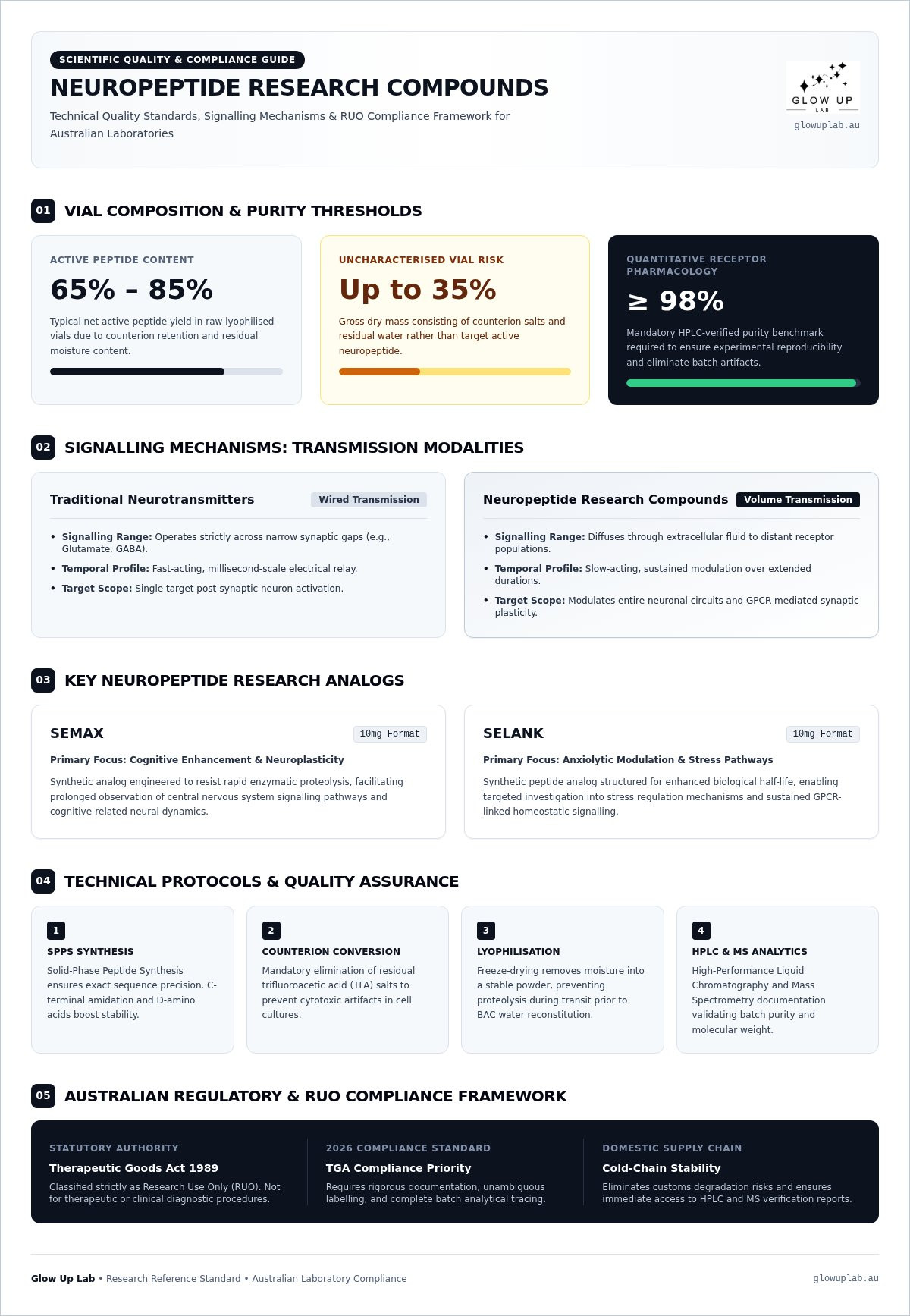
Up to 35% of the mass in an uncharacterised lyophilised vial may consist of residual water and counterion salts rather than the active peptide itself. For Australian researchers, this discrepancy highlights why relying on gross dry weight is a significant technical risk in precision neurobiology. Sourcing high-quality neuropeptide research compounds requires a move away from ambiguous labels toward rigorous, HPLC-verified documentation that ensures experimental reproducibility. You likely recognise that the 2026 regulatory landscape, now a formal TGA compliance priority, has made domestic procurement more complex than simply placing an order with an overseas vendor.
We understand the difficulty of navigating these stringent requirements while ensuring your materials meet the ≥98% purity threshold required for quantitative receptor pharmacology. This guide provides a comprehensive framework for understanding neuropeptide signalling mechanisms and the specific technical standards essential for high-purity laboratory research in Australia. We'll examine the critical shift toward mandatory counterion conversion to avoid TFA-induced neurotoxicity, outline precise reconstitution protocols using BAC water, and identify reliable domestic supply chains that prioritise transparency and procedural integrity for your facility's peace of mind.
Key Takeaways
- Understand the distinct signalling mechanisms of neuropeptides, focusing on their interaction with G Protein-Coupled Receptors (GPCRs) to influence synaptic plasticity.
- Compare the functional applications of specific research analogs, such as the cognitive-focused Semax and the anxiolytic properties of Selank.
- Identify the critical role of HPLC and Mass Spectrometry in verifying the purity and batch consistency of neuropeptide research compounds.
- Evaluate the benefits of utilising a domestic Australian supply chain to ensure product stability and maintain strict compliance with Research Use Only (RUO) standards.
- Master the technical protocols for reconstitution and storage to preserve the integrity of peptide sequences throughout the duration of your study.
Defining Neuropeptide Research Compounds: Scope and Classification
Neuropeptides are small protein-like molecules that function as signalling messengers within the nervous system. While traditional neurotransmitters like glutamate or GABA operate across narrow synaptic gaps, neuropeptides often act via volume transmission. This allows them to influence larger neuronal populations over longer durations. In laboratory settings, neuropeptide research compounds are utilised to study complex physiological responses, including stress modulation and cognitive enhancement.
The classification of neuropeptides is typically based on their chemical structure and the specific G protein-coupled receptors (GPCRs) they activate. Unlike classic neurotransmitters, these compounds are synthesised as large precursor proteins before being cleaved into active forms. Synthetic analogs, such as Semax and Selank, are frequently developed to bypass natural enzymatic degradation. This extends the half-life of the compound for more accurate in vitro or in vivo observations.
Chemical Structure and Synthesis
Neuropeptides consist of short chains of amino acids linked by peptide bonds. Their stability is a primary concern for researchers. Standard synthesis protocols often involve solid-phase peptide synthesis (SPPS) to ensure sequence accuracy. To maintain compound integrity during transport and storage, lyophilisation (freeze-drying) is essential. This process removes moisture, resulting in a stable powder that resists proteolysis. Researchers should recognise that raw lyophilised peptide typically yields only 65% to 85% net active peptide due to counterion and water retention. Modifications such as C-terminal amidation or the inclusion of D-amino acids are common strategies to enhance the research longevity of these compounds.
Research Use Only (RUO) Parameters
In Australia, the regulatory landscape for research materials is strictly defined. Neuropeptide research compounds provided for laboratory use are classified as Research Use Only (RUO). This designation means they are not intended for human consumption or clinical diagnostic procedures. Under the Therapeutic Goods Act 1989, RUO materials must be clearly labelled to distinguish them from therapeutic goods. Compliance requires that these compounds are used exclusively in controlled environments by qualified personnel. Proper documentation, including HPLC and mass spectrometry reports, is necessary to verify that the materials meet the technical standards required for institutional research. Providing these verification documents ensures that Australian labs can maintain the procedural integrity required for high-impact studies.
Signalling Mechanisms: How Neuropeptides Modulate Physiological Research
Neuropeptides function as slow-acting modulators that fundamentally differ from fast-acting neurotransmitters. While traditional "wired" transmission involves signals jumping across specific synapses, many neuropeptide research compounds facilitate volume transmission. This process allows peptides to diffuse through the extracellular fluid to reach distant receptors. Research into neuropeptide functions and regulation demonstrates that this mechanism enables the sustained modulation of neuronal circuits. It defines how these molecules influence physiological states such as arousal, metabolic rate, and satiety over extended durations.
The influence of these compounds extends into complex metabolic and cognitive research models. By acting as primary messengers, neuropeptides can alter the excitability of entire neuronal populations. This makes them essential tools for labs investigating the underlying drivers of systemic homeostasis and the secondary effects of hormonal signalling. High-purity analogs allow for the isolated study of these pathways without the interference of endogenous degradation.
GPCR Binding and Activation
The majority of neuropeptides exert their physiological effects by binding to G Protein-Coupled Receptors (GPCRs). These receptors are highly diverse, often possessing multiple subtypes that dictate the specific cellular response. Once a research compound binds to its target GPCR, it initiates a series of downstream intracellular signalling cascades. These typically involve secondary messengers like cyclic AMP or calcium ions, which eventually lead to changes in gene expression or ion channel activity. GPCR affinity refers to the strength and selectivity with which a neuropeptide research compound binds to its target receptor, determining the potency and duration of the resulting biological signal.
Modulation of Homeostasis and Neuroplasticity
In metabolic research, neuropeptides are central to studying the regulation of water balance, energy expenditure, and stress responses. Compounds targeting the hypothalamus allow researchers to investigate the complex interplay between appetite suppression and metabolic efficiency. This is particularly relevant when examining Tirzepatide Research Peptide Australia: A 2026 Technical Overview, which details how dual-agonist mechanisms influence glucose homeostasis in laboratory models.
Beyond metabolism, these compounds are indispensable for investigating long-term potentiation (LTP), the cellular basis for learning and memory. By modulating synaptic strength, neuropeptides help define the parameters of neuroplasticity and neuronal survival. Labs focused on cognitive decline utilise these signalling pathways to observe how specific analogs might protect neuronal cultures from oxidative stress or inflammatory damage. Ensuring your facility has access to documented materials is essential for maintaining these precise signalling observations. You can explore our documented research compounds to support your institutional requirements.
Comparative Analysis of Key Neuropeptide Research Analogs
Selank and Semax represent two of the most frequently studied neuropeptide research compounds in modern neurobiology. While both are synthetic heptapeptides derived from endogenous sequences, their research applications diverge significantly. Selank is primarily utilised to investigate anxiolytic signalling pathways, whereas Semax serves as a model for cognitive enhancement and neuroprotection. Understanding these functional differences is vital for labs selecting the appropriate analog for their specific research objectives. While their molecular weights are similar, their receptor affinities dictate entirely different experimental outcomes.
Assessing the molecular weight and stability profiles of these analogs reveals critical logistical considerations for the laboratory. Both compounds possess high stability in lyophilised form, but it's clear their integrity in aqueous solutions is relatively brief. Researchers must account for this when designing protocols, particularly for in vivo microinjections or sensitive cell culture assays. Maintaining a cold chain and using high-purity reconstitution liquids are standard requirements for preserving the peptide's structural conformation.
Selank: Investigating Anxiolytic Signalling
The research application of Selank 10mg focuses heavily on its interaction with the GABAergic system. Unlike traditional benzodiazepines, Selank appears to modulate GABA receptors without the same sedative profile, making it a unique subject for stress-response laboratory models. Research data suggests that Selank maintains its integrity well in specific buffered solutions, though it remains sensitive to thermal degradation. In Australian laboratory protocols, concentrations are typically standardised to ensure consistent receptor saturation across different experimental batches. This allows for a precise analysis of how the peptide influences neurotransmitter metabolism under controlled stress conditions.
Semax: Examining Cognitive and Neuroprotective Properties
Semax is distinguished by its potential to influence Brain-Derived Neurotrophic Factor (BDNF) expression within the central nervous system. When comparing Semax 10mg with traditional cognitive research compounds, the peptide exhibits a more targeted mechanism of action on neuronal survival and synaptic plasticity. Observations in neuronal cell cultures indicate that Semax modulates the mRNA expression of various neurotrophins and their receptors. This makes it a valuable tool for studying the recovery of neural tissues after induced ischaemic or oxidative stress. Its ability to trigger these specific genetic responses provides a more nuanced model for neuroprotection than many non-peptide alternatives. Labs often prioritise Semax when investigating the molecular drivers of memory formation and neuronal repair.
Quality Assurance Standards for Australian Research Laboratories
Maintaining research integrity requires rigorous verification of all neuropeptide research compounds before they enter a laboratory workflow. In Australia, where institutional standards for reproducibility are high, relying on manufacturer claims alone is insufficient. High-Performance Liquid Chromatography (HPLC) remains the industry standard for determining the chemical purity of a sample. This process effectively separates the target peptide from residual impurities or truncated sequences. Complementing this, Mass Spectrometry (MS) provides a molecular fingerprint, confirming that the batch matches the intended theoretical mass. These reports together ensure that experimental variables aren't compromised by batch-to-batch inconsistency.
Vial integrity is heavily dependent on precise environmental controls. Neuropeptides are inherently sensitive to thermal fluctuations and UV light. Lyophilised vials should be stored at -20°C for long-term stability, while reconstituted solutions generally require constant refrigeration between 2°C and 8°C. Exposure to light can trigger photodegradation of specific amino acid residues, which may alter the compound's receptor affinity. Utilising bacteriostatic water during the reconstitution phase is a critical step for maintaining sterility, particularly during multi-day studies where repeated vial access is required.
Interpreting Certificates of Analysis (COA)
A comprehensive COA must detail the purity percentage, net peptide content, and moisture levels. Researchers should distinguish between "purity", which is the percentage of the correct peptide sequence, and "net peptide content", which identifies the actual weight of the peptide relative to salts and water. Cross-referencing batch numbers with independent testing data provides an additional layer of transparency for the facility. The 98% purity benchmark is the recognised standard for research integrity in quantitative neurobiology.
Reconstitution Best Practices
Stability is best maintained by using BAC Water 10ml, which contains 0.9% benzyl alcohol to inhibit bacterial growth. When adding the diluent, researchers should aim the stream at the side of the glass vial rather than directly onto the lyophilised powder. Gentle swirling is required to dissolve the compound; vigorous shaking must be avoided as it can cause peptide shearing and denaturation. Reconstituted peptides should be used within a defined timeframe, typically 7 to 14 days when stored correctly, to ensure the signalling properties remain intact. You can order HPLC-verified research materials to ensure your laboratory meets these technical standards.
Sourcing Neuropeptide Research Compounds in Australia
Sourcing neuropeptide research compounds within Australia has become a strategic priority for domestic laboratories. The complexities of international logistics, combined with the 2026 TGA compliance priorities, have made overseas procurement increasingly unpredictable. By opting for a domestic supplier, labs can bypass the risks of customs seizures and significant thermal degradation that often occurs during long-haul transit. Maintaining the structural integrity of sensitive sequences is paramount. A local supply chain ensures that the time between laboratory synthesis and facility arrival is minimised, protecting the peptide from environmental stressors.
Strategic procurement often involves coordinating multiple analogs for comparative studies. For instance, laboratories focused on metabolic signalling may require Retatrutide Research Peptides to investigate triple-agonist mechanisms. Ensuring these materials arrive with verified HPLC documentation allows procurement officers to maintain the high standards required for institutional ethics approvals. This transparency is essential for validating experimental data and ensuring that batch-to-batch variability doesn't compromise the study's results.
Domestic Supply Chain Advantages
One of the most immediate benefits of sourcing within Australia is the reduction in lead times. Time-sensitive projects shouldn't be stalled by international freight delays or ambiguous clearing processes. A domestic partner provides several operational benefits:
- Reliable Australian-based support for technical and logistical enquiries.
- Minimised risk of cold-chain breaches due to shorter transit durations.
- Predictable delivery schedules that align with strict laboratory timelines.
This stability allows researchers to plan their reconstitution and assay phases with greater precision. Knowing that materials haven't been exposed to extreme temperature fluctuations in a cargo hold provides peace of mind regarding compound potency.
Selecting a Professional Research Partner
A professional facilitator should offer a diverse catalogue to support multi-faceted research goals. This includes access to compounds like Cagrilintide for appetite regulation studies and GHK-Cu for investigating tissue regeneration. Verification of secure payment and data protection protocols is also a key indicator of a supplier's professional standing.
Procurement officers should utilise a final checklist when evaluating a potential partner:
- Are HPLC and MS reports provided for every batch to verify purity?
- Does the supplier maintain secure nationwide shipping with tracked delivery?
- Is there a clear commitment to RUO (Research Use Only) compliance and standardised labelling?
By prioritising these criteria, Australian facilities can ensure a seamless procurement experience. This allows the focus to remain entirely on the precision of the research itself, backed by the confidence that all materials meet the required technical standards.
Advancing Precision in Australian Neurobiology Research
The evolution of neuropeptide research in 2026 demands a shift toward higher analytical standards and domestic supply chain reliability. We've established that experimental success relies on a technical understanding of signalling mechanisms and the rigorous verification of neuropeptide research compounds. By prioritising HPLC-verified purity and correct counterion conversion, your facility can ensure the reproducibility of your data while navigating the complex Australian regulatory landscape.
Relying on a professional facilitator provides the peace of mind necessary for high-impact studies. Glow Up Lab supports your institutional goals through transparent HPLC verification for every batch, secure nationwide Australian shipping, and dedicated domestic support for all laboratory enquiries. This structured approach to procurement minimises the risks of thermal degradation and ensures your materials meet the strict Research Use Only (RUO) criteria required for compliance.
Explore our range of HPLC-verified neuropeptide research compounds at Glow Up Lab to secure the precision your next project requires. We look forward to supporting your contribution to the field of neuroplasticity and metabolic research.
Frequently Asked Questions
What is the primary difference between a neuropeptide and a neurotransmitter in research?
Neuropeptides differ from neurotransmitters primarily in their signalling range and duration. While neurotransmitters facilitate rapid communication across narrow synaptic gaps, neuropeptides often employ volume transmission to influence larger neuronal populations. They are synthesised as large precursor proteins and possess a longer half-life, allowing for sustained modulatory effects. In laboratory settings, these characteristics make them essential for studying complex physiological states rather than just immediate synaptic events.
How should neuropeptide research compounds be stored to maintain maximum stability?
Maximum stability is achieved by storing lyophilised vials in a freezer at -20°C. Once the neuropeptide research compounds are reconstituted, they must be kept in a refrigerator between 2°C and 8°C. Protecting the vials from light is also critical, as UV exposure can trigger photodegradation of sensitive amino acid residues. Following these temperature and light protocols prevents premature denaturation and ensures the integrity of the peptide sequence during your study.
Why is HPLC testing considered the gold standard for research peptide purity?
High-Performance Liquid Chromatography (HPLC) is the gold standard because it provides a quantitative measure of chemical purity by separating the target peptide from residual impurities. This process ensures that the compound matches the intended sequence without contamination from truncated peptides or reagents used during synthesis. For Australian labs, HPLC verification is a prerequisite for experimental reproducibility, as it confirms that the results are driven by the active compound rather than unintended variables.
Can neuropeptide compounds be shipped safely across Australia?
Yes, neuropeptide compounds are shipped safely across Australia using secure nationwide logistics. Domestic sourcing is the preferred method for Australian labs because it avoids the lengthy transit times and customs delays associated with international orders. Secure packaging and rapid delivery protocols are utilised to prevent thermal degradation, ensuring that the lyophilised powder arrives at your facility in a stable condition, ready for immediate laboratory use or long-term cold storage.
What is the role of BAC water in the reconstitution of lyophilised peptides?
Bacteriostatic (BAC) water serves as a sterile diluent for the reconstitution of lyophilised peptides. It contains 0.9% benzyl alcohol, which acts as an antimicrobial agent to inhibit the growth of bacteria within the vial. This is particularly important for multi-day research projects where a single vial may be accessed several times. Using BAC water ensures the solution remains stable and sterile throughout the duration of the experimental timeframe, preserving the signalling properties of the compound.
Are these neuropeptide research compounds intended for human use?
No, these neuropeptide research compounds are strictly intended for Research Use Only (RUO). They are not for human consumption, clinical diagnostic procedures, or therapeutic applications. Glow Up Lab provides these materials exclusively for laboratory-based in vitro and in vivo studies. Compliance with Australian regulations requires that these chemicals are handled only by qualified researchers within controlled environments, and all vials are clearly labelled to reflect their non-clinical status.
How do I interpret the purity levels on a peptide Certificate of Analysis?
Interpreting a Certificate of Analysis (COA) requires identifying the purity percentage, which should ideally be ≥98% for high-precision research. It's also vital to distinguish this from the net peptide content, which represents the actual weight of the peptide relative to water and counterion salts. You should cross-reference the batch number on the COA with the HPLC and Mass Spectrometry data provided by the supplier to ensure the batch is consistent with institutional quality standards.
What are the most common neuropeptides currently used in cognitive research?
Semax and Selank are among the most frequently utilised neuropeptides in modern cognitive research. Semax is often studied for its influence on Brain-Derived Neurotrophic Factor (BDNF) and its potential neuroprotective properties. Selank is typically used to investigate anxiolytic signalling pathways and GABAergic modulation. Other compounds, such as Tirzepatide or Retatrutide, are increasingly used in metabolic research models to observe their effects on glucose homeostasis and energy expenditure within neuronal circuits.