

Selank in Anxiety Research: A 2026 Technical Reference for Australian Laboratories
Most neuropeptide candidates falter in preclinical trials not from poor receptor affinity, but because enzymatic degradation compromises their molecular integrity before reliable data can be recorded. When assessing anxiety research peptides, Selank represents a purposeful structural evolution, extending the endogenous tuftsin sequence with a C-terminal tripeptide to resist rapid peptidase cleavage.
Securing HPLC-verified compounds doesn't have to compromise your workflow, yet maintaining peptide stability remains a persistent hurdle for Australian facilities working within strict research-use frameworks. You need clear analytical data, validated handling parameters, and transparent domestic sourcing rather than the operational uncertainties of international freight. This 2026 technical reference outlines Selank's molecular profile, its dual modulation of GABAergic signalling and BDNF expression, and rigorous laboratory storage protocols. The following sections review the reconstitution benchmarks, stability thresholds, and quality control metrics required to maintain absolute experimental reproducibility across your assays.
Key Takeaways
- Explore how structural modifications to the tuftsin sequence optimise stability and receptor binding when evaluating anxiety research peptides Selank across preclinical models.
- Examine Selank's dual biochemical actions, including its allosteric modulation of GABA-A receptors and sustained regulatory effects on serotonin metabolism.
- Compare degradation rates and pH tolerance across Selank, native tuftsin, and Semax to establish rigorous baselines for experimental design.
- Implement standardized laboratory reconstitution and micro-dosing dilution protocols using verified Bacteriostatic Water to prevent peptide aggregation.
- Mitigate customs delays, transit temperature fluctuations, and compliance hurdles by partnering with domestic Australian sources providing batch-specific HPLC and mass spectrometry documentation.
Understanding Selank: A Tuftsin-Derived Neuropeptide in Anxiety Research
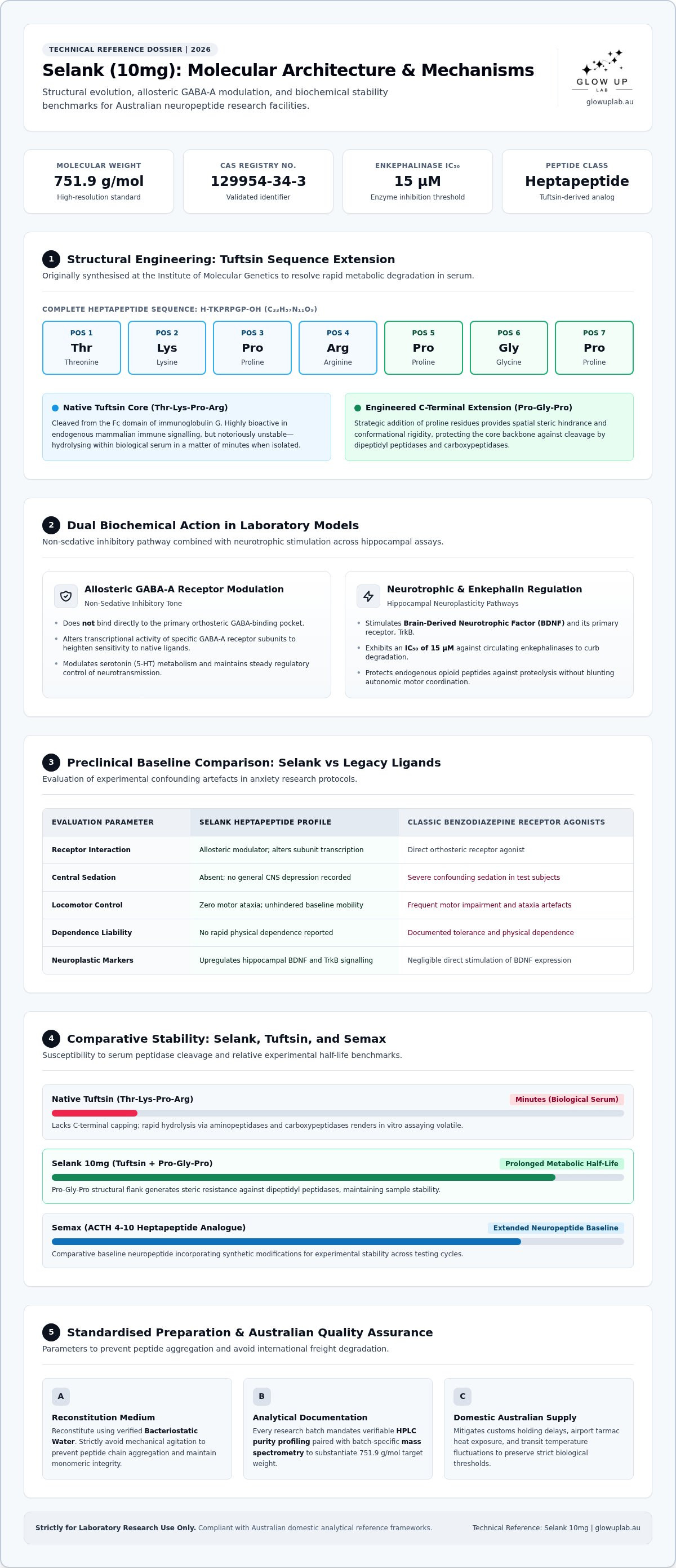
Originally synthesised at the Institute of Molecular Genetics, the tuftsin-derived heptapeptide Selank was developed to overcome the rapid metabolic degradation of endogenous regulatory peptides. Tuftsin is a naturally occurring tetrapeptide (Thr-Lys-Pro-Arg) cleaved from the Fc domain of immunoglobulin G. While physiologically potent, native tuftsin hydrolyses in biological serum within minutes. By appending a stable Pro-Gly-Pro tripeptide sequence to its C-terminus, pharmacologists engineered a resilient analog with prolonged bioactivity. For laboratories studying anxiety research peptides, Selank provides a robust foundation for examining targeted anxiolytic pathways alongside cognitive modulation without the metabolic instability of native regulatory molecules.
Molecular Structure and Synthesis
Selank is defined by the heptapeptide sequence Thr-Lys-Pro-Arg-Pro-Gly-Pro (H-TKPRPGP-OH). Laboratory identification and validation protocols rely on the following molecular specifications:
- Chemical Formula: C33H57N11O9
- Molecular Weight: 751.9 g/mol
- CAS Registry Number: 129954-34-3
The strategic inclusion of proline residues confers unique conformational rigidity. This arrangement introduces steric hindrance that shields the core peptide backbone from rapid cleavage by dipeptidyl peptidases and carboxypeptidases. This design ensures standard Selank 10mg preparations maintain structural integrity throughout complex experimental timelines.
Why Selank is a Primary Focus in Anxiety Research
Preclinical behavioural models historically relied on classic benzodiazepine receptor agonists. While effective at dampening acute stress responses, conventional ligands consistently introduce confounding experimental artefacts, including severe sedation, motor ataxia, and rapid physical dependence in test subjects. Selank offers a cleaner baseline. It acts as an allosteric modulator rather than a direct agonist, altering GABAergic transmission without depressing the central nervous system or blunting motor function.
Recent investigations also highlight the peptide's capacity to stimulate brain-derived neurotrophic factor (BDNF) and its primary receptor, TrkB, within the hippocampus. This dual action enables researchers to investigate anxiolytic mechanisms alongside neuroplasticity markers. Because of these distinct biochemical characteristics, investigating anxiety research peptides like Selank allows Australian research teams to map stress signalling pathways without the disruptive side effects common to legacy sedative compounds.
The Biochemistry of Selank: Mechanisms of Action in Laboratory Models
Understanding the cellular interactions of Selank requires examining its dual capacity to regulate inhibitory neurotransmission and stimulate neurotrophic signalling. Unlike broad-spectrum tranquillisers, this heptapeptide operates via complex receptor modulation and metabolic enzyme regulation. Preclinical assays demonstrate that Selank acts as an inhibitor of enkephalin-degrading enzymes, exhibiting a half-maximal inhibitory concentration (IC50) of 15 μM against circulating enkephalinases. This specific enzymatic suppression protects endogenous opioid peptides from rapid proteolysis, establishing a balanced foundation for measuring physiological stress markers in vitro.
GABAergic Pathways and Neurotransmitter Regulation
The principal anxiolytic profile of Selank stems from its capacity to modify GABA receptor complexes. Rather than directly binding to the primary orthosteric GABA-binding pocket, the peptide functions through subtle conformational changes. A peer-reviewed study on Selank and GABAergic neurotransmission genes demonstrated that exposure alters the transcriptional activity of several GABA-A receptor subunits, increasing receptor sensitivity to native ligands.
Selank’s GABAergic interaction constitutes an allosteric, non-sedative pathway that enhances inhibitory tone without depressing central autonomic control. Beyond the GABAergic network, analytical assays reveal stable shifts in monoamine activity:
- Serotonin (5-HT): Accelerates the turnover rate of 5-HT and increases concentrations of 5-hydroxyindoleacetic acid (5-HIAA) within the frontal cortex.
- Catecholamines: Exerts a moderate balancing influence on dopamine and noradrenaline levels, preventing the monoamine depletion typically provoked by acute behavioural stress protocols.
When screening anxiety research peptides, Selank provides experimental models with distinct neurochemical modulations, free from the compensatory receptor downregulation common to classic GABA-A positive allosteric modulators.
Neuroprotective and Immunomodulatory Properties
Beyond neurotransmitter systems, Selank directly influences neuroplasticity. Preclinical data confirm a rapid upregulation of Brain-Derived Neurotrophic Factor (BDNF) mRNA and TrkB receptor signalling in hippocampal tissue within 2 to 4 hours of administration. This elevation supports synaptic plasticity, neuronal survival, and dendritic arborisation in cellular stress models.
Simultaneously, Selank downregulates the gene expression of pro-inflammatory cytokines, specifically interleukin-6 (IL-6), while stabilising systemic inflammation markers. These neuroprotective profiles make the peptide particularly valuable when pairing anxiety models with neurodegenerative assays, often investigated alongside complementary compounds such as Semax 10mg to assess concurrent neurotrophic and cognitive preservation pathways. For domestic trials requiring high analytical purity, evaluating batch-specific documentation from Glow Up Lab ensures reproducible biochemical data across long-term experimental series.
Comparative Stability: Evaluating Selank Against Traditional Research Compounds
The experimental value of anxiety research peptides Selank depends heavily on resistance to rapid enzymatic degradation. While endogenous regulatory peptides offer high target specificity, rapid hydrolytic clearance often undermines assay reproducibility. Native tuftsin, for example, degrades within several minutes when exposed to biological serum due to circulating aminopeptidases. In contrast, Selank’s terminal Pro-Gly-Pro tripeptide creates steric shielding, slowing carboxypeptidase cleavage and extending its experimental half-life.
| Compound | Sequence / Structural Origin | Serum Stability (In Vitro) | Optimal pH Range |
|---|---|---|---|
| Selank | Thr-Lys-Pro-Arg-Pro-Gly-Pro (Tuftsin + PGP) | High (~20–30 min retention) | 6.0 – 7.5 |
| Tuftsin | Thr-Lys-Pro-Arg (IgG Fc domain) | Poor (<3 min rapid hydrolysis) | 6.5 – 7.5 |
| Semax | Met-Glu-His-Phe-Pro-Gly-Pro (ACTH 4-10 + PGP) | High (~20–25 min retention) | 6.0 – 7.4 |
Pharmacokinetic Profiles in Research
Pharmacokinetic evaluations demonstrate rapid, targeted biodistribution. In rodent models, Selank crosses the blood-brain barrier via olfactory and trigeminal pathways, achieving detectable cerebral tissue concentrations within 2 to 4 minutes following intranasal instillation. Hydrolysis yields secondary peptide fragments, primarily Gly-Pro and Arg-Pro, before resolving into basic amino acids. Utilizing material aligned with the PubChem reference standard for Selank with purity levels of ≥98.0% ensures that unexpected degradation products don't confound behavioural scoring across rodent strains like Wistar rats or C57BL/6 mice.
Stability in Aqueous Solution
In lyophilised solid form, Selank remains stable at ambient temperatures (20°C to 25°C) for up to four weeks during transit. Long-term institutional archiving requires -20°C or -80°C to prevent moisture absorption and peptide breakdown. Once reconstituted into an aqueous phase, stability declines sharply at temperatures above 8°C.
Reconstituted solutions must be held between 2°C and 8°C and used within 14 to 30 days. Australian facilities planning longitudinal protocols should aliquot reconstituted stock into single-use microcentrifuge tubes before freezing at -20°C. This practice prevents repeated freeze-thaw cycles, which cause peptide aggregation, bond cleavage, and assay variability.
Laboratory Protocols: Reconstitution and Storage of Selank 10mg
Precise handling protocols are essential to preserve molecular conformation during experimental preparation. When working with anxiety research peptides Selank, errors during reconstitution or thermal management can rapidly hydrolyse peptide bonds, resulting in inactive fragments and inconsistent experimental metrics.
Reconstitution Best Practices
Aseptic technique within a certified laminar flow cabinet is required to prevent contamination. For a standard vial of Selank 10mg, adding measured volumes of BAC Water 3ml establishes standard working concentrations for micro-dosing protocols:
- 2.0 mL Diluent: Produces a concentration of 5.0 mg/mL (500 μg per 0.1 mL).
- 2.5 mL Diluent: Produces a concentration of 4.0 mg/mL (400 μg per 0.1 mL).
- 3.0 mL Diluent: Produces a concentration of 3.33 mg/mL (333 μg per 0.1 mL).
Sanitise the rubber septum with a sterile 70% isopropyl alcohol wipe and allow it to dry completely. Using a sterile syringe, introduce the diluent slowly along the inner glass wall of the vial rather than jetting it straight onto the lyophilised cake. Let the liquid pool at the base, equalising internal pressure naturally. Swirl the vial with a gentle, continuous motion until the powder dissolves into a clear liquid. Don't shake or vortex the vial, as mechanical shear stress cleaves peptide backbones and accelerates aggregation.
Long-Term Storage and Preservation
Thermal stability directly governs peptide degradation rates. In unconstituted lyophilised form, the peptide remains stable at 2°C to 8°C for standard experimental handling, but long-term institutional archiving demands storage at -20°C or -80°C alongside a desiccant pack.
Once reconstituted, the liquid solution must remain refrigerated between 2°C and 8°C. Solutions prepared with bacteriostatic water containing 0.9% benzyl alcohol retain experimental viability for 14 to 30 days under these conditions. The peptide is also photo-sensitive; store vials in amber containers or dark boxes to prevent light-induced oxidation. Avoid repeated freeze-thaw cycles by aliquoting working volumes into sterile microcentrifuge tubes before freezing. To secure verified materials for your testing schedules, source research-grade Selank 10mg backed by batch-specific documentation.
Sourcing High-Purity Selank for Australian Research Institutions
Procuring research-grade peptides requires stringent quality verification to prevent compromised assay outcomes. When evaluating anxiety research peptides Selank, Australian laboratories frequently face supply chain obstacles ranging from inconsistent overseas purity to customs holdups. Relying on unverified international vendors introduces considerable experimental risk, particularly when shipments encounter border delays and fluctuating holding temperatures. Establishing a domestic supply chain with complete batch transparency ensures both experimental continuity and compliance with strict institutional standards.
Verifying Peptide Purity and Identity
Every research batch requires independent analytical validation before entering laboratory workflows. A comprehensive Certificate of Analysis (COA) must feature two core analytical techniques:
- High-Performance Liquid Chromatography (HPLC): Reversed-phase HPLC at 214 nm or 220 nm should display a single sharp, symmetrical peak. The baseline must show minimal noise, and the integrated area under the curve should confirm purity levels of ≥98.0% to ≥99.0%. Multiple elution peaks indicate truncated sequences or residual synthesis impurities that distort in vitro receptor binding data.
- Mass Spectrometry (MS): Electrospray ionisation (ESI-MS) or MALDI-TOF must verify molecular identity. The observed monoisotopic mass must match Selank’s theoretical molecular weight of 751.9 g/mol, confirming correct peptide synthesis without sequence errors or unremoved protecting groups.
A purity threshold of ≥99.0% represents the scientific benchmark for neurochemical assays. Lower purity preparations risk introducing truncated peptides that compete for receptor sites, leading to conflicting behavioural data in animal stress models.
Logistics and Compliance in Australia
Procuring non-approved peptides within Australia demands strict adherence to institutional research frameworks. Materials must be procured solely under formal "Research Use Only" (RUO) designations, accompanied by full analytical documentation for Institutional Biosafety and Ethics Committees. Importing peptides directly from overseas carries high interception rates, as customs authorities routinely scrutinise and seize undocumented consignments.
Partnering with an Australian supplier eliminates these border uncertainties while protecting peptide stability. Domestic fulfillment avoids lengthy customs clearance in uncontrolled transit hubs where exposure to heat degrades lyophilised cakes. Facilities can secure verified research batches through Glow Up Lab’s Selank 10mg, supported by Australian-based technical support, lot-specific HPLC and mass spectrometry verification, and secure nationwide temperature-monitored shipping. This infrastructure provides local research teams with dependable access to anxiety research peptides Selank without administrative delays.
Advancing Preclinical Protocols in Australian Laboratories
Integrating targeted neuropeptides into behavioural models demands precise molecular stability and documented compound fidelity. By combining an allosteric GABAergic mechanism with neurotrophic stimulation, Selank delivers an experimental model unencumbered by sedative artefacts. Adhering to validated reconstitution guidelines and disciplined thermal storage ensures your assays maintain longitudinal reproducibility across testing cohorts.
Sourcing materials domestically eliminates border enforcement risks and protects compound structure from uncontrolled transit temperatures. When investigating anxiety research peptides Selank, batch integrity is vital to gathering defensible data. Partnering with a domestic provider gives your facility immediate access to compounds HPLC tested for >99% purity, backed by Australian-based research support and secure nationwide shipping. Procure HPLC-Verified Selank 10mg for Your Laboratory to establish reliable baselines across your upcoming experimental schedules.
Frequently Asked Questions
What is the primary mechanism of Selank in anxiety research?
Selank primarily acts as an allosteric modulator of GABA-A receptors and an inhibitor of enkephalin-degrading enzymes. Unlike direct GABA agonists, it alters receptor sensitivity and expression without inducing channel desensitisation. It also elevates hippocampal BDNF expression and stabilises serotonin metabolism. This makes anxiety research peptides Selank particularly valuable for modelling stress reduction devoid of central sedative artefacts or motor disruption in preclinical test subjects.
How should Selank 10mg be stored to maintain its stability?
Lyophilised Selank 10mg vials should be stored at -20°C or -80°C for long-term preservation, protected from light and moisture desiccation. Reconstituted solutions require refrigeration between 2°C and 8°C and should be used within 14 to 30 days. To avoid bond cleavage caused by repeated freeze-thaw cycles, laboratories should aliquot reconstituted solutions into single-use microcentrifuge tubes before any secondary freezing.
What is the difference between Selank and Semax in a research context?
Selank derives from the immunomodulatory peptide tuftsin, whereas Semax is an analog of adrenocorticotropic hormone (ACTH 4-10). While both incorporate a C-terminal Pro-Gly-Pro sequence for enzymatic stability, their research endpoints diverge. Selank is predominantly evaluated in anxiety, stress response, and GABAergic pathways. Semax is typically utilised to study cognitive enhancement, neuroprotection, and focal ischaemia models via melanocortin receptor activity.
Can Selank be reconstituted with sterile water instead of BAC water?
Selank can be reconstituted using sterile water for injection (SWFI) or normal saline (0.9% NaCl), but with critical storage constraints. Sterile water lacks antimicrobial agents like benzyl alcohol, meaning the reconstituted peptide must be consumed immediately in single-session assays to prevent microbial proliferation. For multi-dose protocols spanning up to 30 days, bacteriostatic water remains the necessary diluent to preserve solution sterility.
What purity level is required for Selank in laboratory studies?
Quantitative laboratory research requires a minimum purity threshold of ≥98.0%, with ≥99.0% preferred for high-fidelity behavioural and neurochemical assays. Lower-purity formulations frequently contain truncated peptide fragments or chemical synthesis residuals. These contaminants can bind non-specifically to neural receptors, generating false positives or conflicting baseline data. Analytical validation via reversed-phase HPLC and mass spectrometry ensures experimental reproducibility across testing series.
Is Selank legal for research use in Australia?
Selank is legal in Australia strictly when procured and handled under "Research Use Only" (RUO) designations for authorised in vitro and animal ethics protocols. It isn't approved by the TGA for therapeutic or clinical human use and falls under Schedule 4 regulatory classifications. Australian institutions must procure verified materials through domestic scientific suppliers that offer transparent analytical documentation, avoiding border seizures and customs clearance delays.
How does Selank compare to traditional anxiolytics in animal models?
In preclinical models, Selank produces anxiolytic effects comparable to classic benzodiazepines like diazepam, but without motor impairment or physical dependence. Traditional sedatives cause pronounced muscle relaxation, ataxia, and cognitive blunting by hyperpolarising neurons directly. Selank’s allosteric modulation preserves locomotive activity and exploratory behaviour, making anxiety research peptides Selank an effective tool for isolating stress markers without confounding physical deficits.
What is the half-life of Selank in a research setting?
In biological serum assays, Selank exhibits an in vitro half-life of approximately 20 to 30 minutes, vastly exceeding native tuftsin's rapid hydrolytic clearance of under three minutes. The terminal Pro-Gly-Pro modification resists rapid carboxypeptidase degradation, allowing the intact heptapeptide to reach target tissues. In rodent preclinical models, detectable cerebral concentrations appear within 2 to 4 minutes following administration, sustaining downstream transcriptional effects for several hours.