

How to Reconstitute Peptides with BAC Water: A Safe Research Guide
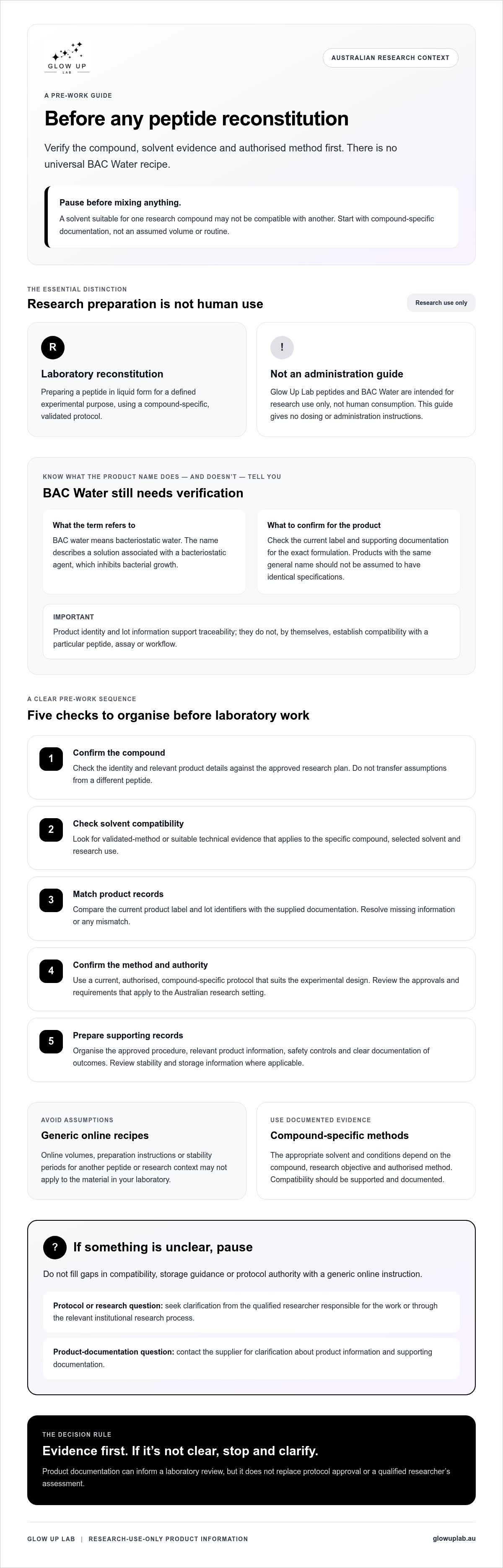
Before looking up “how to reconstitute peptides BAC water”, pause before mixing anything. A solvent that suits one research compound may not be compatible with another, and a generic online recipe can’t replace compound-specific evidence. Start with the relevant documentation, not an assumed volume or routine.
A clear, repeatable process matters when contamination, stability and incomplete records are concerns. Before laboratory work, check the peptide and BAC Water product information, confirm compatibility, and review the approvals and requirements that apply to your Australian research setting. Research-use-only products aren’t for human consumption, and product information isn’t a substitute for an approved laboratory protocol.
This guide explains what to verify before following a qualified, documented, compound-specific procedure, including supporting records, safety controls and stability information. Glow Up Lab supplies research-use-only peptides and BAC Water in Australia, with product information and supporting documentation available for review. Australian-based support can assist with product-documentation enquiries, not protocol or medical advice.
Key Takeaways
- Reconstitution is a laboratory process. BAC Water isn’t automatically compatible with every peptide or experimental design.
- Before considering how to reconstitute peptides BAC water, verify the compound identity, lot records, product labels and supporting documentation.
- Use an authorised, current, compound-specific protocol rather than relying on a generic online recipe.
- Organise the work around protocol authority, prepared records, approved procedures and clear documentation of outcomes.
- If compatibility, storage guidance or protocol authority is unclear, pause and seek clarification from a qualified institutional researcher. Contact the supplier for product-documentation questions.
What does reconstituting peptides with BAC water mean in research?
In laboratory research, reconstitution means bringing a peptide preparation into liquid form for a defined experimental purpose. It isn’t a universal procedure: the appropriate solvent and conditions depend on the compound, research objective and authorised method. Anyone researching how to reconstitute peptides BAC water should begin with compound-specific evidence, not an online recipe.
Quotable definition: Peptide reconstitution is the laboratory preparation of a peptide in liquid form, using a compound-specific, validated protocol. BAC water should be used only when that protocol and supporting evidence establish its suitability.
This is distinct from preparing a substance for administration. Glow Up Lab’s peptides and BAC Water are intended for research use only, not human consumption. This section does not provide dosing, administration or human-use guidance.
What is BAC water, and what does its product documentation establish?
BAC water refers to bacteriostatic water. Its name describes a solution associated with a bacteriostatic agent, which inhibits bacterial growth. Confirm the exact formulation of a particular product from its current label and supporting documentation. Don’t assume products with the same general name have identical specifications.
For research records, product identity and lot information help link the material used to its documentation. Before procurement or laboratory work, check that the label, lot details and available supporting records are legible, current and consistent. Record the relevant product and lot identifiers in the laboratory’s approved documentation. This supports traceability, but doesn’t by itself prove compatibility with a specific peptide, assay or workflow.
Why is there no universal peptide reconstitution recipe?
Peptides can differ in their properties, and research objectives and validated methods vary. A solvent suitable for one compound or experimental design may not be supported for another. Follow the current, authorised protocol for the specific compound and study, and make sure the compatibility evidence is documented.
Don’t transfer online volumes, preparation instructions or stability periods from one peptide to another. Information for a different compound or research context may not apply to the material in your laboratory. If the protocol doesn’t identify an appropriate solvent, or the documentation doesn’t resolve compatibility, pause and seek clarification through the relevant institutional research process.
For Australian laboratories, confirm applicable institutional, regulatory and ethics requirements before work begins. Product documentation can inform that review, but it doesn’t replace protocol approval or a qualified researcher’s assessment.
What should researchers verify before a BAC water reconstitution workflow?
Before laboratory work begins, establish that the planned method is authorised, current and supported for the specific research application. Search results and general online discussions can provide context, but they aren’t substitutes for an approved protocol. If you’re searching how to reconstitute peptides BAC water, treat missing compatibility evidence as a reason to pause, not as an invitation to fill in the gaps.
How do you assess compound and solvent compatibility?
Look for evidence from a validated method or suitable technical documentation that names the specific compound and supports the selected solvent and research use. Don’t infer compatibility from another peptide, a different supplier’s listing or an online discussion. If the evidence doesn’t clearly apply, refer the question to the qualified researcher responsible for the work before proceeding.
Use this pre-work checklist to organise the review:
- Compound: Confirm the identity and relevant product details against the approved research plan.
- Solvent: Check that the protocol or technical documentation explicitly supports the selected BAC water for this compound and application.
- Product records: Compare the current label and lot identifiers with the supplied documentation. Resolve any mismatch or missing information.
- Method: Confirm that the protocol is current, authorised and appropriate to the intended experimental design.
- People and setting: Check researcher authorisation, institutional procedures and relevant safety documentation before work starts.
Which records and approvals belong in the pre-work review?
Maintain a clear record of the product name, lot identifiers, document versions and protocol approval status. Include relevant institutional procedures and safety records, and confirm that the person conducting the work is authorised under the laboratory’s process. Check applicable Australian institutional, regulatory and ethics requirements with the appropriate authority. Requirements can depend on the work, so don’t rely on a general online summary.
For broader SOP context, consult the peptide reconstitution guide, then verify that any method you consider is approved for your specific study. The USP General Chapter <797> is a United States reference for sterile compounding. It may provide useful background, but it doesn’t replace Australian institutional requirements or approval for a research protocol.
If you need to clarify product identity or supporting information, review the relevant BAC Water product information and direct product-documentation questions to the supplier. Glow Up Lab’s products are for research use only. Supplier enquiries don’t replace qualified protocol review.
How should a documented peptide reconstitution workflow be organised?
A reliable workflow is a controlled sequence, not informal instructions copied between compounds. It begins with an approved, compound-specific protocol. The protocol should define who may perform the work, which materials are authorised and how the laboratory will assess and record the outcome.
For researchers searching how to reconstitute peptides BAC water, it’s important to distinguish understanding the workflow from carrying out a validated method. This section outlines the documentation sequence only. It doesn’t provide volumes, concentrations, transfer or mixing instructions, or administration guidance.
What belongs in a research SOP before work begins?
An SOP should set clear boundaries before work starts. It should identify the research scope, personnel responsibilities, approved materials, document-control process and relevant safety references. Qualified personnel should define protocol-specific acceptance criteria and escalation points, rather than leaving operators to interpret gaps during the work.
Keep the SOP aligned with institutional requirements and current product documentation. If a product label or supporting record changes, assess whether the applicable documents need review or revision. A general SOP should not imply that one method is suitable for every peptide or research purpose.
How should researchers document and review the work?
Prepare the recordkeeping system before approved work begins. Use the laboratory’s authorised format and terminology so entries can be reviewed consistently and linked to the relevant protocol and materials.
- Authority: Record the protocol identifier, version and approval status.
- Materials: Capture product names and relevant lot identifiers, and reference the applicable product documentation.
- Accountability: Identify the operator and date in the approved record.
- Outcome: Document observations and any deviations using the laboratory’s established process.
- Review: Route records and deviations to the designated reviewer, following institutional SOPs for assessment and follow-up.
This sequence supports traceability: verify authority, review the protocol, prepare records, conduct only the approved work, then document and review outcomes. Records should distinguish what the protocol required from what was observed, without informal edits that obscure the original entry. Handle any deviation through the institution’s established process. This article doesn’t prescribe an alternative.
Stop before work proceeds if compatibility, product identity, supporting documentation or protocol authority remains unresolved. Don’t infer an answer or proceed on an assumption. Refer the question to a qualified laboratory reviewer and follow the relevant institutional escalation pathway. Clear stop points help prevent undocumented decisions from becoming part of the method.
How can laboratories manage contamination, stability and storage risks?
Contamination control depends on more than the solvent. It requires trained personnel, suitable facilities and aseptic procedures approved for the laboratory’s work. An SOP should direct researchers to the relevant institutional training and contamination-control requirements. A general online guide to how to reconstitute peptides BAC water isn’t a substitute for local procedures.
Laboratory controls should address material handling, workspace conditions and waste management in a way that suits the approved work. The SOP should also explain how to report suspected contamination, unexpected observations or procedural deviations. Follow the laboratory’s documented escalation process, and don’t assume a material remains suitable if its status is uncertain.
Which contamination controls should a laboratory SOP address?
Confirm that personnel have the required training and that the facility is appropriate to the approved protocol. Refer to institutional procedures for workspace controls, material handling and waste management. If contamination is suspected or a deviation occurs, stop and escalate it through the laboratory’s established process. Qualified personnel should determine the appropriate response under those procedures.
How should storage and stability claims be evaluated?
Storage directions for unopened material and conditions validated after preparation aren’t interchangeable. Check the current product label for the supplied material, then consult compound-specific stability evidence and the approved protocol for any post-preparation conditions. A general rule of thumb or online shelf-life claim isn’t enough to establish suitability for a particular study.
Don’t assume storage guidance for one compound applies to another. Peptide properties, research methods and supporting evidence can differ. If documentation doesn’t specify the relevant conditions, or product information and protocol guidance appear inconsistent, pause and request a qualified review rather than estimating a storage period.
Keep the evidence used to justify storage decisions linked to the relevant compound, product lot and protocol version. This lets reviewers distinguish the manufacturer’s directions for supplied material from the laboratory’s validated conditions for prepared research material. Glow Up Lab’s BAC Water is supplied for research use only. Confirm current product details and documentation before procurement, and direct product-documentation enquiries to the supplier.
For product-selection context, see the BAC Water Australia buyer’s guide. You can also review the available BAC Water product information before considering procurement. Product information can support a laboratory review, but it doesn’t replace compound-specific stability evidence or an approved protocol.
What should you do when the protocol or BAC water documentation is unclear?
Pause the work. If the label, lot records, compatibility evidence or protocol authority is unclear, don’t proceed by filling gaps with assumptions. Resolve a missing protocol, uncertain product identity or conflicting instructions before laboratory activity continues.
When should a laboratory stop and seek qualified review?
Stop and refer the matter through the laboratory’s established review process if instructions conflict, the material can’t be confidently identified or the approved protocol is unavailable. Unresolved safety, compatibility or stability questions belong with a qualified institutional researcher or the person responsible for the study. Crowd-sourced instructions and generic calculator results can’t confirm that a method suits a specific compound or research application.
Researchers searching for how to reconstitute peptides BAC water may find different recommendations online. Treat those differences as a prompt to check the authorised protocol, not as a basis for choosing between unverified methods. Record the question and its resolution in the laboratory’s approved system so the decision can be reviewed and traced.
How can researchers assess supplier information responsibly?
Compare the product name and lot details on the label with the available supporting documents and your laboratory’s procurement requirements. Check that the records refer to the material received, and raise discrepancies with the supplier before procurement or work proceeds. Supplier documentation can help establish product identity and traceability, but it doesn’t prove that BAC Water is compatible with a particular peptide or experimental method.
For example, Glow Up Lab’s BAC Water 3mL product information can be reviewed as part of a product-documentation check. Australian-based support is a channel for product-information enquiries, not protocol decisions, medical advice or prescriptions. Direct technical questions about the research method to a qualified institutional researcher.
Keep procurement decisions separate from decisions about suitability for a study. Glow Up Lab products are intended for research use only, not human consumption. A product listing or supporting document shouldn’t be interpreted as approval for human use or as a substitute for institutional review.
Before procurement, review the relevant BAC Water product information and supporting documentation, then confirm suitability through your laboratory’s authorised process. If any key detail remains uncertain, pause and seek qualified clarification instead of proceeding on an assumption.
Make documentation the starting point for your next research workflow
The central principle is straightforward: BAC Water isn’t automatically suitable for every peptide or research design. Before work begins, confirm compound-specific compatibility, check current product and lot documentation, and follow an authorised protocol. If any detail is unclear, pause and seek qualified laboratory review rather than relying on a generic online recipe.
For researchers asking how to reconstitute peptides BAC water, a documented process matters as much as the materials selected. Record the protocol and product identifiers, follow approved contamination controls, and assess storage and stability against relevant evidence for the specific compound. Glow Up Lab’s research supplies include product information and supporting documentation; its products are for research use only, not human consumption.
Review the Glow Up Lab website and its BAC Water product information before procurement, then confirm current details with the supplier. Australian-based support and nationwide shipping are stated business features, so check their current details when needed. Product enquiries aren’t protocol or medical advice. To review BAC Water product details, visit Glow Up Lab and contact its support team with product-documentation questions.
Frequently Asked Questions
How do you reconstitute peptides with BAC water?
There’s no safe universal recipe for every research peptide. Follow an approved, compound-specific laboratory protocol and verify compatibility using relevant product information and technical documentation. This guide doesn’t provide volumes, mixing instructions, concentrations or administration directions. If the protocol or product information is incomplete, pause the work and seek qualified institutional review before proceeding. Searching “how to reconstitute peptides BAC water” doesn’t replace protocol approval or compound-specific evidence.
How much BAC water should be used for a peptide?
The appropriate amount depends on the specific compound and authorised research protocol. Don’t copy a volume from another peptide, an online post or a generic calculator, as those sources may refer to different materials or methods. Use only the amount specified in a validated, approved protocol. If the method isn’t clearly established, don’t improvise. Ask the responsible researcher or institution to clarify the procedure before laboratory work proceeds.
Can BAC water be used with every research peptide?
No. Compatibility shouldn’t be assumed across different peptides, research methods or product sources. Confirm suitability using a validated method or appropriate technical evidence for the specific research application. A product listing alone doesn’t demonstrate compatibility with every peptide or experiment. Check the current product label and supporting documentation, then compare them with the approved protocol. Glow Up Lab products are intended for research use only, not human consumption.
Does BAC water make a reconstituted peptide sterile?
Don’t assume that a solvent or preservative makes a preparation sterile or removes contamination. Any sterility claim must be supported by relevant product documentation and the laboratory’s validated procedures. Follow institutional handling and contamination-control requirements, including applicable training and approved procedures. This FAQ isn’t a substitute for training, a product label or an authorised SOP. If contamination is suspected, follow the laboratory’s documented escalation process and seek qualified review.
How long does peptide reconstituted with BAC water remain stable?
There’s no reliable shelf-life rule for every peptide. Stability depends on evidence for the specific compound, the approved protocol and documented storage conditions. Don’t apply an online duration to a different product or research method. Review current technical documentation and validated data relevant to the material and study. If those sources don’t establish appropriate conditions, ask a qualified researcher to assess the evidence before relying on a storage period.
What should I do if the BAC water label or protocol is unclear?
Pause before beginning or continuing the work. Check the product identity, lot documentation and current protocol version, then raise unresolved questions with the responsible researcher or institution. Contact the supplier for product-information questions, not protocol approval, medical advice or prescriptions. Don’t infer compatibility or handling instructions from another compound, product or informal online source. Glow Up Lab’s Australian-based support can assist with product-documentation enquiries; its products are for research use only.