

BAC Water Australia: A Research Buyer’s Guide for 2026
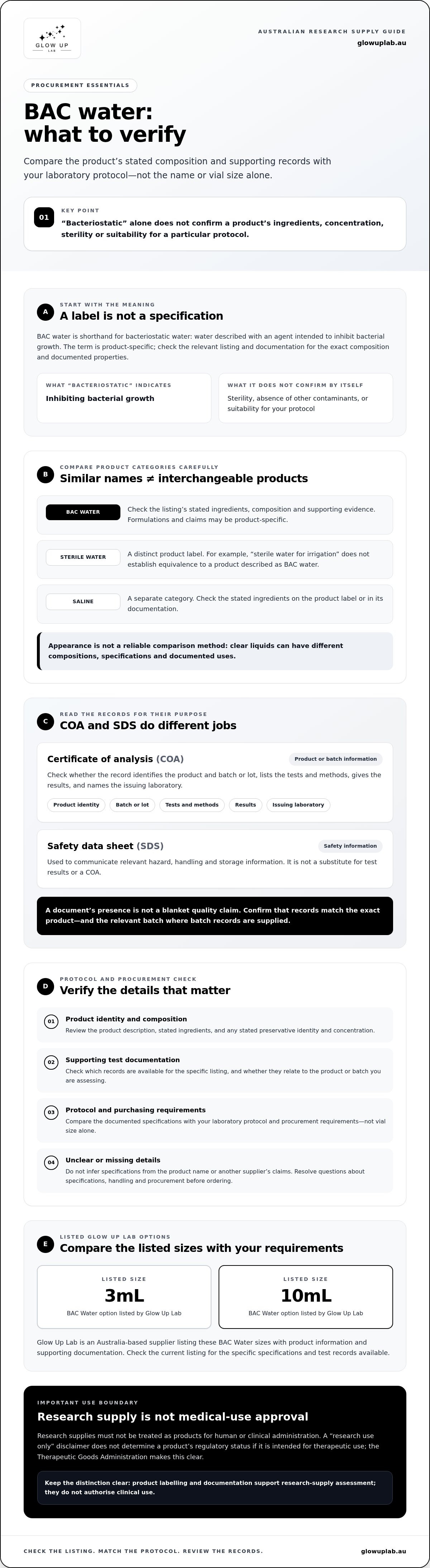
The label “bacteriostatic” alone doesn’t confirm that a vial fits your research protocol. When comparing BAC water Australia options, check the stated composition and supporting documentation rather than assuming every product is interchangeable with sterile water or saline.
Product names can sound familiar, while the specifications that matter for procurement may be less clear. This guide explains what BAC water refers to, what to verify in a product listing, and how to compare research-supply options with your laboratory protocol and purchasing requirements.
It also draws a clear boundary between research supplies and medical products. A “research use only” disclaimer doesn’t determine a product’s regulatory status if it is intended for therapeutic use, as the Therapeutic Goods Administration makes clear. Research supplies must not be treated as products for human or clinical administration.
Glow Up Lab is an Australia-based supplier listing BAC Water in 3mL and 10mL sizes, with product information and supporting documentation. The sections ahead explain what to check in each listing, including specifications and available test documentation, before procurement.
Key Takeaways
- Compare BAC water australia listings against your laboratory protocol and procurement requirements, not vial size alone.
- Check product identity, stated composition and batch traceability, then confirm which supporting test records are available for the specific listing.
- Understand the different roles of a certificate of analysis and a safety data sheet before reviewing product documentation.
- Resolve specification, handling and procurement questions before ordering. Research-use labelling does not make a product suitable for human or medical use.
- Compare Glow Up Lab’s listed 3mL and 10mL BAC Water options with your requirements, and review current product information before procurement.
What is BAC water in Australia, and what does the term mean?
BAC water is shorthand for bacteriostatic water, a label used for water formulated with an agent intended to inhibit bacterial growth. The term alone doesn’t confirm a product’s ingredients, concentration, sterility or suitability for a particular research protocol. Formulations and claims are product-specific, so check the relevant documentation rather than assuming every listing describes the same material.
Quotable definition: BAC water is a product-specific term for bacteriostatic water. Verify its exact composition and documented properties for each product.
In Australia, BAC water may appear in research-supply listings, but the term shouldn’t be read as a medical-use endorsement. Glow Up Lab supplies research-use products that are not for human consumption. The product name itself does not establish regulatory status or authorise use in a clinical setting.
What does “bacteriostatic” mean on a product listing?
“Bacteriostatic” refers to inhibiting bacterial growth. It is not the same as sterilisation and doesn’t, by itself, confirm that a product is sterile or free from other contaminants. Listing wording is not a substitute for product-specific evidence.
Check the documentation for the stated preservative identity and concentration, along with any applicable test records. Don’t assume these details or the product’s performance are identical across BAC water listings. The phrase Water for injection provides related terminology and notes that versions with bacteriostatic agents exist. It doesn’t verify the composition or intended use of a particular research-supply product.
How is BAC water different from sterile water or saline?
These labels describe different product characteristics or ingredients, so they shouldn’t be treated as interchangeable. “Sterile water for irrigation”, for example, is a distinct labelled product. Its name alone doesn’t establish equivalence to a listing described as BAC water. Saline is a separate category, so check its stated ingredients on the product label or in its documentation.
Appearance is not a reliable basis for comparison. Two clear liquids can have different compositions, specifications and documented uses. When considering BAC water Australia listings, compare the exact product information with your protocol requirements before procurement. If a listing doesn’t clearly state its composition or supporting records, ask the supplier rather than inferring details from the product name.
Which BAC water specifications and documents should Australian researchers check?
A product name is only a starting point. Before assessing a BAC water Australia listing, compare its documentation with the specifications required by your laboratory protocol and procurement process. Documents should relate to the exact product and, where batch records are supplied, the lot you’re considering.
Documentation supports assessment, but it doesn’t prove protocol suitability. Use records to check what has been stated or tested, then assess whether that evidence meets your requirements. A document’s presence alone is not a blanket quality claim.
What should a BAC water certificate of analysis show?
A certificate of analysis (COA) reports information about a product or batch. Check whether it identifies the product and batch or lot, lists the tests and methods used, gives the results, and names the issuing laboratory. Confirm that the record matches the listing rather than relying on a generic document that may refer to another item or batch.
A safety data sheet (SDS) has a different purpose: it communicates relevant hazard, handling and storage information. It isn’t a substitute for test results or a COA. Don’t assume a COA is available for a Glow Up Lab BAC Water listing unless the current listing or supporting documentation confirms it. If a required result isn’t shown, ask the supplier whether the relevant record is available.
Which claims need product-specific verification?
Check each claim against current product information. Don’t transfer another supplier’s formulation, test claims or after-opening period to a different product. In particular, verify:
- Identity and composition: product description, stated ingredients, and any preservative identity and concentration.
- Traceability and testing: batch or lot details, applicable test records, and any stated sterility or endotoxin results.
- Storage and expiry: documented storage conditions, expiry information and any after-opening instructions.
If a specification isn’t documented, treat it as unverified, not as an implied feature. For context on a separate, regulated practice, the Pharmacy Board of Australia publishes Australian sterile compounding guidelines. These guidelines concern compounding medicines; they don’t establish the specifications or suitability of a research-supply product.
Glow Up Lab provides product information and supporting documentation. Check the records for the specific listing and resolve any gaps before procurement. You can review the BAC Water 3mL listing alongside the applicable documentation, without assuming its specifications meet a particular protocol.
How can you compare BAC water sizes and supplier listings in Australia?
Compare listings with your laboratory protocol and procurement requirements, not vial size alone. Stated volume tells you how much the container holds, but doesn’t confirm composition, test status or whether the product meets your project’s requirements. Assess each BAC water Australia listing together with its supporting information.
Glow Up Lab lists BAC Water in 3mL and 10mL sizes. These are listed volumes, not recommendations. The appropriate procurement choice depends on documented project needs and your organisation’s procedures. Check current listing details and product-specific documents before deciding.
When should a researcher compare 3mL and 10mL listings?
Compare each stated volume with the quantity specified in your approved protocol and your laboratory’s purchasing controls. Don’t infer that one size is more suitable, economical or convenient from volume alone. Review the corresponding product specifications and confirm storage or handling requirements in its documentation, rather than applying instructions from another listing.
Supplier comparison checklist
| What to compare | Questions to check |
|---|---|
| Stated volume | Is the listed amount clear, and does it align with documented project and procurement requirements? |
| Specifications | Does the product information identify the item and state its composition and relevant specifications? |
| Supporting records | Are applicable records available, and do they match the product and, where relevant, the batch or lot? |
| Supplier support | Can you contact the supplier to clarify missing details before procurement? |
What makes an Australian supplier listing useful?
A useful listing clearly identifies the product, provides accessible product information and supporting documentation, and offers a way to ask questions. Australian-based support can help buyers clarify listing details, while nationwide domestic shipping can be relevant to procurement planning. Confirm current arrangements directly, and don’t assume a delivery timeframe or product availability.
Glow Up Lab provides product information and supporting documentation, with Australian-based support and secure domestic shipping as business features. Review the BAC Water 3mL product details alongside the separate 10mL listing and your laboratory’s requirements. These are research-use products, not for human consumption. A general laboratory guide may provide context, but it doesn’t replace your protocol or product-specific records.
What research-use limits and handling questions should you resolve before ordering?
Before ordering BAC water Australia supplies, follow a clear procurement sequence: define the protocol requirements, review the exact product documentation, resolve missing information, then confirm suitability through your laboratory’s approval process. This keeps product selection separate from assumptions based on a name, supplier description or clinical marketing.
Glow Up Lab supplies research-use products. They are not for human consumption or medical use, and Glow Up Lab does not provide medical advice or prescriptions. This section addresses product review and laboratory procurement only. It does not provide administration, dosing, reconstitution or clinical handling instructions.
Which questions should a laboratory resolve before procurement?
Check the listing and available records for the details your protocol and purchasing procedures require. If information is absent or unclear, pause and ask the supplier or the responsible laboratory personnel before proceeding.
- Does the product identity and stated composition match the requirement?
- Are batch or lot details and any required test records available for the specific product?
- What storage, expiry and handling conditions are stated in its current documentation?
- Have unanswered protocol or procurement questions been referred to the laboratory’s responsible personnel?
Don’t apply a storage instruction or post-opening period from another supplier’s listing. These claims are product-specific, so confirm them against the exact product documents rather than treating them as general guidance. A laboratory SOP provides context only within its documented scope. Follow your organisation’s applicable procedures and refer uncertainties to the personnel responsible for them.
Why shouldn’t medical-use claims determine a research purchase?
A supplier’s clinical wording doesn’t establish that a product is suitable for a research protocol or determine its regulatory status. Similarly, the general term “bacteriostatic” doesn’t verify the composition, test records or intended use of a particular listing. Assess product evidence and research requirements independently. If your question is medical, seek advice from an appropriately qualified professional, not a research supplier.
Glow Up Lab’s BAC Water listings are research supplies, not clinical products. Before procurement, review the current listing and supporting documents, then resolve any gaps with the supplier and your laboratory’s responsible staff. As a product-specific starting point, review the BAC Water 10mL product information against your laboratory’s procurement requirements.
Where can Australian laboratories source BAC water and what should happen next?
For BAC water Australia procurement, start with the product listing, then compare its documented details with your laboratory protocol and purchasing requirements. Glow Up Lab lists BAC Water in 3mL and 10mL sizes as research-supply options. Check each current listing and its supporting information before deciding whether it meets your requirements. Stated volume alone doesn’t establish suitability.
How do you assess an online BAC water supplier?
Look for a clearly identified product, accessible product information and a way to contact the supplier with questions. Confirm that the stated research-use purpose fits your laboratory’s requirements. Marketing language, including clinical claims, is not a substitute for reviewing product details and relevant records.
Glow Up Lab is an Australia-based supplier, with Australian-based support and secure nationwide shipping as business features. These may be relevant when planning domestic procurement, but confirm current arrangements directly rather than assuming a delivery timeframe. If a required specification or document is unclear, ask the supplier before proceeding.
What is a sensible next step for a BAC water enquiry?
Use this procurement check before placing an order:
- Review the current BAC Water 3mL and BAC Water 10mL listings.
- Compare their stated details and available supporting documents with your protocol and procurement requirements.
- Resolve information gaps with the supplier or your laboratory’s responsible personnel.
- Confirm the selected listing meets your organisation’s research-supply requirements.
Glow Up Lab’s BAC Water products are for research use only, not for human consumption or medical use. The business does not provide medical advice or prescriptions. Keep the procurement decision within your laboratory’s approved research context.
For a product-specific reference, see the BAC Water 3mL product details and compare them with the current 10mL listing and your documented requirements.
Make your next BAC water procurement decision with confidence
Choosing BAC water in Australia starts with evidence, not assumptions. Match documented product specifications and available records to your laboratory protocol and procurement requirements. A stated volume or bacteriostatic label alone can’t confirm that a product is appropriate for your research.
Glow Up Lab lists BAC Water in 3mL and 10mL sizes and provides product information and supporting documentation for review. Check the current listing and applicable documents for the exact specifications you need to verify. Australian-based support and secure nationwide shipping are also business features to consider when assessing a domestic research-supply option.
Keep the intended use clear: Glow Up Lab products are for research use only, not for human consumption or medical use. If a document, specification or procurement detail remains unclear, resolve it before proceeding.
Review Glow Up Lab BAC Water product information and compare the listed details with your laboratory’s requirements. A careful, documented assessment is a practical next step towards an informed research-supply decision.
Frequently Asked Questions
What is BAC water?
BAC water is shorthand for bacteriostatic water, a product category rather than a universal formulation. “Bacteriostatic” refers to inhibiting bacterial growth, but the term alone doesn’t confirm sterility, ingredients or other specifications. Check the exact product label and supporting documents for those details. These records help laboratories assess a listing against their requirements. Glow Up Lab products are for research use only and are not for human consumption.
Is BAC water the same as sterile water?
No. The terms describe different product attributes and shouldn’t be treated as interchangeable. A bacteriostatic label doesn’t, by itself, establish that a product is sterile. Check any sterility claim against documentation for that specific product. Don’t apply another supplier’s specifications to Glow Up Lab BAC Water. Neither label is a recommendation for medical use, and a research listing should be assessed only against laboratory requirements.
Does BAC water contain benzyl alcohol?
Some bacteriostatic water products use benzyl alcohol as a preservative, but its presence and concentration depend on the specific product. Don’t assume every BAC water listing has the same ingredients or formulation. Check the exact product label and supporting documents for stated composition and preservative details. Don’t infer Glow Up Lab’s formulation from general descriptions. Verify its current product documentation before relying on any specification.
Can BAC water be used for research peptides?
Whether a particular product is appropriate for a research project depends on the protocol, compound and product specifications. The BAC water label alone isn’t enough to establish suitability. Review the relevant product documents and refer protocol questions to the laboratory’s responsible personnel before procurement. Glow Up Lab products are for research use only, not for human consumption or medical administration. This information doesn’t provide preparation or use instructions.
How do I choose between 3mL and 10mL BAC water?
Compare the listed volume with your documented protocol and laboratory procurement requirements rather than following a general online recommendation. Glow Up Lab lists BAC Water in 3mL and 10mL sizes, but neither should be assumed to suit every project. Review current product information and supporting documents for the specific listing, and confirm unresolved procurement questions with the appropriate laboratory personnel.
How should BAC water be stored after opening?
Storage, expiry and after-opening directions depend on the specific product. Follow the label or current product documentation rather than treating a timeframe for another supplier’s product as a universal rule. Check that the instructions relate to the exact listing you have. If required information isn’t provided or is unclear, seek clarification from the supplier or your laboratory’s responsible personnel before proceeding.
Where can I buy BAC water in Australia for research?
Compare product identity, supporting documentation, research-use statements and supplier support before ordering. Glow Up Lab lists BAC Water in 3mL and 10mL sizes and serves customers nationally across Australia, with Australian-based support and secure nationwide shipping as business features. Check current listing details and available documents, then confirm they align with your laboratory’s procurement requirements. These products are for research use only, not for human consumption.