

GIP GLP-1 Agonist Research Compounds: 2026 Trends in Metabolic Science
The transition from single-receptor targets to dual-receptor synergy represents the most significant shift in metabolic research since the initial isolation of incretin hormones. For Australian laboratories, the demand for a high-quality GIP GLP-1 agonist research compound has increased as the focus moves beyond simple glucose management toward complex receptor interactions. You likely recognise that inconsistent compound purity and the absence of transparent HPLC documentation remain primary obstacles to achieving reproducible results. Reliable data relies on the integrity of the molecule, yet sourcing these materials domestically often feels like a compromise between speed and verification.
This article provides a clinical analysis of the dual-agonist landscape, specifically examining how receptor synergy influences metabolic pathways in a laboratory setting. We'll examine current standards for Australian researchers, including how to identify verified domestic sources that provide necessary Certificates of Analysis. You'll also find technical guidance on establishing stable reconstitution protocols to ensure your research materials maintain their structural integrity throughout the duration of your study.
Key Takeaways
- Understand the molecular synergy between GIP and GLP-1 receptors and how this dual agonism creates a "twincretin" effect in metabolic studies.
- Identify the latest 2026 trends in metabolic science regarding the use of a GIP GLP-1 agonist research compound within Australian laboratory environments.
- Master standardised reconstitution protocols using Bacteriostatic Water to ensure the long-term stability and structural integrity of lyophilised peptide powders.
- Evaluate the critical role of HPLC verification and Certificates of Analysis (COA) when selecting domestic suppliers to mitigate the risks of compound impurity.
- Recognise the shift from single-receptor to dual-receptor focus and how this paradigm shift requires more rigorous laboratory verification standards.
Evolution of GIP and GLP-1 Dual Agonist Research in Australia
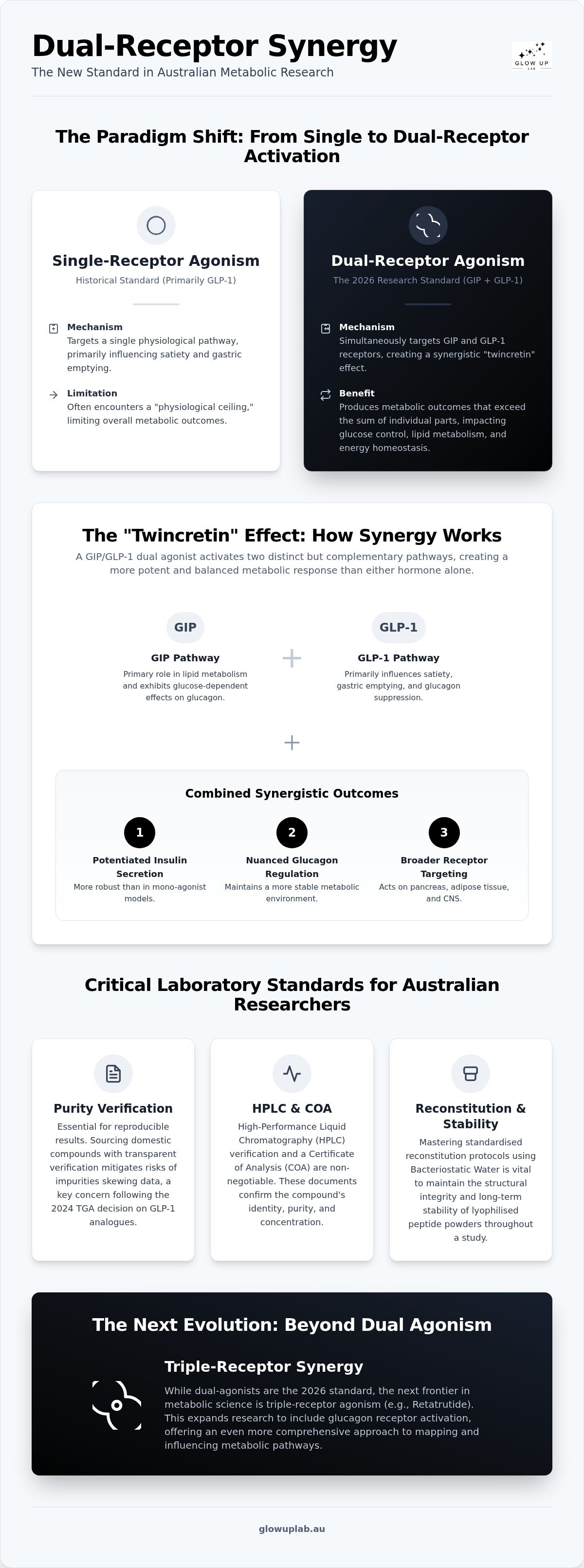
The historical focus of metabolic science in Australia has largely centred on GLP-1 mono-agonists. However, the research landscape has shifted significantly toward multi-receptor targets. GIP (Glucose-dependent Insulinotropic Polypeptide) and GLP-1 (Glucagon-Like Peptide-1) are both incretin hormones, yet they govern distinct physiological pathways. While GLP-1 primarily influences satiety and gastric emptying, GIP plays a critical role in lipid metabolism and glucagon regulation. By 2026, the use of a GIP GLP-1 agonist research compound has become the standard for investigators seeking to understand the "twincretin" effect, where dual activation produces metabolic outcomes that exceed the sum of their individual parts.
The year 2026 represents a critical juncture for Australian metabolic science. Following the 2024 TGA decision to restrict the compounding of GLP-1 analogues, the distinction between clinical branded products and high-purity laboratory compounds has become more defined. Researchers now prioritise materials that offer transparent verification to ensure that experimental results aren't skewed by impurities or degradation. Establishing reproducible laboratory data requires a commitment to these higher standards of documentation and procedural integrity.
The Molecular Rationale for Dual Agonism
Research into GLP-1 poly-agonist peptides suggests that dual activation more closely mimics the natural nutrient-stimulated hormone response. Single-receptor agonism often faces a physiological ceiling. Dual agonists bypass this by targeting receptors in both the pancreas and the central nervous system simultaneously. This synergy allows researchers to explore metabolic regulation beyond simple glucose control, focusing instead on long-term energy homeostasis and tissue-specific insulin sensitivity. Establishing reproducible data in these complex models requires peptides with verified structural integrity, such as Tirzepatide (30mg), which provides the necessary purity for high-precision laboratory analysis.
Current Research Landscape in Australian Institutions
Australian institutions are increasingly investigating dual agonists for conditions including obesity, type 2 diabetes, and neurodegenerative disorders. The 2024 regulatory changes have accelerated this transition toward standardised, HPLC-verified compounds for laboratory use. Domestic supply chains are now essential for maintaining study timelines, as international shipping often introduces variables that compromise peptide stability. Modern 2026 research standards dictate that a GIP GLP-1 agonist research compound must achieve a dual-receptor affinity that facilitates precise metabolic mapping in vivo. For researchers focused on triple-receptor synergy, Retatrutide (20mg) represents the next evolution in this field, expanding the scope of inquiry to include glucagon receptor activation.
Synergistic Mechanism: How GIP and GLP-1 Receptors Interact
The "twincretin" effect defines the functional synergy between GIP and GLP-1 receptors. While GLP-1 receptor agonists have been the focus of metabolic study for years, the addition of GIP receptor activation provides a more comprehensive approach to insulinotropic research. GIP receptors are highly expressed in pancreatic beta cells and adipose tissue, whereas GLP-1 receptors are more widely distributed across the pancreas and central nervous system. When a GIP GLP-1 agonist research compound activates both pathways, it creates a potentiation of insulin secretion that is significantly more robust than what is observed in mono-agonist models.
This dual-action mechanism also influences glucagon suppression. In laboratory subjects, GLP-1 typically inhibits glucagon secretion during hyperglycaemia. GIP, however, exhibits a glucose-dependent effect on glucagon, which helps maintain a more stable metabolic environment. These GLP-1 Medicine Trends in Australia highlight the move toward dual-target research to overcome the physiological plateaus encountered with single-receptor targets. The interaction between these two pathways allows for a more nuanced regulation of energy homeostasis, making dual agonists a primary focus for 2026 metabolic studies.
Tirzepatide as a Benchmark Research Compound
Tirzepatide serves as the primary reference for dual-agonist studies. It's a synthetic 31-amino acid peptide that shares a high degree of homology with the native GIP sequence. A defining feature of its molecular structure is the attachment of a C20 fatty diacid moiety. This side chain enables the peptide to bind reversibly to albumin, which significantly extends its half-life and stability in vitro. Researchers can examine the Tirzepatide 20mg research specifications to see how this structural integrity supports prolonged experimental windows without premature degradation. This stability is essential for maintaining consistent receptor occupancy throughout the duration of a study.
Cellular Signalling Pathways
At the cellular level, dual agonists initiate a cascade of events beginning with cAMP production and intracellular calcium mobilisation. Recent 2026 studies place a heavy emphasis on biased agonism. This concept involves the compound's ability to prefer certain intracellular signalling pathways, potentially reducing receptor internalisation and recycling. By favouring G-protein activation over beta-arrestin recruitment, the compound maintains receptor availability on the cell surface for longer periods. High-purity peptides are required to accurately observe these delicate signalling shifts. You can review verified HPLC reports to ensure your materials meet these rigorous laboratory standards before beginning your assays.
Comparative Trends: Dual vs. Single Receptor Agonism
Traditional research models relied heavily on GLP-1 mono-agonists for metabolic mapping. These compounds were effective for initial studies but often encountered a metabolic plateau where escalating the dosage failed to produce further changes in energy expenditure or lipid regulation. By contrast, a GIP GLP-1 agonist research compound enables investigators to bypass these physiological ceilings. Data-driven analysis in 2026 laboratory models indicates that dual agonism results in more robust metabolic rate changes compared to single-receptor activation. This is largely attributed to the recruitment of GIP-mediated pathways in adipose tissue, which complements the insulinotropic effects of GLP-1.
Researchers are increasingly opting for multi-agonist profiles because they offer a more comprehensive view of metabolic homeostasis. While single-receptor agonists focus on a narrow set of signalling pathways, dual agonists provide a broader data set regarding nutrient-stimulated hormone responses. This shift is essential for studies targeting complex metabolic disorders where single-pathway intervention has proven insufficient. The ability to monitor simultaneous receptor interactions allows for more precise experimental controls and more reliable longitudinal data.
Retatrutide and the Triple Agonist Frontier
While dual agonism is the current benchmark, the research frontier has moved toward triple-receptor activation. Compounds like Retatrutide add glucagon receptor agonism to the GIP and GLP-1 foundation. This inclusion is specifically designed to investigate enhanced thermogenesis and energy expenditure in laboratory models. Investigators comparing potency profiles often find that Retatrutide 10mg offers a broader scope for comparative studies than dual-agonists alone. The triple-agonist approach allows for the study of increased hepatic glucose production balanced by the insulinotropic effects of the other two receptors, providing a unique model for metabolic flux research.
Efficiency in Laboratory Models
The transition to multi-agonist profiles is also driven by laboratory efficiency. Because these compounds possess higher potency and target multiple pathways, research durations can often be reduced. Significant physiological shifts are observed in shorter experimental windows, which is vital for time-sensitive studies. The following table outlines the receptor targets across primary research compounds used in 2026 metabolic science.
| Compound Type | Receptor Targets | Primary Research Focus |
|---|---|---|
| GLP-1 Mono-agonist | GLP-1R | Insulin secretion, gastric emptying |
| GIP/GLP-1 Dual Agonist | GIPR, GLP-1R | Twincretin effect, lipid metabolism |
| GIP/GLP-1/GCG Triple Agonist | GIPR, GLP-1R, GCGR | Thermogenesis, energy expenditure |
Using a verified GIP GLP-1 agonist research compound ensures that these comparative observations are based on molecularly stable materials. To maintain these standards, researchers must prioritise compounds with documented purity. You can examine HPLC verification reports to confirm that your materials meet the necessary requirements for high-precision comparative analysis.
Laboratory Protocols: Stability and Reconstitution Standards
Maintaining the structural integrity of a GIP GLP-1 agonist research compound requires precise laboratory handling to avoid premature degradation. These peptides are supplied as lyophilised powders to ensure stability during domestic transit, but the transition to a liquid state introduces several variables that can compromise your data. Standardising your reconstitution and storage protocols is essential for achieving the high-purity results required in 2026 metabolic research. Precision is mandatory. Shaking the vial can lead to shearing of the molecular structure, rendering the compound inactive.
Reconstitution Best Practices
The goal of reconstitution is to achieve a homogenous solution without subjecting the delicate peptide chains to mechanical stress. Modern investigations using a GIP GLP-1 agonist research compound rely on these strict parameters to prevent molecular unfolding. Standardisation is key to reproducibility.
- Ensure all materials reach room temperature before beginning the process to avoid thermal shock.
- Clean the vial septums with a sterile swab to prevent cross-contamination from environmental microbes.
- Slowly introduce BAC Water 10ml by allowing the liquid to run down the interior glass wall rather than spraying the powder directly.
- Gently swirl the vial in a circular motion until the powder is fully dissolved; never shake the vial.
Consistency in this stage ensures the concentration remains uniform across multiple assays. For a deeper understanding of how to verify your starting material before you begin the reconstitution process, refer to our guide on Peptide HPLC Purity in Australia.
Stability and Degradation Monitoring
Dual-agonist peptides are sensitive to light and temperature fluctuations. Exposure to direct UV light or mechanical agitation can lead to aggregation, which often presents as turbidity or visible "floaters" in the solution. If a solution becomes cloudy or shows a significant shift in pH, it's a clear indicator of degradation. To maintain bioactivity, store reconstituted vials in a dark environment at refrigerated temperatures. If your study requires long-term storage, it's best to aliquot the solution into single-use doses. This prevents the repeated freeze-thaw cycles that can fracture the peptide's fatty acid side chains. Once reconstituted with bacteriostatic water, most dual-agonist peptides maintain optimal bioactivity for up to 28 days when stored consistently between 2°C and 8°C.
Ensuring your laboratory has the correct supplies is the first step toward experimental success. You can source high-quality bacteriostatic water and other essential research materials directly from our Australian-based facility to ensure your protocols remain standardised.
Sourcing High-Purity Research Compounds in Australia
Procuring a GIP GLP-1 agonist research compound requires a level of due diligence that extends beyond simply comparing lead times. International procurement often introduces variables that can invalidate months of laboratory work. Long transit times through varying climates lead to peptide degradation, while customs delays often result in compromised structural integrity. By choosing a domestic partner, researchers eliminate these logistical risks and gain access to transparent documentation that international vendors often withhold. Reliability in metabolic research is built on this foundation of molecular verification and supply chain stability.
Verifying Compound Purity
Verification begins with the High-Performance Liquid Chromatography (HPLC) report. This document provides a visual representation of the peptide's purity, showing the "peak" of the target molecule against any baseline noise. Researchers must also scrutinise the mass spectrometry data to confirm the molecular weight matches the theoretical value of the sequence. Contaminants such as Trifluoroacetic acid (TFA), which is a common byproduct of peptide synthesis, must be minimised to ensure the compound doesn't interfere with cellular assays. For a detailed breakdown of these metrics, you can consult our technical guide on Tirzepatide Research Peptide Australia. Accurate data is only possible when the starting material is free from these unwanted residuals.
Glow Up Lab: Your Australian Research Partner
Glow Up Lab functions as a professional facilitator for the Australian scientific community. We prioritise the provision of premium, HPLC-tested research compounds that meet the rigorous standards of 2026 metabolic science. Our commitment to transparency means that every batch is accompanied by a Certificate of Analysis (COA). This allows you to maintain the procedural integrity required for high-level metabolic mapping and longitudinal studies.
Laboratory continuity depends on a predictable supply chain. We provide secure, nationwide shipping across Australia to ensure your materials arrive in optimal condition without the risks associated with international borders. All products, including Tirzepatide (30mg) and Retatrutide (20mg), are strictly for research use only and are not for human consumption. This adherence to regulatory compliance ensures a stable and professional environment for your ongoing studies. You can view the Glow Up Lab Research Catalogue to explore our full range of verified peptides and essential laboratory supplies.
Advancing Metabolic Research Standards in 2026
The transition toward dual and triple-receptor agonism has redefined the parameters of metabolic science. Understanding the "twincretin" effect requires researchers to move beyond single-pathway models and adopt more complex investigative frameworks. Achieving reproducible data depends entirely on the stability of your starting materials. By utilising a verified GIP GLP-1 agonist research compound, investigators ensure their results are based on molecularly sound foundations rather than degraded or impure peptides.
Success in the laboratory is facilitated by strict adherence to reconstitution protocols and a reliance on transparent documentation. Choosing a domestic partner provides the logistical stability and technical support needed to maintain experimental continuity without the risks associated with international shipping. Glow Up Lab remains committed to this standard of transparency. We provide HPLC purity reports with every batch, supported by Australian-based technical assistance and secure nationwide delivery. This ensures your facility receives materials that meet the highest industry standards for purity and structural integrity.
Explore our range of HPLC-verified research compounds to support your next phase of metabolic inquiry. We look forward to facilitating your contributions to this evolving field.
Frequently Asked Questions
What is a GIP GLP-1 agonist research compound?
A GIP GLP-1 agonist research compound is a synthetic peptide designed to activate both the glucose-dependent insulinotropic polypeptide (GIP) and glucagon-like peptide-1 (GLP-1) receptors. These compounds are used in laboratory settings to study metabolic pathways, insulin secretion, and energy homeostasis. By activating two distinct receptors, researchers can observe synergistic effects that single-target agonists cannot replicate. These materials are provided in a lyophilised format to ensure molecular stability during domestic transport and storage.
How should Tirzepatide be stored in a laboratory setting?
Tirzepatide should be stored in its lyophilised powder form in a freezer at -20°C for long-term stability. Once you've reconstituted the peptide, the solution must be kept in a refrigerator at temperatures between 2°C and 8°C. It's essential to protect the vial from direct light exposure and avoid mechanical stress such as vigorous shaking. Proper storage ensures the C20 fatty diacid moiety and amino acid sequence remain intact for your metabolic assays.
What is the standard purity requirement for metabolic research peptides?
High-precision metabolic research generally requires a minimum purity level of 98% as verified by HPLC and mass spectrometry. Using compounds with lower purity introduces unknown variables and contaminants like TFA that can skew experimental data. Glow Up Lab prioritises transparency by providing HPLC purity reports for every batch. This documentation allows researchers to verify the identity and concentration of their materials before beginning complex in vitro or in vivo studies.
Can GIP GLP-1 agonists be reconstituted with sterile water?
While sterile water can dissolve these peptides, Bacteriostatic (BAC) Water is the laboratory standard for multi-use research vials. BAC water contains 0.9% benzyl alcohol, which inhibits the growth of bacteria that could otherwise degrade the peptide chains. Using BAC water ensures the GIP GLP-1 agonist research compound remains stable for up to 28 days when refrigerated. Sterile water lacks these preservative properties, making it suitable only for single-use applications where the solution is used immediately.
What are the primary differences between Tirzepatide and Retatrutide in research?
The primary difference lies in their receptor targets. Tirzepatide is a dual agonist targeting GIP and GLP-1 receptors to study the "twincretin" effect. Retatrutide is a triple agonist that adds glucagon receptor activation to the GIP and GLP-1 foundation. This additional target allows researchers to investigate enhanced thermogenesis and hepatic glucose flux. While both are used in metabolic science, Retatrutide represents the next frontier in multi-receptor research for energy expenditure studies.
Why is third-party HPLC testing critical for research compounds?
Third-party HPLC testing provides an unbiased verification of the compound's purity and molecular identity. Without this documentation, researchers risk using materials that are under-dosed or contaminated with synthesis byproducts. Verification is the foundation of reliable metabolic research, as it ensures that observed physiological changes are caused solely by the target peptide. Glow Up Lab includes these reports to provide researchers with peace of mind regarding the integrity of their starting materials.
Are these compounds intended for human consumption in Australia?
No, these compounds are strictly not for human consumption and are intended for laboratory research purposes only. In Australia, therapeutic use of these substances requires a valid prescription and TGA-approved branded products. Research peptides sold in a lyophilised format are chemical reagents designed for scientific inquiry. Using these materials outside of a controlled laboratory environment violates safety protocols and regulatory standards. All documentation provided is intended to support scientific research and data collection.
How long does nationwide shipping take for research peptides?
Glow Up Lab provides secure nationwide shipping to ensure laboratory continuity across Australia. Most orders are processed and dispatched promptly, with delivery times typically ranging from two to five business days depending on the destination. We use reliable courier services to maintain the structural integrity of the lyophilised peptides during transit. This domestic supply chain avoids the lengthy delays and temperature fluctuations often associated with international procurement and customs processing.