

Tirzepatide 30mg Laboratory Compound: A Technical Reference for Australian Research
Achieving reproducible results in metabolic research depends entirely on the verified precision of your reagents. Most Australian researchers understand that even a minor variance in peptide concentration can compromise months of data, leading to wasted resources and inconclusive findings. Precision is not optional in these environments. This technical reference provides a complete breakdown of the tirzepatide 30mg laboratory compound, focusing on HPLC-verified purity standards and rigorous stability protocols. You'll gain a clear understanding of the specifications required for high-titration studies and the logistical advantages of sourcing within Australia to avoid the uncertainties of international shipping.
We will examine the specific handling requirements, documentation expectations, and domestic logistics necessary to maintain the integrity of your study while ensuring strict adherence to laboratory compliance. This guide details the chemical profile of the 30mg variant, providing the transparency needed for informed, independent decisions in a professional setting. By the end of this technical overview, you'll have the data required to integrate this compound into your research framework with confidence in its batch consistency and procedural integrity.
Key Takeaways
- Understand the biochemical specifications of the tirzepatide 30mg laboratory compound, including its role as a dual GIP and GLP-1 receptor agonist in metabolic research.
- Identify the critical importance of HPLC verification and purity standards of at least 99% for maintaining scientific integrity and data reproducibility.
- Compare the efficiency of 30mg concentrations against 20mg alternatives to optimise titration scales and resource management in long-term studies.
- Implement precise reconstitution and storage protocols, such as the gentle swirl technique, to preserve the structural stability of lyophilised peptide compounds.
- Recognise the advantages of sourcing research materials from within Australia to ensure reliable domestic delivery and avoid the risks associated with international logistics.
Tirzepatide 30mg Laboratory Compound: Technical Profile
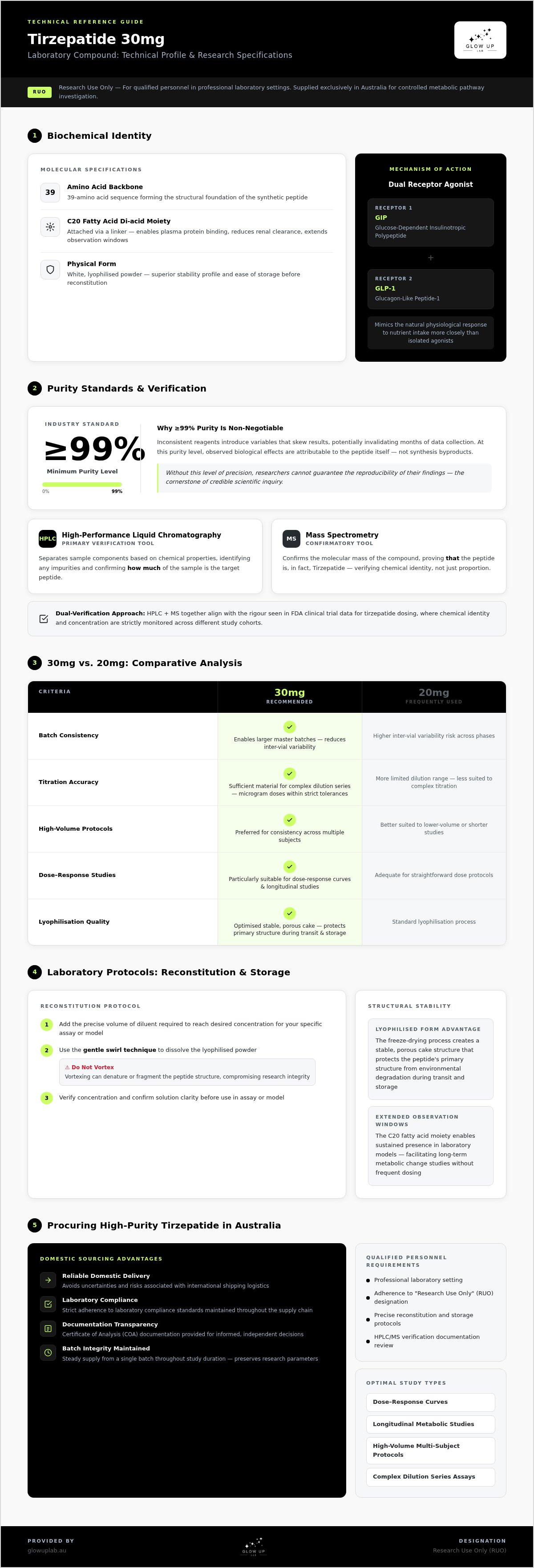
The tirzepatide 30mg laboratory compound is a synthetic peptide developed for the rigorous investigation of metabolic pathways. As a tirzepatide dual receptor agonist, it provides researchers with a unique mechanism to probe the interactions between glucose-dependent insulinotropic polypeptide (GIP) and glucagon-like peptide-1 (GLP-1) receptors. In Australia, this compound is provided exclusively for "Research Use Only" (RUO) to ensure it is handled only by qualified personnel in professional laboratory settings. It arrives as a white, lyophilised powder, a format chosen for its superior stability profile and ease of storage before reconstitution.
Molecular Structure and Research Mechanism
Tirzepatide's structure is based on a 39-amino acid backbone. It's essentially a modified GIP peptide that incorporates GLP-1 receptor agonist activity. A critical technical detail is the inclusion of a C20 fatty acid di-acid moiety attached via a linker. This side chain is vital for research involving extended observation windows; it enables the peptide to bind to plasma proteins, which reduces renal clearance. This structural design allows for a sustained presence in laboratory models, facilitating the study of long-term metabolic changes without the need for frequent dosing. The dual-pathway interaction is what differentiates this compound, as it mimics the natural physiological response to nutrient intake more closely than isolated agonists.
The 30mg Specification: Why Concentration Matters
The selection of a 30mg vial concentration provides clear benefits for specific study designs. While 20mg variants are frequently used, the 30mg specification is often preferred for high-volume protocols where consistency across multiple subjects is essential.
- Optimised Lyophilisation: The freeze-drying process creates a stable, porous cake. This protects the peptide's primary structure from environmental degradation during domestic transit and storage.
- Batch Consistency: Using a higher concentration vial allows for the preparation of larger master batches. This reduces the risk of inter-vial variability during a single experimental phase.
- Measurement Accuracy: For studies requiring precise titration, the 30mg volume provides enough material for complex dilution series. This ensures that even microgram doses stay within strict tolerance levels.
Precision in concentration remains the foundation of high-quality data. The 30mg format is particularly suitable for laboratories focused on dose-response curves or longitudinal studies. It is a choice that supports the need for a steady supply from a single batch, maintaining the integrity of the research parameters throughout the study duration. Researchers must account for the specific volume of diluent required to reach the desired concentration for their specific assay or model.
Purity Standards and HPLC Verification for Research Peptides
High purity isn't just a marketing claim; it's a fundamental scientific requirement. In laboratory settings, inconsistent reagents introduce variables that skew results, potentially invalidating months of data collection. For the tirzepatide 30mg laboratory compound, maintaining a purity level of ≥99% is the industry standard for ensuring that observed biological effects are attributable to the peptide itself rather than synthesis byproducts. Without this level of precision, researchers cannot guarantee the reproducibility of their findings, which is the cornerstone of credible scientific inquiry.
High-Performance Liquid Chromatography (HPLC) serves as the primary tool for assessing peptide purity. This process separates the components of a sample based on their chemical properties, allowing for the identification of any impurities. Complementing this is Mass Spectrometry (MS), which confirms the molecular mass of the compound. While HPLC confirms how much of the sample is the target peptide, MS proves that the peptide is, in fact, Tirzepatide. This dual-verification approach aligns with the rigour seen in FDA clinical trial data for tirzepatide dosing, where chemical identity and concentration are strictly monitored to ensure consistent results across different study cohorts.
Interpreting the Certificate of Analysis (COA)
A Certificate of Analysis (COA) is the primary document for quality assurance in a research environment. When reviewing a COA, researchers should focus on the batch number, the purity percentage, and the molecular mass verification. On an HPLC chromatogram, the "peak" represents the target peptide. A single, sharp peak indicates high purity, while secondary peaks suggest the presence of truncated sequences or isomers. You can review the latest Tirzepatide 30mg batch data directly on the product page to verify these technical specifications before starting your study.
Contaminant Screening in Peptide Synthesis
Peptide synthesis involves several reagents that must be meticulously removed during the purification phase. Trifluoroacetic acid (TFA), a common byproduct, can interfere with cellular assays if it isn't properly managed. Furthermore, residual solvents used in the manufacturing process must be eliminated to prevent toxicity in laboratory models. Endotoxin testing is another critical layer of verification, especially for studies involving sensitive biological systems where bacterial byproducts could trigger an unintended immune response. Glow Up Lab maintains procedural integrity by ensuring these contaminants are screened and documented. For researchers who value this level of transparency, sourcing from Glow Up Lab provides the documentation necessary for independent verification and peace of mind.
Comparative Analysis: Tirzepatide 30mg vs. 20mg Concentrations
Selecting the appropriate concentration is a strategic decision that affects both the logistical workflow and the financial efficiency of a project. While the chemical identity of the peptide remains constant, the tirzepatide 30mg laboratory compound offers distinct advantages for specific experimental frameworks compared to its 20mg counterpart. Choosing between these concentrations depends on the required titration schedule and the total duration of the research phase. For pilot studies or protocols involving lower-dose controls, the Tirzepatide 20mg variant remains a standard choice, providing flexibility for smaller-scale interventions where a lower total milligram count is sufficient.
Efficiency in Study Design
Long-term studies involving high-titration models benefit from the 30mg format by significantly reducing the frequency of vial changes. This minimises the potential for minor errors during the reconstitution process and ensures a more consistent supply from a single batch. Mathematically, the 30mg vial simplifies the creation of concentration gradients, especially when targeting increments of 7.5mg or 15mg. It's the optimal choice for high-efficiency metabolic research where large-scale cohorts require a steady, high-concentration reagent supply. By using the 30mg variant, laboratories can often streamline their inventory management and reduce the administrative burden of tracking numerous smaller vials.
Solubility and Reconstitution Ratios
Proper reconstitution is vital for maintaining the peptide's structural integrity. When using a 30mg vial, researchers must calculate the volume of BAC Water 10ml required to reach the target molarity. While a 30mg lyophilised cake contains more material, it doesn't typically exhibit a slower solubility rate provided the freeze-drying process was executed correctly. Standard laboratory protocols suggest that higher concentrations require careful attention to the diluent volume. For instance, adding 3ml of bacteriostatic water to a 30mg vial results in a 10mg/ml solution. This concentration is often more manageable for automated dispensing systems than the more dilute solutions often derived from 20mg vials.
Cost-efficiency is another factor that shouldn't be overlooked. Sourcing the 30mg variant usually results in a lower cost per milligram. This reduction in the overall project budget allows for either a larger sample size or a longer study duration, both of which enhance the statistical power of the research. When managing limited grant funding, these marginal gains in efficiency can be the difference between a completed study and a stalled project. Researchers should assess their specific titration requirements to determine which concentration aligns best with their experimental timeline and budgetary constraints.
Laboratory Protocols: Reconstitution and Storage Stability
Maintaining the structural integrity of the tirzepatide 30mg laboratory compound requires precise adherence to handling protocols. Peptides are inherently fragile molecules; the specific peptide bonds and the C20 fatty acid side chain are susceptible to degradation if exposed to mechanical stress or thermal fluctuations. Proper preparation ensures that the compound remains biologically active throughout the research cycle, preventing the loss of valuable material and ensuring the validity of your data.
Reconstitution Best Practices
Reconstitution must be performed using a strict aseptic technique within a controlled environment. Before beginning, ensure the vial and the diluent have reached room temperature. For high-concentration research applications, using BAC Water 3ml allows for a potent solution while maintaining a manageable volume for micro-dosing protocols.
- Clean the rubber stopper of both the peptide vial and the bacteriostatic water with an isopropyl alcohol swab.
- Introduce the diluent slowly by aiming the needle at the side of the glass vial. This allows the liquid to trickle down the wall rather than splashing directly onto the lyophilised cake.
- Once the liquid is added, use a gentle swirl technique. Never shake the vial, as vigorous agitation causes peptide shearing and denaturation.
- Wait for the powder to dissolve completely. A successful reconstitution results in a clear, colourless solution free of particulates or cloudiness.
Maintaining Stability in the Australian Climate
The Australian environment presents unique challenges for peptide stability, particularly regarding ambient temperature and UV exposure. Lyophilised powder is most stable when stored in a laboratory freezer at -20°C. At this temperature, the compound can maintain its integrity for extended periods, provided the vacuum seal remains intact. This prevents moisture ingress and oxidative stress on the amino acid sequence.
Once reconstituted, the compound is significantly more vulnerable. It must be stored in a refrigerator maintained between 2°C and 8°C. Even under these conditions, the shelf-life of a liquid peptide is limited; most studies suggest using the solution within 28 days to avoid potency loss. Light exposure also poses a risk to peptide bond integrity. Reconstituted vials should be kept in their original packaging or an opaque container to shield them from direct laboratory lighting. Breaching the vacuum seal introduces atmospheric oxygen, which accelerates the degradation process. For laboratories requiring a consistent supply of high-purity reagents, you can order the tirzepatide 30mg compound directly from our domestic inventory to ensure minimal transit time and optimal handling.
Procuring High-Purity Tirzepatide 30mg in Australia
Procuring the tirzepatide 30mg laboratory compound within Australia eliminates the logistical variables often associated with international procurement. When laboratories rely on overseas vendors, they face the inherent risk of customs seizures. These delays can compromise research timelines and result in the loss of sensitive materials. Domestic shipping provides a secure and predictable alternative. Nationwide delivery ensures that reagents reach their destination quickly, which is essential for meeting urgent project milestones. This speed is matched by the availability of professional support for technical inquiries. Researchers can resolve procedural questions without navigating different time zones or language barriers.
Navigating Domestic Supply Chains
Domestic sourcing isn't just about speed; it's about reliability. Australian researchers require a supply chain that understands local regulatory requirements and laboratory standards. By choosing a domestic partner, labs avoid the uncertainty of international transit conditions, such as improper temperature management during long-haul flights. Secure, nationwide delivery ensures that the 30mg concentration arrives in its stable, lyophilised state, ready for immediate reconstitution according to the protocols outlined in previous sections. This logistical efficiency allows for better resource allocation. It also ensures that batch consistency is maintained across the entire study period, which is vital for longitudinal data integrity.
The Glow Up Lab Commitment to Research
Glow Up Lab operates as a professional facilitator for the Australian scientific community. The focus remains on transparency and procedural integrity. Every batch of the tirzepatide 30mg laboratory compound is backed by the HPLC verification necessary to ensure data reproducibility. This commitment to documentation supports the independent decision-making process for laboratory managers and principal investigators. For a broader perspective on the industry's technical direction, researchers can review the Tirzepatide Research Peptide Australia Pillar. This resource provides a comprehensive technical overview of the compound's evolving role in metabolic studies.
Strict adherence to the "Research Use Only" (RUO) framework is the foundation of our service. This designation ensures that the compound is utilised strictly for in vitro or animal models within professional settings. It's a commitment to regulatory awareness that ensures all laboratory activities remain compliant with Australian standards. Laboratories ready to secure verified materials can procure Tirzepatide 30mg directly from our domestic inventory, ensuring a seamless transition from procurement to active experimentation. Our streamlined process is designed to support the precision and pace of modern Australian research.
Advancing Precision in Australian Metabolic Research
Maintaining the integrity of metabolic studies requires consistent access to verified reagents. This technical reference has detailed the biochemical profile of the tirzepatide 30mg laboratory compound; emphasising the necessity of HPLC-verified purity and rigorous reconstitution protocols. By prioritising batch transparency and domestic logistics; researchers can eliminate the uncertainties of international supply chains and focus on generating reproducible data. It's clear that selecting the 30mg concentration provides the efficiency needed for high-titration protocols while ensuring procedural compliance within Australian laboratory frameworks.
Glow Up Lab serves as a dedicated partner by providing HPLC-verified purity; secure Australia-wide shipping; and clinical-grade research documentation. These standards ensure that your focus doesn't shift from scientific discovery to logistical variables. You can procure Tirzepatide 30mg for your laboratory research today to secure a reliable supply for your next study phase. We look forward to supporting your contribution to the Australian scientific community with the precision your work demands.
Frequently Asked Questions
What is the exact purity of the Tirzepatide 30mg laboratory compound?
The tirzepatide 30mg laboratory compound is provided with a purity level of 99% or higher. Every batch undergoes rigorous High-Performance Liquid Chromatography (HPLC) testing to ensure it meets these professional standards. This level of verification is essential for maintaining the integrity of metabolic research data. Researchers can access batch-specific documentation to confirm the chemical identity and purity percentage before starting their experimental protocols, ensuring consistent results across all study phases.
Is Tirzepatide 30mg suitable for human consumption or clinical use?
No, this compound is strictly for Research Use Only (RUO). It isn't intended for human consumption, therapeutic use, or clinical applications. Glow Up Lab does not provide medical advice or prescriptions. The compound is designated for in vitro or animal models within a professional laboratory environment. Handling must be performed by qualified personnel who understand the technical requirements and safety protocols necessary for working with synthetic peptides in a research capacity.
How should I store the 30mg Tirzepatide vial upon arrival?
Upon arrival, store the lyophilised powder in a laboratory freezer at -20°C for long-term stability. This prevents degradation of the peptide sequence and maintains the compound's potency. If the vial is reconstituted, it must be stored in a refrigerator between 2°C and 8°C. Keep the vial in an opaque container to protect it from light exposure. Ensuring these temperature controls are met is vital for preserving the structural integrity of the peptide bonds.
What is the recommended volume of BAC water for reconstituting 30mg?
The volume of Bacteriostatic (BAC) water depends on your specific target concentration. For a standard 10mg/ml concentration, researchers typically use 3ml of BAC water for a 30mg vial. Glow Up Lab provides BAC Water (3mL) and BAC Water (10mL) variants to facilitate this process. Always introduce the diluent slowly along the side of the vial and use a gentle swirl technique to ensure the lyophilised powder dissolves without mechanical stress or shearing.
Does Glow Up Lab provide HPLC reports for every batch of Tirzepatide?
Yes, Glow Up Lab prioritises transparency by providing batch-specific HPLC and Mass Spectrometry (MS) reports. These documents verify the purity and molecular mass of the tirzepatide 30mg laboratory compound. Accessing this data allows researchers to make independent, informed decisions regarding their reagents. Providing this documentation is a core part of our commitment to procedural integrity. It ensures that every laboratory has the necessary tools to validate their findings and maintain high scientific standards.
Can I buy Tirzepatide 30mg for research purposes anywhere in Australia?
Yes, you can procure high-purity tirzepatide for research purposes across all Australian states and territories. Glow Up Lab provides secure, nationwide shipping from our domestic inventory. This eliminates the risks of customs seizures or long lead times associated with international vendors. Our supply chain is designed to support the Australian research community with reliable access to essential peptides. Domestic sourcing ensures that sensitive materials spend less time in transit, reducing the risk of thermal degradation.
What is the difference between Tirzepatide 30mg and Retatrutide for research?
Tirzepatide is a dual agonist that targets GIP and GLP-1 receptors. In contrast, Retatrutide is a triple agonist that interacts with GIP, GLP-1, and glucagon receptors. Glow Up Lab offers both Tirzepatide (30mg) and Retatrutide (20mg) for comparative metabolic studies. While Tirzepatide mimics natural physiological responses to nutrient intake, Retatrutide's additional glucagon receptor activity provides a different pathway for investigating energy expenditure. The choice between them depends on the specific metabolic mechanisms your study aims to explore.
How long does nationwide shipping take for research compounds?
Nationwide shipping within Australia is typically efficient, with most orders arriving within a few business days. Because we ship domestically, labs don't have to wait for international customs clearance or navigate complex import regulations. This speed is critical for maintaining research momentum and hitting project milestones. We use secure, trackable delivery services to ensure that your materials are handled professionally from our facility to your laboratory, providing peace of mind throughout the procurement process.