

Glow Up Lab Quality Assurance: Standards for Australian Research Peptides
In the pursuit of scientific precision, a certificate of analysis shouldn't be a luxury, yet many researchers still struggle with opaque data and inconsistent batch quality. You likely understand that the validity of any study depends entirely on the purity of the compounds used. Maintaining Glow Up Lab quality assurance means prioritising transparency and technical verification over marketing claims. We recognise the frustration of navigating international suppliers who offer little in the way of accessible HPLC data or compound stability during transit, particularly as regulatory focus on unapproved peptides increases.
This article details the rigorous verification protocols and analytical documentation that underpin our commitment to research integrity. You'll gain a clear understanding of our HPLC-verified standards, specific storage and handling protocols, and how our Australian-based support facilitates a more reliable research environment. From mass spectrometry verification to meticulous procedural integrity, we've organised our operations to ensure your laboratory receives compounds that meet the highest professional standards for research use.
Key Takeaways
- Understand why standardised verification protocols are essential for ensuring the integrity and reproducibility of your research data.
- Learn how to interpret HPLC and Mass Spectrometry results to distinguish between marketing claims and verified analytical purity.
- Master professional storage and handling protocols to prevent peptide bond degradation and ensure long-term compound stability in a laboratory setting.
- Discover how Glow Up Lab quality assurance protocols provide a transparent framework for sourcing high-purity, Australian-verified research peptides.
- Identify the logistical benefits of Australian-based technical support and secure nationwide distribution for maintaining research continuity.
Defining Quality Assurance in the Australian Research Peptide Sector
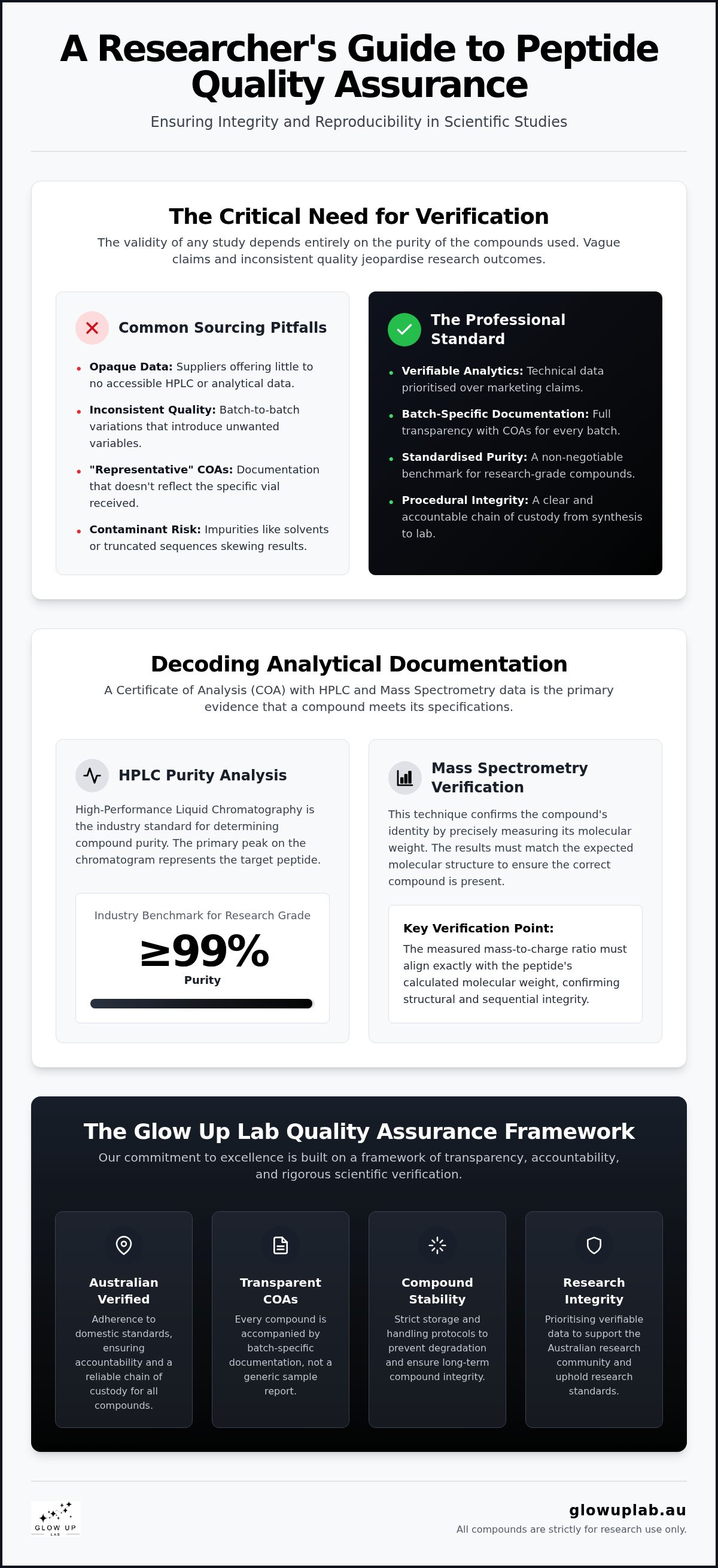
Quality assurance within the Australian research peptide sector serves as the technical foundation for reproducible data. It's not merely a marketing claim; it's a procedural requirement that ensures compound integrity remains uncompromised from synthesis to delivery. Glow Up Lab quality assurance focuses on providing researchers with verifiable analytical data rather than subjective commercial promises. By distinguishing between marketing "purity" and analytical "purity", we provide the transparency necessary for high-stakes laboratory environments. Domestic procurement within Australia requires a level of accountability that international vendors often bypass. We prioritise procedural integrity by ensuring all compounds are accompanied by batch-specific documentation, eliminating the guesswork associated with "representative" COAs that don't reflect the actual vial in the researcher's hand.
The Critical Role of Purity in Compound Integrity
The industry benchmark for research compounds is 99% purity. Anything below this threshold introduces variables that can invalidate metabolic studies or lead to unpredictable cellular responses. Impurities often include residual solvents, salts, or truncated peptide sequences. These contaminants can skew results by interacting with biological assays in unintended ways. Precision is non-negotiable. Without a standardised approach to verification, the risk of data contamination increases significantly, potentially wasting months of laboratory resources. For Tirzepatide research, analytical purity must exceed 99% to ensure that observations regarding dual agonist activity are not confounded by synthesis byproducts. Maintaining these levels requires rigorous testing of every batch, ensuring that the chemical profile matches the expected molecular weight and sequence precisely.
Why Sourcing Standards Matter for Reliable Data
Sourcing standards directly impact research credibility. Relying on unverified international suppliers often leads to a lack of documentation or inconsistent batch quality. Maintaining a consistent chain of custody is vital for laboratory procurement within Australia. This process involves the use of High-Performance Liquid Chromatography (HPLC) to confirm the identity and purity of every compound. By utilising local standards, researchers can access compounds like Retatrutide (20mg) or Tirzepatide (30mg) with the confidence that the materials have been handled according to strict professional protocols. Supplier transparency isn't just about providing a document; it's about the reliability of the data contained within that document. When sourcing for "Research Use Only" purposes, the ethical framework of the supplier must match the precision required by the scientist. This commitment to standards ensures that the focus remains on the research outcomes rather than the stability of the materials being tested.
Decoding Documentation: HPLC and Mass Spectrometry Verification
A Certificate of Analysis (COA) is a prerequisite for any professional laboratory purchase. It serves as the primary evidence that a compound meets its stated specifications and hasn't degraded. Glow Up Lab quality assurance relies on these analytical reports to bridge the gap between procurement and application. Without batch-specific documentation, researchers are effectively operating without a baseline, which contradicts the Australian Code for the Responsible Conduct of Research. We ensure that every document provided is not a representative sample but a direct reflection of the current inventory, allowing for full transparency in the sourcing process.
Interpreting an HPLC Purity Report
High-Performance Liquid Chromatography (HPLC) is the industry standard for determining compound purity. Reviewers focus on the main peak on the chromatogram, which represents the target peptide. Purity is calculated by the area under the curve (AUC) for this peak relative to the total area of all detected peaks. When analysing these reports, it's essential to consider the following:
- Primary Peak: This should account for at least 99% of the total area to meet research-grade standards.
- Baseline Noise: Minor fluctuations are expected, but they must be distinguished from significant impurities.
- Date and Batch: Always cross-reference these details to ensure the data matches your specific vial's batch number.
Identifying additional significant peaks is vital for preventing contaminants from influencing metabolic pathways or cellular assays. If a report lacks a clear date or batch number, the integrity of the data cannot be verified.
Identity Verification via Mass Spectrometry
Mass Spectrometry (MS) confirms the molecular identity and weight of the substance. This ensures the compound is exactly what is labelled, such as Retatrutide (20mg), and not a different peptide with a similar chromatographic profile. The spectrum must show a molecular ion peak aligning with the theoretical mass specifications of the peptide. We utilise third-party verification to maintain unbiased results and provide researchers with the ability to examine these specifications for each batch to ensure data integrity.
Batch-specific documentation is the cornerstone of our procedural integrity. We don't rely on outdated reports or generic templates. Every researcher receives access to the precise analytical data for their specific materials. This transparency allows for independent verification and ensures that your laboratory protocols are based on confirmed chemical properties. By providing this level of detail, Glow Up Lab quality assurance facilitates a higher standard of research within the Australian scientific community and eliminates the risks associated with unverified supply chains.
Maintaining Compound Stability: Storage and Handling Protocols
The chemical stability of research peptides is highly dependent on environmental variables. Peptide bonds are inherently susceptible to hydrolysis and oxidation, particularly when exposed to fluctuating temperatures or ultraviolet light. Glow Up Lab quality assurance protocols extend beyond analytical verification to include the logistical standards required for maintaining compound integrity during transit. In the Australian climate, where ambient temperatures often exceed the stability thresholds for sensitive biological materials, temperature-controlled logistics are essential. High-purity compounds require a consistent thermal environment to prevent premature degradation before they reach the laboratory. Managing the transition from secure shipping to internal storage is a critical phase that requires precise procedural adherence.
Temperature Control and Environmental Factors
Preserving the structural integrity of a peptide requires strict adherence to specific temperature ranges. Lyophilised powders are generally stable at 2 to 8 degrees Celsius for short-term storage, but long-term preservation in a laboratory setting often requires temperatures of -20 degrees Celsius or lower to maintain maximum stability. Once a compound is reconstituted, its stability window narrows significantly. Reconstituted solutions must be stored at 2 to 8 degrees Celsius and used within a defined period to avoid potency loss. Light sensitivity is another critical factor; exposure to direct light can initiate photochemical reactions that alter the peptide's primary structure. Vials should be kept in original packaging or dark storage containers. Additionally, ensuring desiccation is vital, as moisture can facilitate microbial growth or chemical breakdown. For researchers requiring bacteriostatic integrity during their studies, using BAC Water 10ml provides the necessary environment to inhibit bacterial proliferation in reconstituted solutions.
Standard Operating Procedures for Post-Delivery Handling
The transition from secure shipping to internal storage is a critical phase in the research lifecycle. Upon receiving a nationwide delivery, researchers should conduct an initial inspection to verify vial integrity and batch numbers against the provided documentation. Organising inventory using a "first-in, first-out" (FIFO) system ensures that compounds are used according to their synthesis dates, maintaining a consistent quality profile across different study phases. This methodical approach minimises the risk of using aged materials that may have undergone subtle structural changes. Improper storage conditions, such as exposure to ambient temperatures or UV light, lead to the irreversible cleavage of peptide bonds and a significant loss of compound potency. By integrating these handling procedures with Glow Up Lab quality assurance standards, laboratories can ensure that their research data remains accurate and reproducible, free from the variables introduced by compound degradation.
Navigating Regulatory Compliance and Research Standards
Regulatory compliance is the framework that ensures research integrity. In Australia, the Therapeutic Goods Administration (TGA) has significantly increased its focus on the supply and advertising of unapproved peptides as of June 2026. This heightened scrutiny means that adhering to "Research Use Only" (RUO) protocols isn't just a preference; it's a legal necessity. Glow Up Lab quality assurance is built on this foundation of compliance. We ensure that every compound is strictly categorised for laboratory use, providing the technical data required for institutional oversight. Transparency in labelling is a non-negotiable marker of quality. It provides researchers with the clarity needed to maintain their own ethical and professional standards.
The Research Use Only Mandate in Australia
The distinction between laboratory research and clinical applications is definitive. RUO compounds are intended for in vitro or animal studies within controlled environments. They aren't evaluated by the TGA for safety or efficacy in humans. Researchers hold the responsibility for ensuring that their use of these materials aligns with institutional ethics committee requirements and Australian law. We maintain strict alignment with these protocols by providing products like Tirzepatide (20mg) specifically for these validated research purposes. This clarity prevents the obfuscation often seen with international vendors who may lack awareness of the local regulatory landscape. Adhering to these boundaries protects the integrity of the scientific process and ensures that research remains within its intended scope.
Ethical Sourcing and Procedural Transparency
Ethical sourcing involves a commitment to clear communication throughout the supply chain. Many international suppliers fail to provide accurate product origins or batch-specific purity data, which creates significant risks for domestic researchers. Building trust requires a consistent delivery of documentation and professional support. Glow Up Lab quality assurance prioritises this transparency by ensuring that technical laboratory enquiries are handled by an Australian-based team. We avoid the commercial hyperbole that characterises much of the global peptide market, focusing instead on the provision of HPLC and MS data. This methodical approach allows researchers to make informed decisions without being misled by vague quality claims. Supporting legitimate research requires more than just supplying a vial; it involves providing the analytical tools and regulatory context necessary for a successful study. You can access our full range of research-grade compounds and technical documentation to support your laboratory's objectives.
The Glow Up Lab Framework: Our Commitment to Excellence
The Glow Up Lab framework integrates every stage of the supply process to ensure compound integrity remains uncompromised. From the initial point of sourcing to the final nationwide shipping, each step is governed by specific procedural standards that prioritise data over marketing. Glow Up Lab quality assurance isn't a static set of rules; it's a dynamic system of integrated quality control that removes the variables often encountered when dealing with fragmented international supply chains. By maintaining oversight of the entire logistics path, we ensure that researchers receive materials that haven't been compromised by environmental exposure or administrative oversight. Streamlining the procurement of high-demand compounds like Tirzepatide (30mg) allows laboratories to maintain their research timelines without sacrificing analytical certainty.
Professional Support for Australian Research Institutions
Accessing technical assistance shouldn't be a hurdle in the scientific process. Our framework provides direct access to professional support for technical laboratory enquiries regarding compound specifications and purity profiles. Having an Australian-based team means that communication is clear, time-efficient, and aligned with local research standards. One of the primary benefits of domestic logistics is the ability to maintain a robust cold chain, which is often a point of failure for international imports. Researchers can request specific batch documentation for their projects through our professional support channels, ensuring that every vial used in a study is backed by verified data. This level of accessibility fosters a collaborative environment where technical precision is the priority.
A Future-Centred Approach to Research Supply
Investing in transparency is the most effective way to elevate the Australian research landscape. We focus on continuous process improvement by integrating researcher feedback and evolving industry standards into our quality control measures. This commitment extends to the careful expansion of our catalogue, introducing verified compounds such as Cagrilintide (10mg) only after they meet our rigorous verification criteria. By prioritising documentation and analytical integrity, we provide a reliable alternative to unverified vendors. Our framework is designed to evolve alongside the requirements of the scientific community, ensuring long-term stability for Australian laboratories. Learn more in our Tirzepatide Research Peptide Australia: A 2026 Technical Overview to understand the broader context of these standards.
Advancing Research Integrity with Verified Standards
Maintaining rigorous standards in laboratory procurement ensures that your data remains reproducible and credible. You've seen how analytical verification through HPLC and Mass Spectrometry serves as the technical backbone for every compound we provide. Glow Up Lab quality assurance isn't just about the initial synthesis; it encompasses the entire lifecycle of the peptide, from temperature-controlled logistics to batch-specific documentation. By prioritising clinical transparency and secure Australia-wide shipping, we've eliminated the uncertainty often associated with international supply chains.
Reliable research depends on compounds that haven't been compromised by environmental factors or opaque sourcing practices. Our framework supports your laboratory's objectives by providing the professional support and analytical certainty required for high-stakes studies. When you choose a partner committed to these procedural standards, you're investing in the longevity and accuracy of your scientific work. View our HPLC-verified research catalogue to access premium materials for your next project. We're ready to help you facilitate research precision with confidence.
Frequently Asked Questions
How does Glow Up Lab ensure the purity of its research peptides?
We use a multi-stage verification process that includes HPLC and Mass Spectrometry for every batch. This procedural integrity ensures that compounds like Tirzepatide (30mg) meet the 99% purity benchmark. Glow Up Lab quality assurance focuses on providing analytical documentation rather than vague commercial claims. By maintaining a transparent chain of custody, we ensure that the chemical profile matches the expected molecular sequence for all research materials in our catalogue.
Can I request a Certificate of Analysis (COA) for my specific batch?
Yes, batch-specific documentation is a standard component of our service. We provide detailed COAs that include HPLC and Mass Spectrometry data for the exact materials you receive. This level of transparency allows researchers to verify the purity and molecular weight of their compounds before beginning laboratory assays. Providing these documents is a core part of Glow Up Lab quality assurance, ensuring that your research is supported by verifiable technical data.
What is the difference between HPLC and Mass Spectrometry in quality testing?
HPLC determines the purity of a compound by separating its components and measuring the primary peak's area relative to impurities. In contrast, Mass Spectrometry verifies the molecular identity and weight, ensuring the substance is chemically identical to the target peptide. While HPLC confirms that a compound is 99% pure, Mass Spectrometry proves that the 99% is actually the intended peptide, such as Retatrutide (20mg), rather than a lookalike substance.
How should I store my compounds to ensure they remain stable for research?
Lyophilised powders should be stored at 2 to 8 degrees Celsius for short-term use; however, long-term preservation requires temperatures of -20 degrees Celsius or lower. Once you reconstitute a compound with BAC Water (10mL), it must be kept refrigerated at 2 to 8 degrees Celsius and used within its stability window. Vials should also be protected from direct light and moisture to prevent the premature degradation of sensitive peptide bonds during your study.
Are Glow Up Lab products intended for human or veterinary consumption?
No, all products in our catalogue are strictly for Research Use Only (RUO). They aren't intended for human or veterinary consumption, nor are they approved for clinical applications. Our compounds are supplied for in vitro laboratory research and animal studies conducted under institutional oversight. We don't provide medical advice or prescriptions, as our role is to facilitate scientific precision by supplying high-purity chemical materials for experimental use.
How does nationwide shipping in Australia impact compound quality?
We use secure, discreet nationwide shipping protocols designed to maintain compound stability during transit. Since environmental factors like heat and UV light can degrade peptide bonds, our logistical framework prioritises speed and protective packaging. While lyophilised powders are relatively stable during short transit periods, we ensure that materials are handled with the care required to reach your laboratory in their original, high-purity state, regardless of your location within Australia.
Why is third-party testing important for research compounds?
Third-party testing provides an unbiased, independent verification of a supplier's quality claims. It ensures that the HPLC and Mass Spectrometry data aren't manipulated or outdated, offering researchers peace of mind regarding the integrity of their materials. By utilising independent laboratories for our verification protocols, we provide a transparent audit trail that supports the validity of your research data and aligns with Australian standards for responsible scientific conduct.
What should I do if my research compound arrives damaged or compromised?
You should conduct an initial inspection immediately upon receiving your nationwide delivery to verify the integrity of the vials and packaging. If you suspect that a compound has been compromised or damaged during transit, please contact our professional support team with your batch details and documentation. We prioritise the reliability of your research materials and will work to ensure that your laboratory protocols aren't delayed by logistical issues or compromised supplies.