

GHK-CU Research Peptide Australia: Procurement and Laboratory Handling Guide
The distinction between a cosmetic-grade additive and a high-purity laboratory reagent is often the primary factor that determines the validity of scientific data. Many investigators in the domestic sector find it challenging to distinguish between retail-focused copper peptides and the rigorous standards required for a GHK-CU research peptide Australia. You understand that the integrity of your outcomes depends on the chemical stability and documented verification of your starting materials. Precision isn't just a preference; it's a requirement for any legitimate laboratory enquiry.
This guide provides the technical protocols required to source, verify, and handle high-purity GHK-CU research compounds within the Australian scientific landscape. You'll master the essential SOPs for managing 100mg vials, including the critical importance of HPLC and Mass Spectrometry documentation for batch verification. We'll outline how to establish a reliable domestic supply chain that ensures your materials arrive without degradation. This allows you to maintain strict compliance while focusing on achieving precise and reproducible research data through professional-grade procurement.
Key Takeaways
- Distinguish between cosmetic-grade copper peptides and high-purity GHK-CU research peptide Australia to maintain laboratory data integrity.
- Master the interpretation of HPLC and Mass Spectrometry reports to confirm the molecular identity and purity of each batch.
- Implement precise reconstitution protocols using sterile media to ensure the chemical stability of 100mg lyophilised vials.
- Apply rigorous storage standards to protect copper-peptide complexes from UV degradation and temperature sensitivity.
- Establish a secure domestic procurement strategy to mitigate international shipping risks and ensure consistent material availability.
The Research Use Only Framework for GHK-CU in Australia
The Australian regulatory landscape for biochemical research is defined by strict classifications that separate therapeutic goods from laboratory reagents. When procuring a GHK-CU research peptide Australia, investigators must operate within the Research Use Only (RUO) framework. This designation specifies that the compound is intended strictly for laboratory evaluation, in vitro studies, or animal research under approved institutional protocols. It's not intended for human therapeutic use or clinical application. The Copper peptide GHK-Cu has been the subject of extensive study since its discovery in 1973, but the transition from a theoretical model to valid data requires a high-purity starting material that meets specific analytical standards.
Research Grade vs. Cosmetic Grade: The Critical Distinction
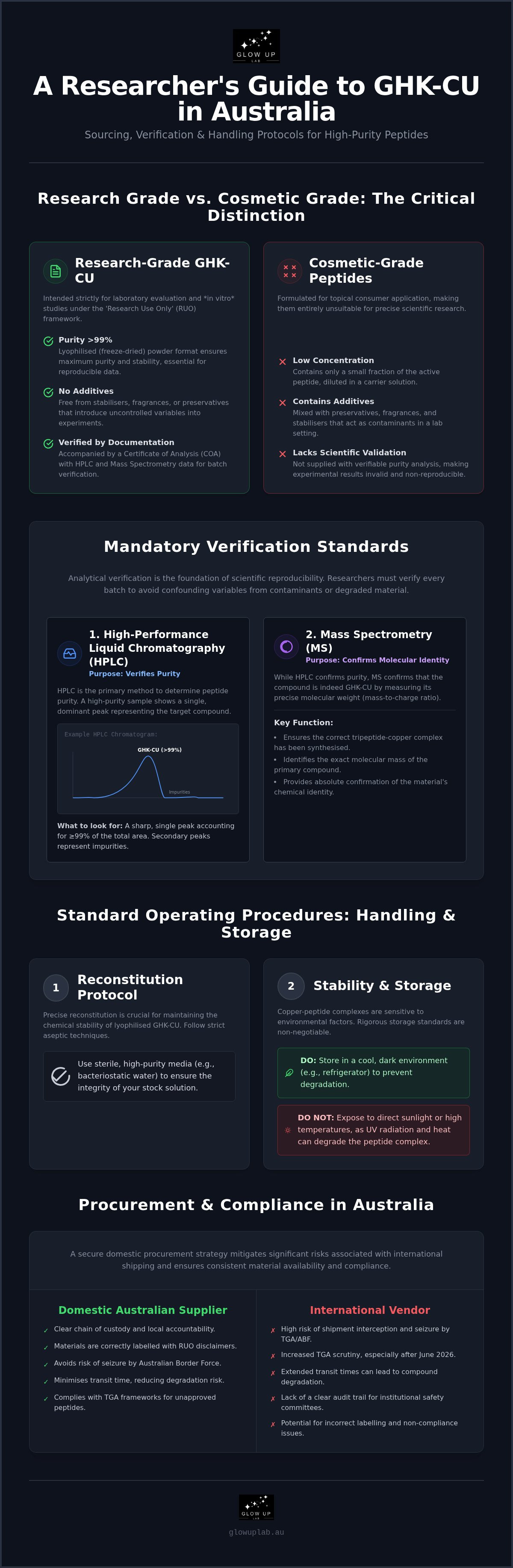
A common challenge for researchers is differentiating between retail-focused cosmetic serums and true research-grade peptides. Cosmetic formulations typically contain low concentrations of the active ingredient mixed with stabilisers, fragrances, and preservatives. These additives introduce uncontrolled variables into a laboratory environment, making them unsuitable for precise scientific work. In contrast, research-grade GHK-CU (100mg) is provided as a lyophilised powder. This format ensures a high purity level, often exceeding 99%, which is essential for maintaining the integrity of experimental results. High-concentration vials allow for efficient titration and the creation of standardised stock solutions that are free from the contaminants found in consumer products.
Australian Compliance and Sourcing Accountability
Maintaining compliance with Australian laboratory safety and chemical handling standards requires a transparent chain of custody. Sourcing materials from international vendors often involves significant risks, including seizure by the Australian Border Force or degradation during extended transit times. The Therapeutic Goods Administration (TGA) has increased its focus on the importation of unapproved peptides, making domestic procurement a more stable alternative for local institutions. As of June 2026, the TGA has formally prioritised compliance regarding unapproved peptides, which increases the likelihood of international shipments being intercepted.
By utilising a domestic supplier, researchers ensure that their materials are labelled correctly with RUO disclaimers, meeting legal requirements for possession and use within a professional setting. This local accountability simplifies the procurement process and provides a clear audit trail for institutional safety committees. Professional labs prioritise these domestic channels to ensure that every vial is accompanied by necessary documentation, such as a Certificate of Analysis (COA), which provides the peace of mind that the compound meets the required chemical specifications before research commences.
Verification Standards: Analysing HPLC and Mass Spectrometry
Analytical verification is the foundation of scientific reproducibility. It ensures that the chemical properties of a compound align precisely with the requirements of the experimental design. The Australian Department of Health has highlighted the public health risks of unapproved peptides, which underscores why researchers must verify every batch of GHK-CU research peptide Australia. High-purity reagents are essential to avoid the confounding variables introduced by contaminants or degraded material.
Reading an HPLC Report for GHK-CU
High-Performance Liquid Chromatography (HPLC) is the primary method used to determine the purity of a peptide. When reviewing a Certificate of Analysis (COA), investigators should focus on the peak area and retention time. A high-purity sample will show a single, sharp peak that accounts for at least 99% of the total area. Any secondary peaks represent impurities or synthesis byproducts that could skew your research results. HPLC verification for research-grade copper peptides serves as the definitive analytical method for quantifying the purity of the tripeptide complex by isolating it from any residual synthesis reagents. Researchers seeking documented purity can review the analytical standards for GHK-CU (100mg) to ensure their laboratory protocols remain robust.
Mass Spectrometry and Molecular Weight Confirmation
While HPLC confirms purity, Mass Spectrometry (MS) confirms molecular identity. This process measures the mass-to-charge ratio of the ions to ensure the compound matches its theoretical molecular weight. For GHK-CU, it's vital to verify the presence of the copper ion within the tripeptide structure. Without this confirmation, you cannot be certain the peptide has correctly complexed with the copper. Precise identification is a standard requirement in modern biochemistry. Just as with a Tirzepatide Research Peptide Australia: A 2026 Technical Overview, molecular confirmation is a non-negotiable step in the verification process for any high-purity compound.
Batch-to-batch consistency is the gold standard for long-term studies. Transparency in documentation allows researchers to cross-reference new shipments with previous data points. When procurement involves a GHK-CU research peptide Australia, the analytical data provided must be specific to the current batch. This level of detail provides the peace of mind that your variables remain controlled. Professional laboratories prioritise suppliers who provide these reports as a standard component of their service. It's the most reliable way to maintain the integrity of your research data over time.
Technical SOPs for GHK-CU Reconstitution
The transition from a verified lyophilised powder to a stable solution requires meticulous attention to laboratory protocol. When preparing a GHK-CU research peptide Australia, the reconstitution phase is where the structural integrity of the copper-peptide complex is most vulnerable to mechanical stress. Precision in this stage ensures that the titration used in your study remains consistent across all samples. Establishing a Standard Operating Procedure (SOP) for reconstitution is the most effective way to eliminate procedural variables that could compromise your data.
Calculating the final concentration is a primary step in the SOP. For a 100mg vial, the volume of diluent added directly determines the dose-response accuracy. For example, adding 5ml of diluent creates a 20mg/ml concentration. This high-concentration approach is often preferred for institutional research efficiency, as it allows for smaller aliquot volumes while maintaining a high molarity of the active compound. Accuracy in these calculations prevents the waste of high-purity reagents and ensures reproducibility.
Reconstitution Best Practices
Maintaining a sterile work environment is mandatory. Before starting, the work surface must be disinfected with 70% isopropyl alcohol (IPA). The vial's septum should also be swabbed. When introducing the diluent, aim the needle toward the inner wall of the vial. This allows the liquid to flow down the glass slowly rather than splashing directly onto the lyophilised cake. Rapid pressure changes or direct impact can cause foaming, which indicates air entrapment and potential denaturation of the peptide backbone. Don't shake the vial; instead, use a gentle swirling motion until the powder is completely dissolved and the solution is clear and blue.
Diluent Selection: BAC Water vs. Sterile Water
Selecting the correct diluent is vital for the longevity of your GHK-CU research peptide Australia. While sterile water is suitable for immediate, single-use applications, BAC Water 10ml is the industry standard for multi-use research vials. The 0.9% benzyl alcohol in bacteriostatic water acts as a preservative, inhibiting the growth of bacteria that could otherwise contaminate the solution over time. This is particularly important when managing a suite of compounds, such as Selank 10mg, where microbial integrity is paramount for neuropeptide research. Using a dedicated preservative ensures the chemical stability of the copper-peptide complex remains intact throughout the duration of the study.
Stability and Storage Protocols for GHK-CU 100mg
The chemical stability of a copper-peptide complex is the final pillar of research integrity. Once you've secured a high-purity GHK-CU research peptide Australia, maintaining its molecular structure through proper storage is essential. While the lyophilised form is designed for stability, it remains sensitive to environmental variables like temperature, light, and moisture. Failure to adhere to strict storage protocols can lead to peptide degradation, resulting in inconsistent experimental outcomes and compromised data accuracy.
Temperature Control and Monitoring
Standard refrigeration at 2 to 8 degrees Celsius is the minimum requirement for the short-term storage of lyophilised GHK-CU. For institutional studies spanning several months or years, deep-freeze protocols at -20 degrees Celsius are recommended to preserve the peptide's primary structure. Researchers must avoid repeated freeze-thaw cycles, as the resulting mechanical stress can break the delicate bonds within the tripeptide chain. Once reconstituted, the solution's stability window narrows significantly. Reconstituted peptides should be stored exclusively at 2 to 8 degrees Celsius and used within a specific timeframe, typically not exceeding four weeks, to ensure the concentration remains accurate. Documenting these conditions is a standard requirement for audit trails and ensures that your study can be replicated with precision.
Handling High-Concentration 100mg Vials
Managing high-concentration 100mg vials requires a systematic approach to inventory. These larger vials are ideal for large-scale studies where consistent titration across multiple samples is necessary. When managing a diverse inventory that includes other reagents like Retatrutide 10mg, clear labelling and secondary containment are vital. Vials must be protected from moisture and humidity, as the lyophilised cake is highly hygroscopic; exposure to air can lead to rapid degradation. Additionally, GHK-CU is light-sensitive. Storing vials in their original packaging or light-opaque containers prevents UV-induced breakdown of the copper-peptide complex. In Australian laboratories, researchers must also adhere to strict disposal protocols for research materials and sharps, ensuring all biohazardous waste is managed according to local safety regulations.
To maintain the highest standards of laboratory efficiency, you can secure 100mg GHK-CU research vials that are specifically batch-tested for stability and purity. Establishing these protocols from the outset allows your team to focus on data collection rather than troubleshooting material failure.
Procurement Reliability: The Glow Up Lab Standard
Reliability in the supply chain is as critical as the purity of the compound itself. For laboratories managing complex projects, procurement delays or material degradation can derail months of work. Glow Up Lab establishes a professional standard for sourcing GHK-CU research peptide Australia by prioritising transparency and logistical precision. We position ourselves as a facilitator for the scientific community; ensuring every interaction is grounded in documentation and professional accountability. This focus on procedural integrity allows researchers to bypass the uncertainties often found with international vendors and grey-market sources.
Nationwide Logistics and Secure Delivery
Peptide stability is highly dependent on transit conditions. Our logistics framework ensures temperature-stable delivery across Australia, mitigating the risks associated with the country's diverse climate. We use discreet and secure packaging designed to protect sensitive research materials from physical impact and light exposure. This systematic approach ensures that time-sensitive laboratory projects proceed without the variables introduced by inconsistent delivery timeframes or customs-related interruptions. We understand that laboratory schedules are rigid. Our domestic focus means your reagents arrive within a predictable window, allowing for better resource allocation within your facility. Every shipment is tracked to provide researchers with the visibility required for precise experiment planning.
The Glow Up Lab Commitment to Research Integrity
Transparency serves as the core of our Australian business model. We provide batch-specific HPLC and Mass Spectrometry documentation to confirm the chemical identity and purity of every vial. This commitment to documentation allows biochemists to focus on their data with the peace of mind that their reagents meet institutional standards. By providing specialised tools like GHK-CU (100mg), we support the technical needs of large-scale studies. We aim to build long-term partnerships with the Australian research community based on the predictable delivery of high-purity compounds. Our operational focus remains strictly on providing materials for research use only, ensuring full alignment with local regulatory expectations. This commitment to compliance protects the integrity of your institution's work and ensures that your laboratory protocols remain beyond reproach.
Secure your high-purity GHK-CU (100mg) from Glow Up Lab today to ensure your next study is supported by analytical excellence and reliable domestic logistics.
Advancing Research Integrity through Technical Precision
The successful evaluation of biochemical compounds depends on the rigorous application of laboratory standards. By mastering technical protocols for reconstitution and maintaining strict environmental controls, you ensure every data point reflects the true chemical potential of your sample. Securing a verified GHK-CU research peptide Australia is only the first step; the integrity of your results relies on consistent adherence to the SOPs outlined in this guide. Transparency in documentation isn't just a preference; it's the most reliable way to mitigate material failure and ensure reproducibility.
Glow Up Lab facilitates these standards by providing HPLC and Mass Spectrometry verified reagents for the Australian scientific community. Our team offers professional support and secure nationwide shipping to ensure your materials arrive in optimal condition. Establishing a reliable supply chain allows you to focus on methodology rather than reagent uncertainty. Secure your high-purity research compounds from Glow Up Lab today and advance your laboratory projects with confidence. We look forward to supporting your institutional research goals with professional service.
Frequently Asked Questions
What is the standard purity level for GHK-CU at Glow Up Lab?
Glow Up Lab provides GHK-CU with a standard purity level of ≥99%. This is verified through batch-specific HPLC analysis to ensure laboratory results remain consistent and reproducible. High-purity reagents are essential for modern biochemical studies to eliminate variables caused by synthesis byproducts. Each 100mg vial of GHK-CU research peptide Australia is tested to meet these stringent standards before being released for domestic laboratory use.
How should I store GHK-CU 100mg vials upon arrival?
Lyophilised GHK-CU powder should be stored in a refrigerator at 2 to 8 degrees Celsius for short-term use. For institutional storage exceeding several months, a deep-freeze environment at -20 degrees Celsius is recommended to maintain molecular integrity. Vials must be protected from light and moisture at all times. Once reconstituted, the peptide solution is significantly less stable and should be kept refrigerated and utilised within a four-week window for optimal data accuracy.
Can Glow Up Lab provide HPLC and Mass Spectrometry reports for GHK-CU?
Yes, Glow Up Lab prioritises transparency by providing HPLC and Mass Spectrometry documentation for its research compounds. These reports confirm the molecular identity and purity percentage of each batch, which is a standard requirement for reproducible scientific research. Investigators can request these documents to support their institutional audit trails. This level of verification ensures that the GHK-CU research peptide Australia you receive aligns precisely with your experimental specifications.
Why is BAC water preferred for GHK-CU reconstitution in a lab?
Bacteriostatic (BAC) water contains 0.9% benzyl alcohol, which acts as a preservative to inhibit microbial growth in multi-use vials. While sterile water is suitable for immediate single-use titration, BAC water is the industry standard for maintaining the sterility of a solution over several weeks. This preservation is critical for long-term studies where the integrity of the copper-peptide complex must be protected from bacterial contamination that could otherwise compromise research outcomes.
Does Glow Up Lab ship research peptides outside of Australia?
No, Glow Up Lab only provides domestic shipping within Australia to ensure a secure and reliable chain of custody. By focusing on the Australian market, we mitigate the risks of international customs delays and potential material degradation during extended transit. This domestic-only model allows us to provide nationwide logistics and professional support tailored specifically to the requirements of local research institutions and biochemical laboratories across the country.
How do I calculate the concentration of reconstituted GHK-CU?
Concentration is calculated by dividing the total mass of the peptide by the volume of diluent added. For a 100mg vial of GHK-CU, adding 5ml of BAC water results in a concentration of 20mg/ml. Researchers should use calibrated laboratory equipment to ensure the volume of diluent is exact. Accurate concentration calculation is fundamental for establishing a clear dose-response relationship and ensuring that titration remains consistent across different experimental groups.
What safety precautions are required when handling GHK-CU in a laboratory?
Standard laboratory safety protocols are mandatory, including the use of gloves, lab coats, and eye protection. All reconstitution should take place in a sterile environment, such as a laminar flow hood, to prevent contamination. Work surfaces should be disinfected with 70% isopropyl alcohol before and after handling vials. Additionally, researchers must follow Australian regulations for the disposal of biohazardous materials and sharps used during the preparation of research solutions.
Are these GHK-CU products suitable for human consumption or clinical trials?
No, all products supplied by Glow Up Lab are strictly for research use only and are not for human consumption. They have not been evaluated by the Therapeutic Goods Administration (TGA) for safety, quality, or efficacy in humans. These compounds are intended for laboratory evaluation and animal research under approved institutional protocols. Using these peptides for therapeutic purposes is a violation of current Australian regulatory frameworks for unapproved goods.