

Sourcing Research Peptides in Australia: A Professional Buyer’s Guide (2026)
How can researchers ensure the integrity of their supply chain when the TGA has made unapproved peptides a primary compliance priority for 2026? As of September 2026, the regulatory environment for sourcing research peptides australia has never been more scrutinised given their Schedule 4 classification. Professional researchers understand that the risk of customs intervention often outweighs the perceived benefits of overseas vendors. You likely recognise that inconsistent batch purity and a lack of transparent HPLC documentation can compromise the validity of sensitive laboratory protocols. Finding a reliable domestic partner is no longer just about convenience; it's about ensuring the procedural integrity of your studies through verifiable standards for research use.
This guide provides the technical framework needed to master the complexities of Australian peptide procurement with confidence. You'll learn how to manage domestic logistics to ensure secure delivery and how to interpret batch-specific COA documentation for high-purity compounds not for human consumption. We will also examine the precise specifications required for professional-grade research, including reconstitution calculations and purity verification. By the end of this guide, you'll have a clear, methodical approach to securing the high-quality materials your laboratory requires without the risks associated with international transit.
Key Takeaways
- Learn how to interpret HPLC and COA documentation to ensure every batch meets the high-purity specifications required for precise laboratory results.
- Understand the current regulatory environment for sourcing research peptides australia in 2026 to ensure your procurement remains compliant with professional standards.
- Master technical reconstitution calculations and the use of Bacteriostatic (BAC) Water to preserve the structural integrity of your research compounds.
- Evaluate the distinct properties of neuropeptides and metabolic research compounds, such as Selank and Retatrutide, to align with your specific study objectives.
- Establish a secure domestic supply chain that prioritises transparent verification and reliable nationwide delivery to avoid the risks associated with international logistics.
Navigating the Landscape of Research Peptides in Australia
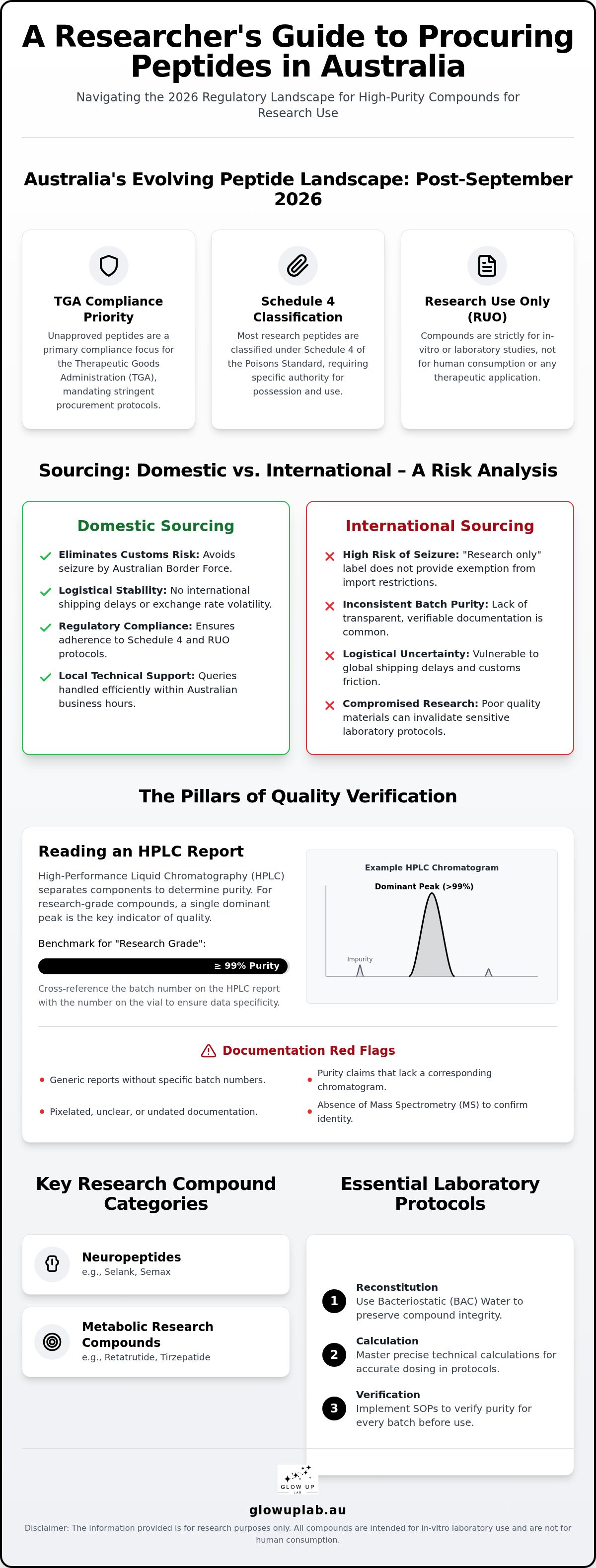
The Australian peptide market has undergone significant structural shifts as of September 2026. The Therapeutic Goods Administration (TGA) has prioritised the monitoring of unapproved peptides, making precise procurement protocols essential for domestic laboratories. Research Use Only (RUO) standards dictate that these compounds are intended strictly for in-vitro or laboratory-based studies. They aren't for human consumption or therapeutic application. Understanding this distinction is the first step in sourcing research peptides australia while maintaining institutional compliance.
Modern Peptide Synthesis Methods allow for high-purity production, but the classification of these materials remains rigid. In 2026, the regulatory focus has shifted towards ensuring that the supply chain for materials like Tirzepatide (30mg) or Retatrutide (20mg) remains transparent and documented. This shift reflects a broader industry move towards clinical accountability and verifiable data.
Domestic vs International Sourcing
Choosing a local supplier provides logistical stability that international vendors can't match. When sourcing research peptides australia, international orders face high rates of seizure by the Australian Border Force. The "research only" label doesn't exempt products from Schedule 4 import restrictions. Domestic sourcing eliminates these customs risks entirely. It also protects your laboratory from the volatility of international exchange rates and global shipping delays. Local technical support ensures that enquiries regarding batch specifications or documentation are handled within Australian business hours. This facilitates a more efficient research timeline and reduces administrative friction.
Regulatory Compliance for Laboratories
Compliance starts with a clear understanding of the Poisons Standard. Most peptides are listed under Schedule 4, requiring specific authority for possession and use in a research context. Laboratories must implement standard operating procedures that include the verification of purity through HPLC and COA documentation for every batch. Procuring materials such as Selank or Semax requires a commitment to these RUO protocols. This ensures that your institution meets all procurement standards while avoiding the legal risks associated with unregulated black-market sources. Maintaining a domestic supply chain is the most reliable way to ensure these standards are met consistently.
Quality Indicators: How to Verify Peptide Purity
Verification is the cornerstone of scientific integrity. When sourcing research peptides australia, the presence of a Certificate of Analysis (COA) is a baseline requirement; it's not a premium feature. Professional researchers rely on High-Performance Liquid Chromatography (HPLC) to determine purity and Mass Spectrometry (MS) to confirm the molecular identity. Without these two datasets, the risk of using mislabelled materials increases significantly. Red flags in vendor documentation often include generic reports without batch numbers or purity claims that lack a corresponding chromatogram.
High-calibre institutions, such as the Australian Centre for Peptide Research, demonstrate the level of precision required in modern peptide studies. For local labs, replicating this rigour starts with verifying every batch of Tirzepatide (20mg) or Retatrutide (10mg) before it enters a protocol.
Reading an HPLC Report
An HPLC chromatogram displays the separation of chemical components. A high-purity compound will show one dominant, sharp peak. Any smaller peaks along the baseline represent impurities or residual solvents. In a research setting, a purity level of 99% or higher is generally the benchmark for "Research Grade" specifications. Always cross-reference the batch number on the report with the label on the vial to ensure the data is specific to your current supply. If a report appears pixelated or lacks a clear date, it's often a sign that the documentation is not batch-specific.
Transparency and Batch Consistency
Reliable vendors provide third-party testing results rather than relying solely on internal factory reports. This independent verification builds a layer of trust when sourcing research peptides australia for long-term studies. Consistency is equally vital. The molecular weight recorded on the COA should match the theoretical weight of the peptide precisely. Glow Up Lab maintains this standard by providing accessible, batch-specific documentation for their entire range, including neuropeptides like Selank. To ensure your study remains accurate, you can review our certified Retatrutide documentation to verify these quality indicators for yourself.
Comparative Analysis of Key Research Compounds
Selecting the appropriate compound requires a thorough understanding of molecular mechanisms and concentration requirements. When sourcing research peptides australia, investigators must distinguish between dual and triple agonist pathways to align with their specific study objectives. This selection process is fundamental to the accuracy of laboratory data, as different peptide structures interact with biological assays in distinct ways. Precision in concentration selection is equally vital for maintaining the integrity of longitudinal research protocols.
Metabolic Agonist Specifications
Tirzepatide acts as a dual agonist of the GLP-1 and GIP receptors. It's often studied for its synergistic effects on metabolic markers in cellular models. Researchers choosing between Tirzepatide 20mg and 30mg specifications usually do so based on the required intensity of the protocol. Higher concentrations allow for more robust data collection in prolonged in vitro models. In contrast, Retatrutide 10mg and Retatrutide 20mg introduce a third agonist pathway via the glucagon receptor (GCGR). This triple agonist mechanism offers a more complex profile for metabolic studies compared to dual agonists. Maintaining the stability of these molecules in a lab setting is critical. Triple agonists can exhibit different degradation patterns than simpler peptides, necessitating precise storage conditions.
Cognitive and Neuropeptide Research
Cognitive research involves different structural requirements and sensitivities. Selank 10mg is frequently utilised in studies focused on anxiolytic mechanisms and regulatory peptide activity. Its counterpart, Semax 10mg, is primarily investigated for its neuroprotective and nootropic properties within a controlled laboratory environment. Both compounds require strict temperature management to prevent peptide denaturing. Neuropeptides are particularly sensitive to thermal fluctuations; consistent refrigeration is standard for preserving their structural integrity during long-term research cycles. Failure to maintain these conditions can lead to peptide fragmentation, rendering the research results unreliable.
Other research areas focus on specific cellular pathways and enzyme inhibition. GHK-CU (100mg) is a copper-binding peptide studied for its influence on gene expression and tissue repair models in vitro. For metabolic pathway research, 5-Amino-1MQ (20mg) provides a targeted approach to investigating NNMT inhibition. Selecting these specialised compounds from a domestic supplier ensures that the materials haven't been compromised by the long transit times and temperature extremes common in international shipping. This reliability is essential for maintaining a controlled laboratory environment.
Laboratory Best Practices: Reconstitution and Handling
Successful laboratory outcomes depend as much on post-procurement handling as they do on the initial quality of the material. When sourcing research peptides australia, securing the correct reconstitution media is a fundamental requirement for maintaining compound stability. Lyophilised peptides are structurally delicate. They require precise handling to ensure the amino acid chains remain intact once they transition into a liquid state. Establishing a standardised protocol for reconstitution and storage is the only way to ensure batch-to-batch consistency in your results.
Utilising Reconstitution Media
Bacteriostatic (BAC) water is the industry standard for reconstituting research peptides. Unlike sterile water, BAC water contains 0.9% benzyl alcohol, which suppresses the growth of potentially contaminating bacteria. This preservative is essential for maintaining the viability of a compound over multiple uses. Researchers can choose between BAC Water 3mL for smaller, individual studies or BAC Water 10mL for larger scale protocols involving multiple vials. Reconstitution math must be exact to achieve targeted concentrations. For example, adding 2mL of BAC water to a 20mg vial creates a 10mg/mL concentration, facilitating easier aliquotting for precise laboratory measurements.
Storage and Stability Protocols
Temperature control is the primary factor in preventing peptide degradation. While lyophilised powders are stable at room temperature for short durations, they should be stored at -20°C for long-term preservation. Once a compound is reconstituted, its shelf life decreases significantly. Reconstituted peptides must be kept in a controlled environment between 2°C and 8°C. Many research compounds are also light-sensitive; exposure to UV rays can lead to rapid molecular breakdown. Using amber vials or storing materials in dark refrigeration units protects these sensitive materials from degradation.
Contamination risks can be minimised by following strict sterile techniques. Always wipe the vial stopper with an alcohol swab before and after needle insertion. To prevent mechanical stress, never shake the vial to dissolve the powder. Instead, gently swirl the liquid until the solution is clear. To avoid the structural damage caused by repeated freeze-thaw cycles, researchers should aliquot the reconstituted solution into single-use volumes. This practice preserves the integrity of the primary stock. You can secure professional-grade BAC water to ensure your handling protocols meet these essential research standards.
Streamlining Your Australian Research Procurement
The final stage of procurement involves establishing a reliable supply chain that can withstand the logistical pressures of ongoing laboratory studies. When sourcing research peptides australia, the objective is to move beyond transactional purchasing toward a partnership with a facilitator that prioritises Australian research standards. A streamlined procurement process reduces administrative overhead and ensures that your materials arrive with their structural integrity intact. Reliability is built through consistent documentation, domestic shipping security, and a strictly professional approach to compound verification.
The Glow Up Lab Advantage
Glow Up Lab functions as a professional facilitator for the Australian scientific community. Our commitment to transparency is evidenced by providing batch-specific HPLC and MS data for every compound in our inventory. By maintaining Australian-based logistics, we eliminate the volatility associated with international transit and customs intervention. This domestic focus ensures rapid delivery across the country, allowing your research timelines to remain predictable. Investigators can access a comprehensive catalogue of research peptides, including metabolic agonists and neuropeptides, all verified to meet a minimum purity benchmark of 99%.
Next Steps for Your Research
To ensure the success of your next protocol, establish a standardised intake process for all new materials. This protocol should include a physical inspection of the vacuum seal and a thorough review of the provided COA to confirm the molecular weight and purity profile. Before initiating any reconstitution, consult the technical documentation to determine the optimal volume of BAC water required for your specific concentration needs. Ordering through a professional research peptide online store in Australia provides the peace of mind that your supply chain is compliant with local standards and free from international shipping risks.
Before finalising your procurement, use the following checklist to ensure all professional standards are met:
- Confirm the supplier provides batch-specific HPLC and COA documentation.
- Verify that the compounds are shipped from within Australia to avoid border seizures.
- Ensure the availability of high-purity reconstitution media like Bacteriostatic Water.
- Check that the supplier maintains a "Research Use Only" policy to ensure compliance with RUO standards.
- Validate that the storage and handling instructions align with the thermal sensitivity of the compound.
By following these methodical steps, you maintain the procedural integrity of your laboratory and ensure that your data is derived from the highest quality research materials available in the domestic market.
Securing Your Research Supply Chain in 2026
Establishing a reliable procurement protocol is essential for the integrity of Australian laboratory studies. Successful sourcing research peptides australia requires a commitment to three core pillars: domestic logistical security, absolute HPLC transparency, and strict adherence to Research Use Only (RUO) standards. By prioritising local suppliers, you eliminate the risks of international customs intervention and ensure that your materials arrive with their structural integrity preserved through controlled temperature management. Verifying batch-specific COA documentation remains the most effective way to confirm compound purity and molecular weight before initiating any protocol.
Professional service and technical support provide the peace of mind needed to focus on your research outcomes. Glow Up Lab facilitates this process through secure nationwide shipping and full transparency for every compound in our catalogue. Whether you're investigating metabolic agonists or neuropeptides, our commitment to verification ensures your laboratory has access to the highest quality materials available domestically. We invite you to Browse our HPLC-verified Research Peptides Collection to establish a stable and compliant supply chain for your ongoing studies. We look forward to supporting your scientific progress with precision and reliability.
Frequently Asked Questions
What is the standard purity for research peptides in Australia?
The industry benchmark for research-grade peptides is a purity level of 99% or higher. Verification is achieved through High-Performance Liquid Chromatography (HPLC) and Mass Spectrometry (MS). These analytical methods ensure that the compound contains minimal residual solvents or impurities that could interfere with laboratory assays. Glow Up Lab provides batch-specific documentation to confirm these standards are met for every item, ensuring consistent results across your study protocols.
How long does nationwide peptide shipping take within Australia?
Domestic shipping times typically range from two to five business days depending on the destination within the national network. Since we operate exclusively within the Australian border, researchers avoid the lengthy delays and logistical uncertainties associated with international transit. All orders are dispatched using secure, discreet methods to ensure the structural integrity of the compounds is maintained. This rapid turnaround is essential for maintaining the momentum of time-sensitive laboratory projects across the country.
Why is HPLC testing necessary for every batch of research peptides?
HPLC testing is the gold standard for verifying the chemical purity of a peptide batch. It identifies any secondary peaks that represent impurities or degradation products. Without batch-specific HPLC data, researchers cannot be certain of the concentration or quality of the material being utilised. This transparency is vital for sourcing research peptides australia, as it provides a verifiable record that the compound matches the exact specifications required for professional-grade in-vitro and laboratory studies.
Can I source BAC water locally for my research reconstitution?
Yes, professional-grade Bacteriostatic (BAC) Water is available domestically to support your laboratory requirements. We provide both 3mL and 10mL specifications containing 0.9% benzyl alcohol to inhibit bacterial growth during research. Sourcing this media locally ensures you have the necessary materials for precise reconstitution without the risks of international shipping. Maintaining a domestic supply of BAC water is a best practice for laboratories focused on compound preservation and viability.
What is the difference between 20mg and 30mg Tirzepatide for lab use?
The difference lies in the total quantity of the lyophilised compound provided per vial. A 30mg vial offers a higher concentration of the dual agonist for use in more intensive or prolonged research protocols. Selecting the appropriate specification depends on your specific study design and the required dosage for your laboratory assays. Both the 20mg and 30mg options undergo identical purification processes and are provided with full HPLC and COA documentation for verification.
Are research peptides legal to purchase for Australian laboratories?
Research peptides are legal to procure for legitimate laboratory and in-vitro studies within Australia. Most of these compounds are classified as Schedule 4 substances, meaning their sale and possession are strictly regulated for research purposes only. Laboratories must ensure they are compliant with the Poisons Standard and institutional procurement rules. It's critical to note that these materials are not for human consumption and do not require a medical prescription when used for authorised research.
How should I store lyophilised peptides to ensure long-term stability?
Lyophilised peptides should be stored in a freezer at -20°C to maintain their structural integrity over several months. For short-term use, refrigeration between 2°C and 8°C is generally acceptable, provided the vials remain vacuum-sealed and protected from light. Exposure to moisture or repeated temperature fluctuations can lead to peptide denaturing. Once reconstituted with BAC water, the solution must be refrigerated and utilised within a specific timeframe to prevent molecular breakdown or the loss of potency.
What are the risks of sourcing peptides from international vendors?
Sourcing research peptides australia from overseas vendors introduces significant risks, including seizure by the Australian Border Force. International shipments often lack the transparent HPLC documentation required for professional verification and may suffer from inconsistent batch purity. Long transit times and exposure to uncontrolled temperatures during shipping can also compromise the stability of the compounds. Domestic procurement eliminates these variables, providing secure nationwide delivery and verifiable quality standards that meet the rigorous demands of local research institutions.