

Peptide Storage Best Practices: 2026 Laboratory Preservation Guide
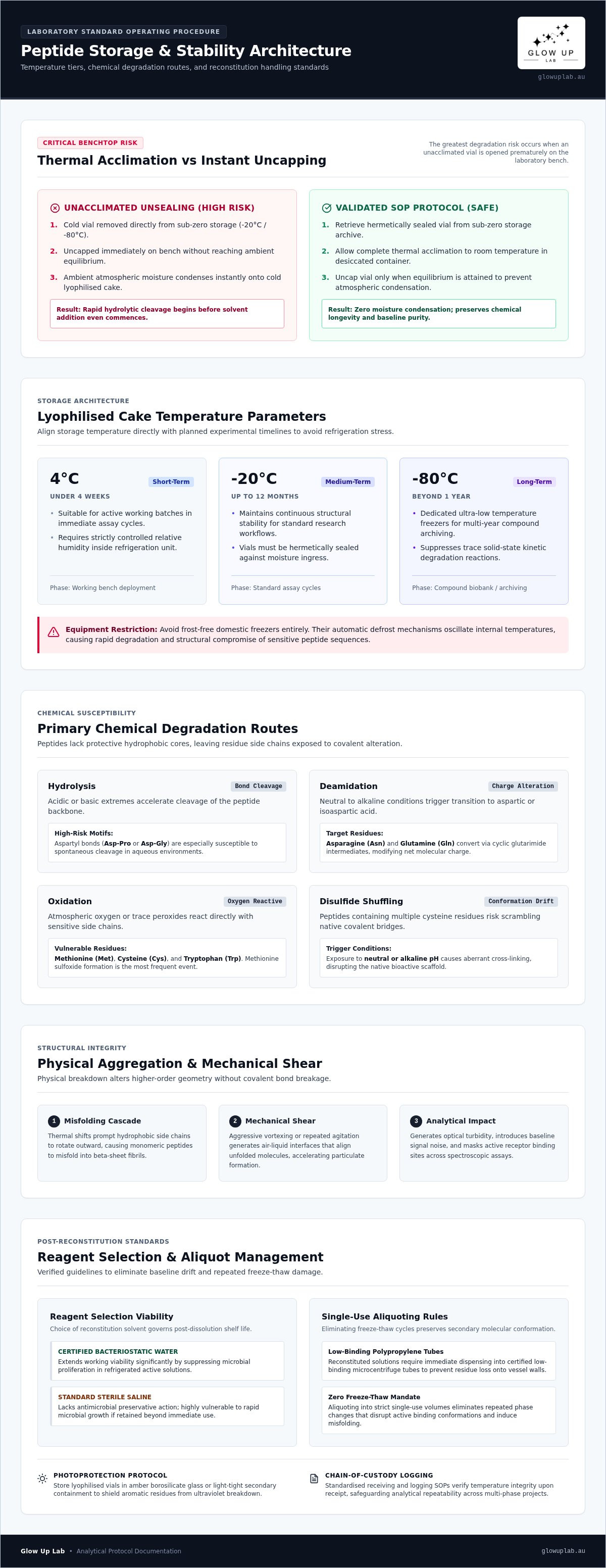
A peptide's greatest degradation risk rarely occurs inside a deep freezer; it happens the second an unacclimated vial is uncapped on the laboratory bench. Ambient moisture condenses instantly onto cold lyophilised cake, initiating rapid hydrolytic cleavage before solvent addition even begins. Mastering peptide storage best practices isn't simply a matter of dialling in sub-zero freezer settings; it demands controlling condensation, atmospheric exposure, and thermal equilibrium across every phase of sample handling.
Every research team recognises the frustration of compromised assays, unexplainable baseline drift, and watching active solutions degrade through repeated freeze-thaw cycles. Without verified standard operating procedures, managing post-reconstitution shelf life often introduces sample uncertainty and needless material waste. In this laboratory guide, you'll master validated protocols for storing lyophilised and reconstituted peptides to preserve chemical integrity and experimental repeatability. We outline precise temperature benchmarks, single-use aliquoting parameters, and solvent handling rules to help you maintain dependable analytical standards across your long-term research projects.
Key Takeaways
- Lyophilised peptides achieve maximum chemical longevity when preserved between -20°C and -80°C in hermetically sealed containers protected from ambient light and thermal fluctuations.
- Establishing validated peptide storage best practices, such as thermal acclimation prior to unsealing, eliminates the moisture condensation that triggers rapid hydrolytic cleavage.
- Reconstituted solutions require immediate single-use aliquoting into low-binding microcentrifuge tubes to prevent experimental error caused by repeated freeze-thaw cycles.
- Reagent selection dictates post-reconstitution stability, where certified bacteriostatic water extends working viability by suppressing microbial proliferation compared to sterile saline.
- Standardised receiving and logging SOPs verify chain-of-custody temperature integrity, safeguarding baseline assay repeatability across multi-phase research projects.
Understanding Peptide Degradation Pathways: Mechanisms and Chemical Vulnerabilities
Peptides are short chains of amino acids linked by amide bonds. Because they lack the dense, protective hydrophobic cores typical of large globular proteins, their individual residues remain exposed to environmental degradation. Without strict adherence to peptide storage best practices, subtle benchtop hazards such as ambient thermal swings, ultraviolet exposure, and atmospheric moisture trigger rapid chemical breakdown. Secondary structural collapse alters spatial conformation, directly reducing receptor binding affinity and generating irreproducible data across analytical assays.
Primary Chemical Degradation Routes
Chemical degradation involves covalent bond cleavage or modification, yielding entirely new chemical species. Susceptibility depends heavily on primary sequence composition and microenvironmental pH:
- Hydrolysis: Acidic or basic extremes accelerate the hydrolytic cleavage of the peptide backbone. Aspartyl bonds (Asp-Pro or Asp-Gly) prove especially prone to spontaneous cleavage in aqueous environments.
- Deamidation: Neutral to alkaline conditions prompt asparagine and glutamine residues to convert into aspartic or isoaspartic acid derivatives through a cyclic glutarimide intermediate, altering overall peptide charge.
- Oxidation: Methionine, cysteine, and tryptophan residues react readily with atmospheric oxygen or trace peroxides. Methionine sulfoxide formation represents one of the most frequent degradation events observed during routine laboratory storage.
- Disulfide Shuffling: Peptides containing multiple cysteine residues risk incorrect disulfide bonding when exposed to neutral or alkaline pH, disrupting the native bioactive scaffold.
Physical Instability and Aggregation
Physical degradation alters higher-order structure without breaking covalent linkages. When hydrophobic side chains rotate outward during thermal shifts, monomeric peptides misfold and form beta-sheet fibrils. This self-association eventually creates insoluble, high-molecular-weight aggregates.
Mechanical shear stress exacerbates this instability. Aggressive vortexing or repeated agitation generates air-liquid interfaces that align unfolded molecules, accelerating particulate formation. In spectroscopic and cell-based assays, these aggregates generate optical turbidity, introduce baseline signal noise, and mask active binding sites. Establishing validated peptide storage best practices prevents physical shear and preserves the structural homogeneity essential for reliable research readouts.
Lyophilised Peptide Storage Protocols: Temperature, Desiccation, and Light Protection
Lyophilised peptide cakes offer superior structural resilience compared to liquid formulations because the freeze-drying process removes the free water that drives hydrolytic cleavage. Despite this inherent stability, dry powders remain vulnerable to photolytic degradation and ambient thermal decay. Storing lyophilised vials in amber borosilicate glass or light-tight outer containers shields sensitive aromatic residues from ultraviolet breakdown, preserving baseline compound purity.
Temperature Selection Guidelines for Dry Compounds
Temperature selection must align directly with experimental timelines to prevent unnecessary refrigeration stress:
- Short-term working storage (under four weeks): Vials remain stable at 4°C, provided relative humidity inside the refrigeration unit is strictly controlled.
- Medium-term preservation (up to twelve months): Maintaining a continuous temperature of -20°C preserves structural stability for standard assay cycles.
- Long-term archiving (beyond one year): Archiving material for multiple years demands dedicated -80°C ultra-low freezers to suppress trace solid-state kinetic reactions.
Avoid frost-free domestic freezers entirely. Their automatic defrost mechanisms oscillate temperatures by as much as 15°C several times daily, causing microscopic thermal cycling that compromises lyophilised cakes.
Desiccation and Moisture Exclusion Techniques
Lyophilised cakes act as aggressive desiccants. When exposed to ambient air, they pull atmospheric moisture into the matrix within seconds, transforming porous cakes into dense, degraded gels. In coastal and high-humidity laboratory environments, managing this exposure is critical to implementing effective peptide storage best practices.
The cardinal rule of dry peptide preservation is thermal equilibration. Never remove the stopper of a chilled vial immediately upon retrieval from cold storage. Allow the sealed container to equilibrate to room temperature on the bench for 30 to 60 minutes. This simple acclimation step prevents warm laboratory air from condensing onto the cold powder the instant the vacuum seal breaks.
Keep primary vials sealed inside airtight secondary desiccator chambers packed with active, colour-indicating silica gel beads. For multi-phase analytical studies requiring verified stability, sourcing research materials backed by independent batch testing from specialised suppliers like Glow Up Lab ensures your baseline compounds arrive dry, intact, and structurally uncompromised.
Reconstituted Peptide Preservation: Reagent Selection, Aliquoting, and Thermal Controls
Reconstitution radically changes a peptide's chemical vulnerability. Introducing a liquid vehicle creates an aqueous environment where hydrolytic cleavage accelerates exponentially and airborne microbes can proliferate. Implementing rigorous peptide storage best practices at this critical transition preserves active concentrations and safeguards long-term experimental repeatability.
Solvent Selection: Reagent Purity and Preservatives
Reagent selection determines both chemical longevity and assay safety. While standard sterile water or unbuffered saline suits immediate single-day assays, it provides no protection against microbial proliferation during multi-day sampling. Air introduced into a vial during sampling rapidly contaminates unpreserved aqueous solutions.
For protocols requiring multi-dose sampling over several weeks, laboratory-grade bacteriostatic water containing 0.9% benzyl alcohol serves as the standard preservation medium. Benzyl alcohol functions as a bacteriostatic preservative, suppressing bacterial growth and extending the refrigerated working sterility window up to 28 days. Utilising certified reagents such as BAC Water 10mL maintains strict sterility across serial dilutions. When preparing sensitive receptor ligands, matching peptide solubility requirements with sterile, preserved diluents ensures chemical integrity throughout your workflow.
The Working Aliquot Protocol
To prevent repeated container access, establish a strict aliquoting routine immediately following reconstitution:
- Divide Immediately: Partition reconstituted stock solution into single-use experimental volumes on day one.
- Select Low-Binding Plastics: Standard laboratory polypropylene tubes bind hydrophobic peptides to their internal walls via passive adsorption. Use low-protein-binding microcentrifuge tubes to prevent significant loss of active concentration.
- Comprehensive Labelling: Mark every microtube with the compound identifier, exact concentration, reconstitution date, and solvent system.
Managing Freeze-Thaw Cycles
Subjecting liquid peptides to repetitive freezing and thawing destroys structural integrity. As aqueous solutions freeze slowly in standard freezers, growing ice crystals create mechanical shear forces that fragment delicate peptide backbones and prompt irreversible aggregation. Cryo-concentration also pushes peptide molecules into localised pockets of un-frozen water, drastically shifting local pH and driving rapid chemical degradation.
Working aliquots intended for use within 48 to 72 hours should stay refrigerated between 2°C and 8°C. For preservation extending up to several months, snap-freeze single-use aliquots rapidly at -80°C using dry ice or liquid nitrogen, then store them at -20°C or -80°C. Thaw each aliquot only once immediately before testing, and never return unused thawed fractions to sub-zero storage.
Laboratory Storage Comparison: Sequence Classes and Stability Parameters
Peptide architectures show markedly different rates of decay under identical laboratory conditions. While a short, capped peptide may withstand short-term ambient shifts, longer multi-agonist chains often aggregate upon minimal thermal disruption. Applying universal protocols across all compounds leads to uneven assay performance; rigorous peptide storage best practices demand sequence-specific handling tailored to molecular length and structure.
Neuropeptide Stability: Short Chains and Linear Peptides
Linear short-chain peptides lack stabilizing tertiary folds, leaving their terminal residues exposed. Without terminal modification, unshielded end residues remain vulnerable to rapid exopeptidase cleavage whenever environmental contamination occurs. Neuropeptides such as Selank 10mg require strict cold-chain preservation at -20°C inside sealed, desiccated chambers to prevent moisture-induced degradation.
Rapid thermal equilibrium is just as critical for sensitive heptapeptides like Semax 10mg. Uncapping these cold vials before they reach room temperature invites instant condensation, compromising the peptide cake. For short linear chains, limiting moisture contact prior to solvent addition protects the sequence from baseline hydrolytic loss.
Longer Polypeptides and Modified Analogs
Complex multi-receptor agonists, including dual and triple incretin mimetics, present entirely different stability challenges:
- Conformational Vulnerability: Polypeptides exceeding thirty amino acids rely on fragile alpha-helical structures. Thermal stress rapidly uncoils these domains, exposing hydrophobic cores that trigger fibril assembly.
- Shear-Induced Aggregation: Shaking or rapid vortexing creates air interfaces that unravel complex analogs. Reconstituted solutions should be swirled gently; aggressive agitation must be avoided.
- pH Sensitivity: Formulated solutions must remain within tightly controlled pH ranges (typically pH 7.0 to 7.8). Deviations accelerate both deamidation and precipitation.
To preserve structural integrity across these distinct sequence classes, Australian research facilities rely on verified reference materials. Standardise your experimental workflows by ordering validated compounds from Glow Up Lab, supported by batch-specific analytical documentation and cold-chain-aware dispatch.
Standard Operating Procedures: Receiving, Logging, and Storing Peptides in Australia
Receiving incoming compounds into Australian research facilities demands immediate, systematic intake procedures. Given Australia's intense seasonal heat and prolonged freight transit corridors, any breakdown in parcel insulation compromises active peptides before they reach the bench. Establishing institutional peptide storage best practices begins the moment a parcel is delivered to goods receiving, ensuring chain of custody and thermal stability remain verified from day one.
Intake Inspection and Analytical Logging
Process shipments immediately upon arrival through a formal intake checklist:
- Physical Inspection: Check secondary thermal packaging, internal cold packs, and temperature indicator strips. Examine primary vials to ensure rubber septa remain concavely seated, confirming the internal vacuum is intact and no ambient humidity has entered.
- Certificate of Analysis (CoA) Verification: Cross-reference container batch numbers with supplier analytical documentation. Confirm purity benchmarks using third-party High-Performance Liquid Chromatography (HPLC) and verify molecular mass via Mass Spectrometry (MS) before logging the compound into inventory.
- Data Entry: Record the date of arrival, supplier identity, manufacturer lot number, declared purity, and designated freezer coordinate (freezer unit, rack, and box position) into the laboratory information management system (LIMS).
Maintaining Inventory Integrity Across Australian Laboratories
Australian laboratories encounter extreme ambient heatwaves during summer months. These environmental spikes place significant stress on facility climate systems and ultra-low refrigeration units. To safeguard high-value research assets, storage freezers must feature continuous electronic temperature logging and calibrated excursion alarms that alert laboratory managers before temperatures drift outside permissible ranges.
Organise storage freezers logically using clear alphanumeric indexing grids. Rapid sample retrieval prevents staff from propping freezer doors open, which inadvertently raises ambient cabinet temperatures and risks surface condensation on nearby racks. Desiccated secondary containers should remain grouped by research project or compound longevity requirements rather than arbitrary arrival dates.
High-standard research requires dependable ancillary supplies. Pairing sensitive compounds with domestic laboratory reagents such as BAC Water 3mL provides reliable sterility control for short-format experimental trials. Sourcing fully documented research compounds from Glow Up Lab ensures Australian laboratories receive verified batch purity alongside nationwide cold-chain-aware dispatch, underpinning repeatable assay outcomes across every study phase.
Securing Assay Precision Through Standardised Preservation
Maintaining molecular integrity requires steady vigilance from initial receipt through to terminal assay pipetting. By adopting rigorous peptide storage best practices, including disciplined thermal equilibration, single-use aliquoting in low-binding plastics, and preservative-supported reconstitution, research teams eliminate baseline drift and structural degradation. Consistent procedural habits protect your lab's material investments and preserve compound viability.
When reliable analytical outcomes are essential, partnering with a dependable supplier ensures experimental baselines remain sound. Source verified research peptides and laboratory reagents at Glow Up Lab to support your ongoing workflows. Every batch arrives backed by comprehensive HPLC and mass spectrometry documentation, dispatched via specialised nationwide cold-aware delivery across Australia. By pairing strictly research-grade compounds compliant with laboratory standards with disciplined storage controls, your facility won't have to compromise on assay reproducibility.
Frequently Asked Questions
Can you store lyophilised peptides in a normal domestic freezer?
No, you should avoid domestic freezers for long-term compound preservation. Domestic units use auto-defrost cycles that heat internal coils periodically by up to 15°C to clear ice buildup. These thermal oscillations stress dry cakes and accelerate degradation. Laboratory peptide storage best practices demand dedicated, non-cycling laboratory freezers maintained at steady -20°C or -80°C parameters to guarantee consistent sample integrity.
How long do reconstituted peptides remain stable at refrigerated temperatures?
Reconstituted peptides stored at 2°C to 8°C generally remain stable for several days up to four weeks, depending on sequence attributes and solvent choice. Solutions prepared with standard sterile water degrade quickly and risk microbial growth within days. Reconstituting with bacteriostatic water containing benzyl alcohol extends refrigerated sterility up to 28 days, though individual molecular degradation rates will still vary.
What happens if a peptide vial is opened before warming to room temperature?
Opening a cold vial causes ambient humidity to condense instantly onto the dry powder. Because lyophilised cakes act as potent desiccants, they pull this condensed water directly into their porous structure. This sudden moisture exposure initiates hydrolytic cleavage and peptide aggregation before reconstitution even starts. You should always let sealed containers warm on the bench for 30 to 60 minutes before uncapping.
Why is bacteriostatic water preferred over sterile saline for peptide storage?
Bacteriostatic water contains 0.9% benzyl alcohol, an effective preservative that suppresses microbial proliferation during repeated container access. Unpreserved sterile saline lacks antimicrobial protection, allowing introduced microbes to multiply rapidly at refrigerated temperatures. Dissolved salts in saline can also alter ionic strength, precipitating hydrophobic residues and accelerating aggregation during prolonged refrigerated storage.
How do repeated freeze-thaw cycles damage reconstituted research peptides?
Thermal cycling damages liquid peptides by generating sharp ice crystals that mechanically shear fragile covalent chains. As water freezes slowly, solutes concentrate into narrow channels, inducing severe pH shifts that unravel secondary structures. This leads to irreversible beta-sheet aggregation. Following peptide storage best practices requires aliquoting stock solutions into single-use volumes immediately after initial reconstitution to avoid repetitive freezing.
Does light exposure degrade peptides stored in transparent laboratory glass vials?
Yes, ambient laboratory light and ultraviolet wavelengths trigger photolytic reactions. Light exposure oxidises sensitive aromatic residues, including tryptophan, tyrosine, and phenylalanine, generating reactive species that disrupt native binding structures. Transparent glass vials provide zero ultraviolet shielding. You should always store transparent vials inside secondary cardboard freezer boxes, aluminium wrap, or dedicated amber glass containers to prevent baseline photolytic breakdown.
Can aggregated peptides be rescued by re-filtering or ultrasonic sonication?
No, aggregated peptides cannot be restored to their native monomeric state. Passing aggregated solution through a membrane filter merely strips out the insoluble fibrils, drastically reducing the active concentration and introducing significant experimental error. Ultrasonic sonication imparts thermal stress and mechanical shear that fragments delicate amino acid bonds. Once irreversible aggregation occurs, the sample must be logged and discarded.