

Cagrilintide Research in Australia: A 2026 Sourcing and Evaluation Guide
A catalogue claim is not the same as evidence of a research material’s quality. If you’re comparing options for cagrilintide research australia, reviewing the supplier’s actual documentation is a practical first step. It can still be difficult to know what to look for and which claims need further checking.
This guide outlines a consistent way to assess research-use options in Australia. As of September 2026, cagrilintide isn’t registered by the Therapeutic Goods Administration (TGA) as a medicine and isn’t approved for human or veterinary use. Research-use-only supply should not be confused with a medicine or clinical guidance.
You’ll learn how to review product information and supporting documents, what to ask about product identity and batch-specific evidence where available, and which Australian compliance questions to check before procurement. The guide also covers Glow Up Lab’s listed Cagrilintide (10mg) as a research-use catalogue option. The focus is on independent evaluation, not supplier claims alone.
Key Takeaways
- Understand the distinction between cagrilintide research and clinical use, and why findings should be interpreted within the context of each study.
- For cagrilintide research australia, compare suppliers by checking product identity, stated amount, form and supporting evidence, not marketing claims alone.
- Check whether documents state their scope and link to the relevant batch. Note any gaps that need clarification.
- Use the procurement worksheet to record research requirements, supplier responses, shipping terms and unresolved questions before deciding.
- Review the Australian compliance questions relevant to your research procurement, and check current requirements with authoritative sources.
Cagrilintide research in Australia: what it is and is not
Cagrilintide is a synthetic, long-acting analogue of amylin, a hormone involved in appetite and satiety signalling. Research into a compound is distinct from its status as a therapeutic medicine. A substance studied in a laboratory or clinical trial is not, by that fact alone, an approved treatment, a recommendation for use or a product suitable for human use. For a foundational overview, see Cagrilintide, then consult primary studies and official Australian sources when decisions depend on current evidence or status.
Working definition: a research compound is a substance supplied or examined for a defined scientific investigation; a therapeutic medicine is a product subject to the applicable regulatory assessment for therapeutic use. This distinction describes purpose. It does not guarantee quality or determine the legal status of a particular product.
What is cagrilintide studied for?
Cagrilintide is studied in relation to amylin biology and its role in satiety. A phase 2 clinical trial by Lau and colleagues assessed once-weekly cagrilintide for weight management in adults with overweight or obesity. The study’s population, design and endpoints define what its findings can support. They do not establish how a research-supply product should be used or interpreted outside that trial (Lau et al., The Lancet, 2021, “Once-weekly cagrilintide for weight management in people with overweight and obesity”).
Combination research addresses a separate evidence question. Cagrilintide and semaglutide, known together as CagriSema, have been examined in clinical research. An Australian study of the combination in children and adolescents was reported as recruiting in September 2026. Trial registration and recruitment status can change, so check the current Australian New Zealand Clinical Trials Registry entry before citing or relying on it. Findings from a combination study cannot automatically be attributed to cagrilintide alone.
What does research-use-only mean for Australian laboratories?
For cagrilintide research australia, a catalogue listing indicates supplier availability, not TGA approval or suitability for human or veterinary use. As of September 2026, cagrilintide is not registered by the Therapeutic Goods Administration (TGA) as a medicine in Australia and is not approved for human or veterinary use. Research findings do not change that status, and research-use-only wording does not replace a review of the material’s documentation.
Laboratories should follow their institution’s procurement, risk-management and research-governance procedures, and check current guidance with the TGA and other relevant Australian authorities. Confirm which documents are available for the specific listing and whether they identify the material and any relevant batch. Glow Up Lab lists Cagrilintide (10mg) for research use and describes product information and supporting documentation. Review the current listing documents before making a procurement decision.
How cagrilintide research evidence is generated and interpreted
Different kinds of cagrilintide research answer different questions. Preclinical studies examine biological activity in laboratory systems or animal models. They can help generate hypotheses, but don’t establish effects in people. Clinical studies investigate defined research questions in human participants under a particular protocol. Analytical testing assesses properties of a material using specified methods. These evidence types complement one another, but they are not interchangeable.
Analytical product verification can help characterise a tested sample, but it does not demonstrate a biological effect or establish clinical safety or efficacy. Similarly, a published clinical result concerns the compound, formulation, population and conditions studied. It cannot automatically be generalised to a separately sourced research material.
Which details matter when reviewing cagrilintide studies?
Start with the source. Record the publication date, authors, study type and exact compound or formulation investigated. Then compare the research question with the methods: was the work preclinical or clinical, what model or participant group was included, and what comparator was used? Check the stated endpoints as well. An endpoint measuring one outcome cannot answer a different question simply because both studies involve cagrilintide.
For example, the phase 2 study by Lau and colleagues in The Lancet (2021) examined once-weekly cagrilintide in adults with overweight or obesity. Its design and participant group matter when interpreting its findings. Those results are not a general assessment of every research material or context. A peer-reviewed paper, trial registry entry, conference abstract, commentary and supplier document also serve different purposes. A registry can clarify a trial’s planned design or status, but it is not a report of completed results.
How should limitations and combination studies be read?
Check whether a study is preliminary, how its sample was selected and which limitations the authors identify. Consider whether the comparator and follow-up period suit the question being asked. Read results within those boundaries, rather than treating them as individual health or treatment advice. For Australian context, Hormones Australia’s Australian overview of obesity medications offers broader background, but it is not a substitute for primary research or regulatory guidance.
Combination studies require particular care. Findings for cagrilintide studied with semaglutide concern that combination and its study protocol. They do not isolate cagrilintide’s contribution unless the study design supports that interpretation. Keep combination evidence separate from cagrilintide-only evidence when assessing cagrilintide research australia. If you’re reviewing a supplier listing alongside the literature, compare the available product information and supporting documents with your research requirements. Glow Up Lab lists Cagrilintide (10mg). Check the current listing documentation rather than assuming it establishes equivalence to a study material.
Compare Australian cagrilintide research suppliers using evidence, not slogans
A useful comparison separates a supplier’s claims from information a researcher can inspect. Record the product details and documents available for the specific listing, and note gaps rather than treating a quality statement or percentage as independent proof. For any certificate, first establish what it covers.
A certificate supports only the tests performed on the sample it documents; it does not automatically verify every batch, property or research outcome. Check whether the document names the method, date, responsible laboratory and sample or batch identifier, and whether those details link to the material being considered.
What should a cagrilintide product record include?
Use the same fields for each supplier. Record the exact compound name, stated amount and physical form, then note the batch identifier if one is provided. List each supporting document and what it verifies. Where appropriate, mark details as “not provided”, “unclear” or “not independently checked”. Don’t infer a batch match or analytical result from a general quality claim.
| Comparison field | What to record or verify |
|---|---|
| Identity and stated amount | Exact name as listed; amount stated; any available batch identifier. |
| Form | Form described in current product information; note if unspecified. |
| Documentation | Documents available, their scope, test method and date, named laboratory, and any link to the relevant batch. |
| Support | Whether written questions about product details and documents receive clear responses. |
| Shipping scope | Confirm domestic shipping availability and current terms directly with the supplier. |
How can Australian procurement teams assess supplier transparency?
Compare written product information, how easily supporting documents can be accessed and how clearly the supplier responds. A percentage without a stated method, sample identity and document scope is difficult to evaluate. Ask what a document demonstrates, whether it relates to the listed material and which details remain unverified. Treat unanswered questions as open procurement issues, not implied assurances.
Glow Up Lab lists Cagrilintide (10mg), describes product information and supporting documentation, and states that it provides Australian-based support and secure nationwide shipping. Confirm which documents are available for the current listing before procurement. Review the Cagrilintide 10mg product information, then check current domestic shipping terms directly. This evidence-led approach gives teams assessing cagrilintide research australia a consistent record for comparing supplier claims without implying clinical suitability.
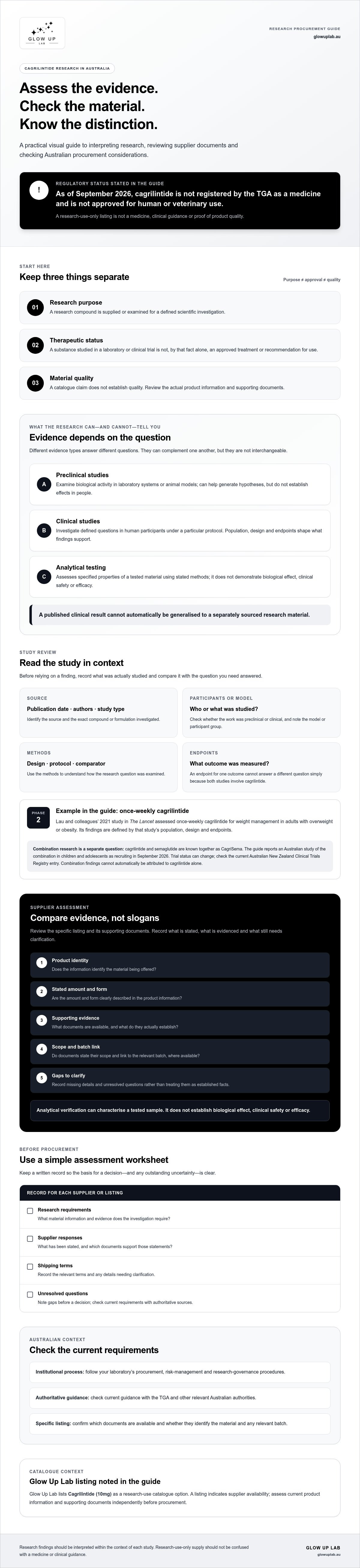
Use this cagrilintide supplier assessment template before procurement
A written record makes supplier comparisons more consistent and keeps evidence gaps visible. Copy the worksheet into your procurement notes, complete one row per supplier, and save the source and date for each claim so you can recheck the details later. A blank or unclear field is a prompt for follow-up, not an assurance.
A practical supplier comparison worksheet
| Supplier | Product identity, amount and form | Available documents | Verified details | Open questions |
|---|---|---|---|---|
| [Name; source and date checked] | [Exact compound name; stated amount; form; batch identifier, if provided] | [Document title; source; date received] | [What the document directly supports] | [Missing, unclear or unverified information] |
For each document, record its scope and check the following where relevant:
- ☐ Does it identify the test or information provided, the method and document date?
- ☐ Is the sample or batch identified, and can it be linked to the listing under review?
- ☐ Is the responsible laboratory or document issuer named?
- ☐ Have you recorded supplier responses, shipping terms and any unresolved questions?
Use “not provided” or “not confirmed” rather than filling gaps with assumptions. A certificate or analytical result supports only the specific sample and details it documents. Don’t treat a stated percentage as proof on its own.
What to confirm before an Australian research order
Check the current research-use terms, confirm that the stated shipping scope is domestic, and note how to contact the supplier with product or document queries. Glow Up Lab describes Australian-based support and secure nationwide shipping. Confirm current listing documents and terms directly before procurement. For institutional work, follow approved procurement and research procedures, and direct regulatory questions to your institution’s responsible compliance contact or the relevant Australian authority.
This worksheet is for supplier evaluation only. It does not provide preparation, handling or use instructions. Consult your institution’s approved procedures for any laboratory handling context, including separate protocols or guidance. For cagrilintide research australia, keep the research question, product record and compliance checks distinct, and document who reviewed each item.
To review the listed research-use option and its current product information, visit Cagrilintide (10mg) product information.
Where to find cagrilintide research information and take the next step
Use a source-led sequence before making a procurement decision: define the research question, find evidence that addresses it, inspect the supplier’s product information and supporting documents, then confirm institutional and regulatory requirements. Keep these steps distinct. A supplier description can help identify what is being offered, but it doesn’t replace scientific literature or an institutional review.
Where can researchers verify compound and regulatory information?
For scientific context, look for peer-reviewed papers and check their methods, study population or model, formulation and endpoints. Use trial registries such as the Australian New Zealand Clinical Trials Registry to review study records, bearing in mind that a registry entry is not the same as published results. Commercial descriptions and supplier documents serve different purposes from both.
For Australian regulatory status, consult current information from the Therapeutic Goods Administration and confirm requirements relevant to your institution and proposed research. Recheck the information at the time of publication or procurement, as status and guidance can change. If an interpretation affects a procurement decision, seek guidance from your institution’s responsible compliance contact rather than relying on a catalogue statement.
How to proceed with Glow Up Lab product information
Glow Up Lab lists Cagrilintide (10mg) as a research-use catalogue item and describes product information and supporting documentation. Review the documents available for the current listing directly. Check what each document covers and whether it states any relevant material or batch identifiers. Don’t assume product-specific analytical results, batch testing or regulatory approval without evidence.
- Define: Record the research question and the evidence needed to address it.
- Review: Compare relevant publications with the listing details and available supporting documents.
- Confirm: Check institutional procedures, current Australian requirements, domestic shipping terms and any unresolved supplier questions.
This process keeps cagrilintide research australia focused on evidence and documented requirements, not implied claims. Research-use supply is not clinical guidance or a human-use product.
For a procurement review, see the Cagrilintide (10mg) product details and contact Glow Up Lab’s Australian-based support with questions about the listing or available documentation. Use this information as one part of your assessment, alongside independent sources and your institution’s approved processes.
Make your next sourcing decision evidence-led
Responsible cagrilintide research australia starts with a clear research question and a careful distinction between scientific findings, supplier information and product documentation. Study results apply to the methods, materials and populations examined. Analytical documents support only the specific details they record.
Before procurement, compare product identity, stated amount, form and available documentation. Record what is verified, what remains unclear and which questions need follow-up. Check current Australian regulatory information and your institution’s procedures. Catalogue availability is not evidence of approval or suitability for human or veterinary use.
Glow Up Lab lists Cagrilintide (10mg) in its research-use catalogue and describes product information and supporting documentation for its items. Australian-based support and secure nationwide shipping are also stated business features. Review the current listing and confirm which documents are available before making a decision.
Review the Cagrilintide research-use product information as one part of your independent assessment. Use a consistent checklist and keep evidence boundaries clear when evaluating research procurement.
Frequently Asked Questions
Is cagrilintide approved for human use in Australia?
Don’t infer approval from a research supplier listing or published studies. Regulatory status can change, so check current information from the Therapeutic Goods Administration and obtain qualified advice where required. This article concerns research-use materials only. It doesn’t provide treatment guidance, recommend human use or establish that a particular product is approved or suitable for people.
What is cagrilintide used for in research?
Cagrilintide is studied in amylin-related research, but the specific question and evidence depend on each study. Check the paper’s model or participant population, methods, endpoints and stated limitations. Findings relate to the design and material investigated in that study. Research findings aren’t medical advice and shouldn’t be interpreted as a treatment recommendation or support for human use.
Can Australian laboratories buy cagrilintide for research?
Glow Up Lab lists Cagrilintide (10mg) as a research-use product and serves customers across Australia. A listing alone, however, doesn’t establish regulatory status, suitability for a research protocol or whether the available documentation meets your needs. Before deciding whether to proceed, review the current product details, check your institution’s procurement procedures and confirm applicable Australian requirements with the appropriate compliance contact.
How can I assess the quality documentation for cagrilintide?
Check what each document identifies and verifies rather than relying on a general quality statement. Look for the stated compound, amount, physical form and, where available, a batch identifier, test method, date and responsible laboratory. Don’t assume a general purity claim represents batch-specific evidence. Record missing or unclear information as a question for the supplier, then assess the documents against your institution’s research and procurement procedures.
What should a cagrilintide certificate of analysis show?
Assess a certificate by its scope, not its title alone. Check whether it identifies the material or batch, describes the analytical method, reports results, and names the issuing laboratory and date. Confirm that it corresponds to the product under consideration. If details are missing, ask the supplier for clarification. A certificate supports only the tests and sample it documents, not claims beyond its stated scope.
Is cagrilintide the same as semaglutide?
No. Cagrilintide and semaglutide are distinct compounds discussed in related areas of metabolic research, so their identities and study findings aren’t interchangeable. When reviewing a paper, confirm which compound or combination was investigated, along with the formulation and study design. Research comparisons don’t establish clinical equivalence, treatment suitability or instructions for human use.
What should I check before ordering cagrilintide in Australia?
Before proceeding, confirm the exact product identity, stated amount and form, available supporting documents, supplier terms, domestic shipping scope and support channels. Check institutional procurement procedures and current Australian regulatory information as well. Keep unresolved questions visible in your records instead of assuming claims are verified. A research-use listing isn’t medical advice or authorisation for human or animal consumption.