

5-Amino-1MQ Research in Australia: A Technical Overview for 2026
Achieving consistent results in metabolic studies depends less on the protocol and more on the integrity of the compound at the molecular level. For those conducting 5-amino-1mq research in Australia, the logistical hurdle of securing high-purity materials often overshadows the scientific enquiry itself. It's common to feel frustrated by the unpredictability of international supply chains, where lengthy customs delays and a lack of transparent documentation can stall critical laboratory work. You need a reliable domestic partner that understands the necessity of batch-to-batch consistency and provides the verification required for precise data collection.
This technical overview serves as a comprehensive guide for Australian researchers, delivering a clear analysis of the biochemical mechanisms, sourcing standards, and laboratory protocols for 5-Amino-1MQ. We'll provide a detailed exploration of NNMT inhibition and a verified protocol for compound reconstitution. By the end of this article, you'll have a thorough understanding of how to maintain procedural integrity while accessing HPLC-verified materials from a trusted Australian source, ensuring your research remains focused on discovery rather than logistics.
Key Takeaways
- Gain a clear understanding of how 5-Amino-1MQ functions as a selective NNMT inhibitor by targeting the SAM binding site to influence cellular metabolic pathways.
- Learn to verify high-purity standards for 5-amino-1mq research australia by reviewing HPLC and Mass Spectrometry documentation to ensure batch-to-batch consistency.
- Master precise laboratory reconstitution protocols using bacteriostatic water to maintain compound stability and achieve accurate concentration ratios for assays.
- Navigate the procedural requirements for domestic procurement under the Research Use Only classification to streamline institutional acquisition and avoid customs delays.
- Compare the distinct laboratory handling and storage requirements of small molecule inhibitors against peptides to better organise your experimental design.
Understanding 5-Amino-1MQ as a Research Compound
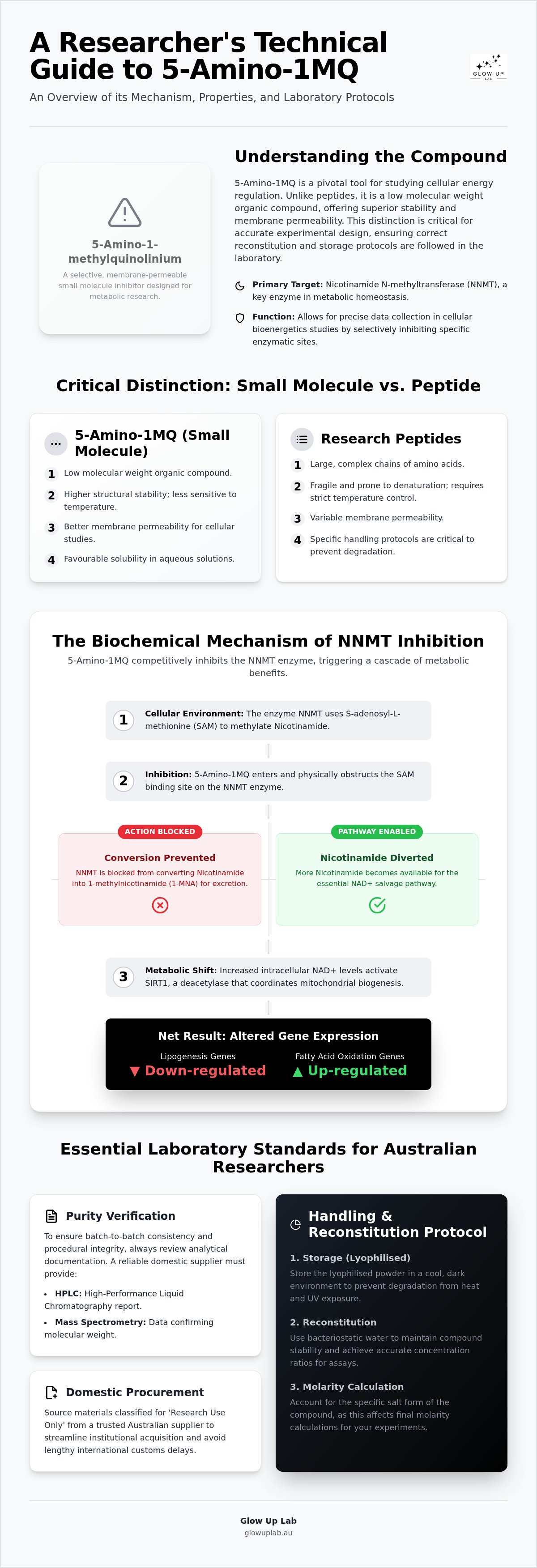
5-Amino-1MQ (5-Amino-1-methylquinolinium) represents a significant advancement in the study of cellular energy regulation. While often grouped with peptides in commercial catalogues, it's strictly a small molecule inhibitor. This distinction is critical for experimental accuracy. Peptides are larger, often fragile chains of amino acids that require specific temperature controlled handling to prevent denaturation. In contrast, small molecules like 5-Amino-1MQ are low molecular weight organic compounds that typically offer better membrane permeability and higher structural stability. 5-Amino-1MQ is a selective, membrane-permeable inhibitor of NNMT.
In the context of 5-amino-1mq research australia, understanding this classification ensures that researchers apply the correct reconstitution and storage protocols. The compound has emerged as a primary tool for investigating Nicotinamide N-methyltransferase (NNMT), an enzyme that plays a central role in metabolic homeostasis. Unlike broad-spectrum inhibitors, 5-Amino-1MQ targets specific enzymatic sites, allowing for more granular data collection in cellular bioenergetics studies.
Chemical Structure and Properties
The molecular formula for the 5-Amino-1-methylquinolinium cation is C10H11N2, with a molecular weight of approximately 159.21 g/mol. When sourcing materials like the 5-Amino-1MQ (20mg) vials from domestic suppliers, researchers must account for the specific salt form used, as this affects final molarity calculations for laboratory assays.
The solubility profile of this compound is favourable for most in vitro experiments. It demonstrates high solubility in aqueous solutions and polar organic solvents like DMSO. While it possesses greater thermal stability than most research peptides, it remains sensitive to prolonged UV exposure. Laboratory teams should store the lyophilised powder in a cool, dark environment to prevent degradation before reconstitution.
Historical Context in Metabolic Studies
The development of NNMT inhibitors has evolved from non-specific compounds to highly refined 1-methylquinolinium derivatives. Early preclinical research often struggled with off-target effects, but the high selectivity of 5-Amino-1MQ has rectified many of these issues. By 2026, Australian research institutions have increasingly adopted this molecule to explore the relationship between NAD+ levels and metabolic efficiency. Current trends focus on how inhibiting NNMT can influence the SAM binding site, providing a clearer picture of how cells manage energy expenditure under varying conditions.
The Mechanism of NNMT Inhibition in Metabolic Studies
NNMT is a cytosolic enzyme primarily expressed in the liver and adipose tissue. It serves as a master regulator of energy homeostasis by methylating nicotinamide using S-adenosyl-L-methionine (SAM) as a methyl donor. When researchers utilise 5-Amino-1MQ (20mg) in their assays, they're targeting this specific enzymatic process. The molecule acts as a potent, competitive inhibitor that sits within the SAM binding pocket of the NNMT protein. By physically obstructing this site, 5-Amino-1MQ prevents the conversion of nicotinamide into 1-methylnicotinamide (1-MNA), which would otherwise be excreted from the cell.
This inhibition creates a significant shift in cellular gene expression, particularly within white adipose tissue (WAT). In research models, suppressing NNMT activity has been shown to down-regulate genes associated with lipogenesis while up-regulating those involved in fatty acid oxidation. This molecular pivot suggests that the compound doesn't just block a single reaction; it fundamentally alters the metabolic programme of the cell. If you're looking to integrate this molecule into your laboratory protocols, you can source 5-Amino-1MQ from our verified domestic stock to ensure experimental precision.
NNMT and the NAD+ Salvage Pathway
The inhibition of NNMT creates a biochemical diversion of nicotinamide. Under standard physiological conditions, NNMT and NAMPT compete for the same substrate pool. By suppressing NNMT, more nicotinamide remains available for the NAMPT-mediated salvage pathway, leading to an increase in intracellular NAD+ concentrations. Higher NAD+ levels are required for the activation of SIRT1, a deacetylase that coordinates mitochondrial biogenesis. For those conducting 5-amino-1mq research in Australia, this pathway offers a clear mechanistic explanation for the observed improvements in cellular energy efficiency.
Cellular Bioenergetics and Energy Expenditure
Research indicates that NNMT inhibition leads to a metabolic "uncoupling" effect. This process is often characterised by an increase in Oxygen Consumption Rates (OCR) without a proportional rise in ATP synthesis, effectively increasing basal energy expenditure. Laboratory data suggests that this modulation of lipid and glucose metabolism occurs through the activation of AMPK and other energy-sensing pathways. By shifting the cell's reliance toward fatty acid catabolism, 5-Amino-1MQ provides a robust model for studying mitochondrial function and systemic metabolic regulation in a controlled laboratory environment.
Evaluating Research Grade Standards in Australia
Maintaining rigorous quality control is the foundation of reproducible 5-amino-1mq research australia. For small molecule inhibitors, High-Performance Liquid Chromatography (HPLC) serves as the primary tool for assessing chemical purity. This process separates the compound from potential synthesis byproducts, ensuring that the material used in cellular assays is free from interference. A 99% purity threshold is standard for metabolic assays to ensure that observed cellular changes are attributable solely to NNMT inhibition rather than extraneous chemical interference.
Beyond simple purity percentages, researchers must identify specific contaminants that can compromise data. Trifluoroacetic acid (TFA) residues, often used during the purification phase, can alter the pH of culture media and affect mitochondrial function if present in significant quantities. Heavy metal testing is equally vital, as even trace amounts of lead or arsenic can induce oxidative stress, confounding results in metabolic studies. Mass Spectrometry (MS) provides the final layer of verification by confirming the molecular identity of the compound through its unique mass-to-charge ratio.
Reading a Certificate of Analysis (COA)
A professional COA should present a clear HPLC chromatogram where the primary peak represents the target molecule. Researchers should examine the peak area percentage to verify that it meets the required specifications. The accompanying Mass Spectrometry report must show a molecular weight signature consistent with the 5-Amino-1MQ cation. Cross-referencing batch numbers on these documents with the physical labels on 5-Amino-1MQ (20mg) vials is a mandatory step for institutional documentation and traceability.
Domestic vs International Sourcing for Australian Labs
Procuring research compounds from international vendors often introduces significant logistical risks. Shipments are frequently subject to Australian Border Force (ABF) inspections, which can lead to lengthy delays or seizures if the documentation isn't perfectly aligned with local regulations. Domestic sourcing mitigates these issues by providing a streamlined supply chain that avoids international customs altogether. This ensures that materials arrive within predictable timeframes and under stable conditions. Local suppliers are also better positioned to provide temperature-controlled logistics, which is essential for maintaining the integrity of sensitive research materials. Choosing a domestic partner ensures compliance with Australian laboratory safety standards while providing accessible professional support for technical enquiries.
Laboratory Handling and Reconstitution Protocols
Precision in concentration is a fundamental prerequisite for reproducible 5-amino-1mq research australia. When working with 5-Amino-1MQ (20mg), researchers must calculate mg/mL ratios that align precisely with their specific assay requirements. A common laboratory standard involves creating a 10mg/mL or 20mg/mL stock solution to facilitate accurate micro-dosing. Using BAC Water is the preferred choice for this process. The benzyl alcohol content serves as a necessary preservative, maintaining the stability of the compound during the study period. It's vital to avoid mechanical degradation during the initial mixing phase. Excessive agitation or high-speed vortexing can compromise the structural integrity of the molecule. Gentle manipulation ensures the compound remains viable for data collection and prevents the introduction of experimental variables.
Reconstitution Best Practices
Success in the lab starts with sterile handling procedures to maintain the purity of your materials. Before introducing any diluent, clean the vial's rubber stopper with a 70% isopropyl alcohol swab and allow it to air dry. Use a sterile syringe to draw the required volume of BAC Water and inject it slowly. Aim the stream against the internal glass wall of the vial rather than directly onto the lyophilised powder. This technique prevents foaming and ensures a smoother dissolution process. Instead of vortexing, gently swirl the vial in a circular motion until the solution is clear and free of visible particulates. This methodical approach protects the 1-methylquinolinium derivative from unnecessary physical stress that could lead to molecular shearing.
Long-term Stability and Storage
Storage conditions directly impact the shelf life and efficacy of research materials. Lyophilised 5-Amino-1MQ should be stored in a freezer at -20°C for long-term preservation, where it can remain stable for up to 24 months. Once reconstituted, the solution is significantly more susceptible to degradation. Researchers should aliquot the solution into smaller, single-use volumes to minimise freeze-thaw cycles. Repeated temperature fluctuations lead to molecular breakdown and inconsistent experimental outcomes. Additionally, 5-Amino-1MQ is a quinolinium derivative, making it sensitive to light exposure. Store both lyophilised and liquid formats in amber vials or wrap them in foil to prevent photodegradation. Following these rigorous protocols ensures that your materials meet the high standards required for metabolic enquiry and institutional audit.
Ensure your laboratory has the necessary supplies for precise research by visiting our store to purchase 5-Amino-1MQ (20mg) today.
Procuring 5-Amino-1MQ for Australian Laboratory Use
Procuring high-purity compounds for 5-amino-1mq research australia requires a clear understanding of the local regulatory environment. 5-Amino-1MQ is strictly classified for Research Use Only (RUO). This means the compound is intended for laboratory use, in-vitro assays, and preclinical research models rather than clinical applications or human consumption. Institutional procurement teams often require extensive documentation to satisfy internal audit and safety standards. By sourcing domestically, researchers can access batch-specific Certificates of Analysis (COA) without the complexities of international trade. Glow Up Lab facilitates this process by providing HPLC-verified materials with secure, nationwide shipping from within Australia. This domestic supply chain ensures that materials reach research hubs across the country without the risk of Australian Border Force seizures or environmental degradation during transit.
The Glow Up Lab Standard
The Glow Up Lab Standard focuses on providing precision tools for metabolic enquiry. Our 5-Amino-1MQ (20mg) research vials are prepared as lyophilised powder to ensure maximum stability. Researchers often investigate the synergistic effects of NNMT inhibition alongside other metabolic regulators. This includes integrating 5-Amino-1MQ into studies involving GIP or GLP-1 receptor agonists, such as Tirzepatide 20mg, to observe changes in cellular energy expenditure and lipid metabolism. We provide full access to batch-specific documentation and technical support to assist with experimental design and procurement compliance.
Compliance and Ethical Research
Adherence to strict laboratory protocols is essential for the validity of any scientific study. Sourcing from a verified Australian organisation provides a level of accountability that international vendors cannot match. It ensures that the compound's provenance is clear and that it meets the rigorous purity standards required for 5-amino-1mq research australia. All preclinical and in-vitro research must be conducted within the appropriate regulatory framework, respecting the boundaries of the RUO classification. We prioritise transparency in our operations, offering the Australian scientific community a reliable facilitator for metabolic research. This commitment to professional service allows investigators to focus on data collection while we manage the logistical and quality assurance requirements of the supply chain.
Advancing Metabolic Research Standards in 2026
The shift towards precise NNMT inhibition marks a significant step in cellular bioenergetics. Successful 5-amino-1mq research australia depends on a combination of rigorous laboratory protocols and the procurement of verified materials. We've examined how this small molecule interacts with the SAM binding site and the critical role that HPLC verification plays in ensuring experimental reproducibility. By prioritising domestic supply chains, researchers can bypass the unpredictability of international shipping and maintain a steady workflow. Accessing batch-specific data remains essential for institutional compliance and ethical research practices.
You can View 5-Amino-1MQ Research Specifications at Glow Up Lab to verify our independent HPLC purity standards and secure nationwide shipping. Our Australian-based support team is available to assist with technical enquiries regarding our 20mg research vials. We're committed to providing the transparency and procedural integrity required for high-stakes metabolic enquiry. We look forward to facilitating your next breakthrough in metabolic science with the professional reliability your work demands.
Frequently Asked Questions
Is 5-Amino-1MQ classified as a peptide in Australian research?
5-Amino-1MQ is technically classified as a small molecule inhibitor, not a peptide. While some commercial catalogues group them together, their chemical structures are fundamentally different. Peptides consist of amino acid chains, whereas 5-Amino-1MQ is a 1-methylquinolinium derivative with a lower molecular weight. This distinction is vital for researchers designing metabolic assays, as small molecules typically exhibit different membrane permeability and stability profiles compared to larger peptide chains.
How should 5-Amino-1MQ be stored to maintain its 99% purity?
To maintain a 99% purity threshold, lyophilised 5-Amino-1MQ should be stored in a freezer at -20°C. It's essential to keep the vials in a dark environment, as quinolinium derivatives are sensitive to photodegradation. Once the compound is reconstituted, you should aliquot the solution into single-use volumes to prevent repeated freeze-thaw cycles. These cycles can cause molecular breakdown, which compromises the integrity of your samples during long-term 5-amino-1mq research australia.
What is the recommended solvent for reconstituting 5-Amino-1MQ?
Bacteriostatic water is the recommended solvent for reconstituting 5-Amino-1MQ in a laboratory setting. The inclusion of 0.9% benzyl alcohol acts as a preservative, inhibiting microbial growth and extending the stability of the solution. For most protocols, using a 3mL or 10mL vial of BAC water allows for precise concentration calculations. Always ensure the diluent is added slowly against the glass wall to avoid mechanical stress and ensure a clear, uniform solution.
Can 5-Amino-1MQ be used in combination with other metabolic compounds like Retatrutide?
5-Amino-1MQ is frequently utilised alongside other metabolic research compounds, such as Retatrutide or Tirzepatide, to investigate synergistic pathways. Researchers often examine how NNMT inhibition interacts with GLP-1 or GIP receptor agonists to influence cellular energy expenditure. When designing these multi-compound studies, it's critical to maintain separate reconstitution protocols and account for the distinct biochemical mechanisms of each molecule. This approach provides a more comprehensive view of metabolic regulation in preclinical models.
How long does nationwide shipping take for research compounds in Australia?
Nationwide shipping for research compounds typically takes between two to five business days, depending on your institutional location within Australia. Because we ship directly from a domestic facility, your materials bypass the lengthy delays and inspections associated with international customs. Every order is packaged securely to maintain temperature stability during transit. This reliable logistics framework ensures that your laboratory work remains on schedule without the unpredictability of overseas supply chains.
What documentation should I expect with a 5-Amino-1MQ batch?
Every batch of 5-Amino-1MQ should be accompanied by a comprehensive Certificate of Analysis (COA). This documentation includes an HPLC chromatogram to verify purity levels and a Mass Spectrometry report to confirm the molecular identity of the compound. These reports are essential for institutional record-keeping and ensuring the reproducibility of your data. We prioritise transparency by providing these batch-specific documents, allowing researchers to proceed with confidence in the chemical integrity of their materials.
Why is NNMT inhibition a focus for Australian metabolic research in 2026?
NNMT inhibition has become a focal point for 5-amino-1mq research australia due to its central role in regulating the NAD+ salvage pathway. By suppressing this enzyme, researchers can investigate methods for increasing intracellular NAD+ levels and SIRT1 activity. This area of study is crucial for understanding mitochondrial biogenesis and cellular energy homeostasis. The ability to selectively target NNMT with 5-Amino-1MQ provides a high-precision model for exploring energy expenditure in various metabolic research models.
What are the signs of degradation in a 5-Amino-1MQ sample?
Physical signs of degradation in 5-Amino-1MQ include discolouration of the lyophilised powder or the presence of insoluble particulates after reconstitution. A clear, colourless solution is expected upon successful dissolution. If you observe a shift in the primary peak on an HPLC report compared to previous batches, it may indicate chemical breakdown. To prevent these issues, always adhere to strict storage temperatures and light protection measures to ensure the compound's structural integrity remains intact.